0 Abstract
In this paper, we give a complete classification of all finite proper partial linear spaces admitting a primitive rank automorphism group of almost simple type.
1 Introduction
The finite non-trivial graphs having the property of 2-ultrahomogeneity are exactly the finite rank graphs, whose classification immediately follows from the classification of finite primitive rank groups. If the automorphism group is imprimitive, then the graph is isomorphic to . If the automorphism group is primitive, then acting on has three orbits , and where one of is the set of edges. So is a primitive rank group.
2 Preliminary definition and results
Construction of partial linear space
For any permutation group acting on , the induced partial linear space has only two possibilities (block or local block):
Theorem
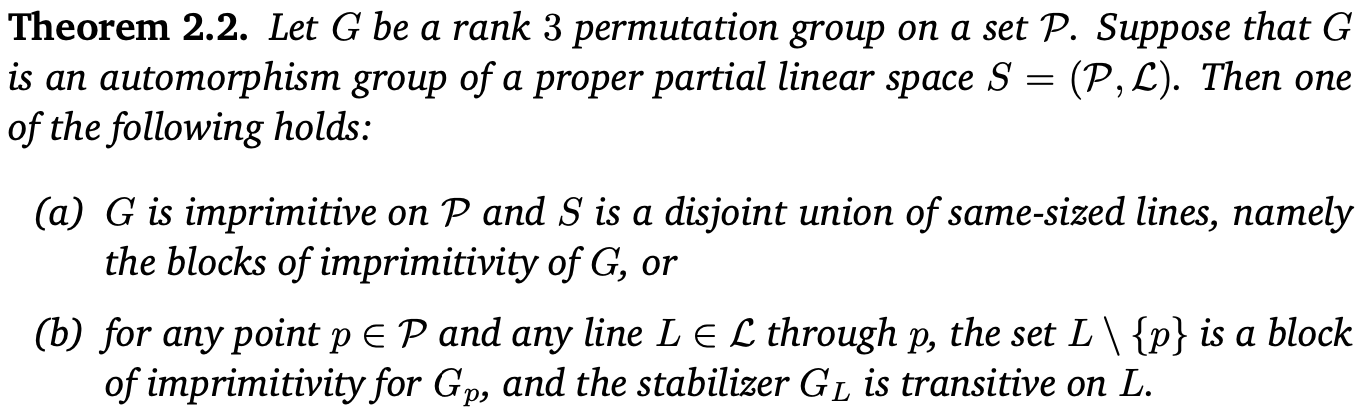
Remark. It is different with “block design”: ^6ky4f9.
It gives us a way to construct a partial linear space.
Theorem

Remark. If there exists a partial linear space having as a rank 3 automorphism group, then its collinearity graph will be one of the two strongly regular graphs associated with .
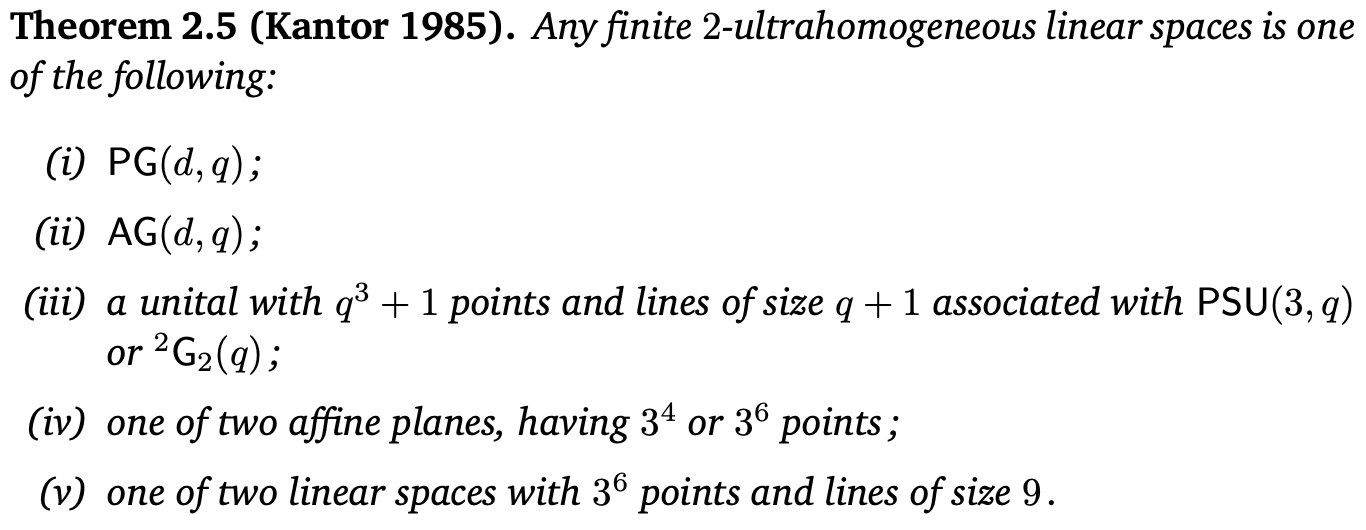
Classification of -ultrahomogeneous linear space
Kantor 1985
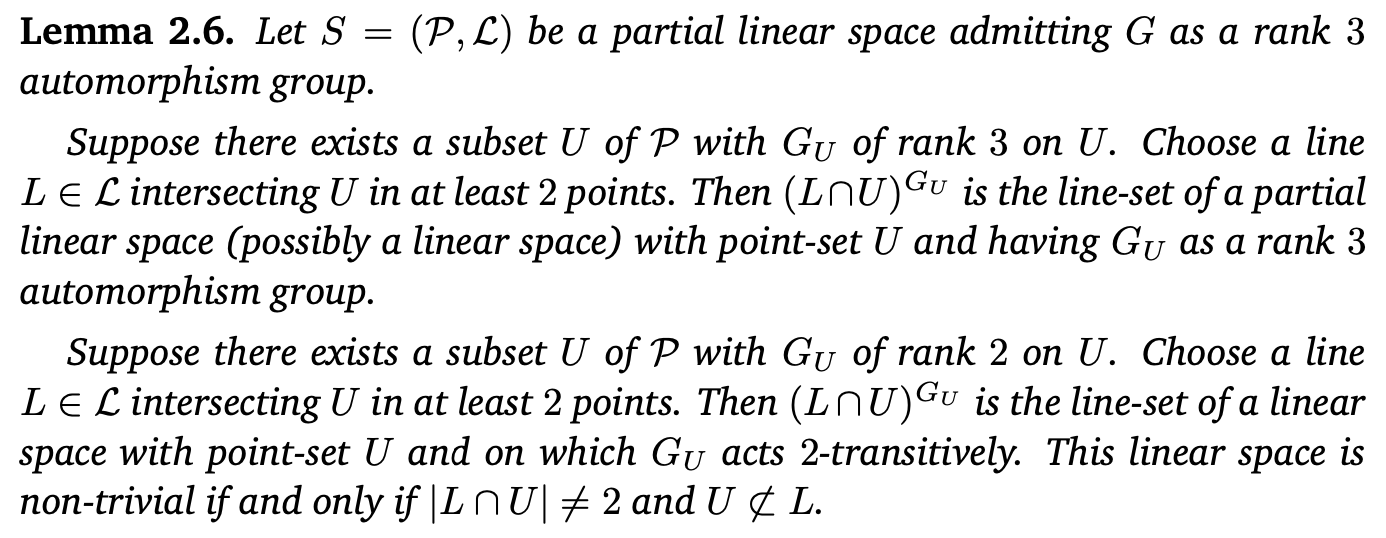
A reduction
Lemma
Definitions of well-known families of partial linear spaces
- A partial geometry with parameters is a partial linear space satisfying the following conditions:
- each line is incident with points (),
- each point is incident with lines ,
- any point outside a line is collinear with a constant number of points of .
- A generalized quadrangle of order is a partial geometry with parameters ; it is also a particular type of polar space.
- A polar space is a partial linear space satisfying the following conditions:
- each line is incident with a constant number of points,
- each point is incident with a constant number of lines,
- any point outside a line is collinear with or all points of .
- A copolar space is a partial linear space satisfying the following conditions:
- each line is incident with a constant number of points,
- each point is incident with a constant number of lines,
- any point outside a line is collinear with none or all but one points of .
- A - design is a point-block geometry where is a set of points and is a collection of -subsets of , with the property that every -subset of is contained in exactly blocks of . For example, a linear space over is a design.
- A Steiner system is a design.