The largest permutation group on Ω having the same orbits as G on Ω×Ω is called the 2-closure of G, denoted by G(2).
A description of 2-closure of rank 3 groups is given.
1 Introduction
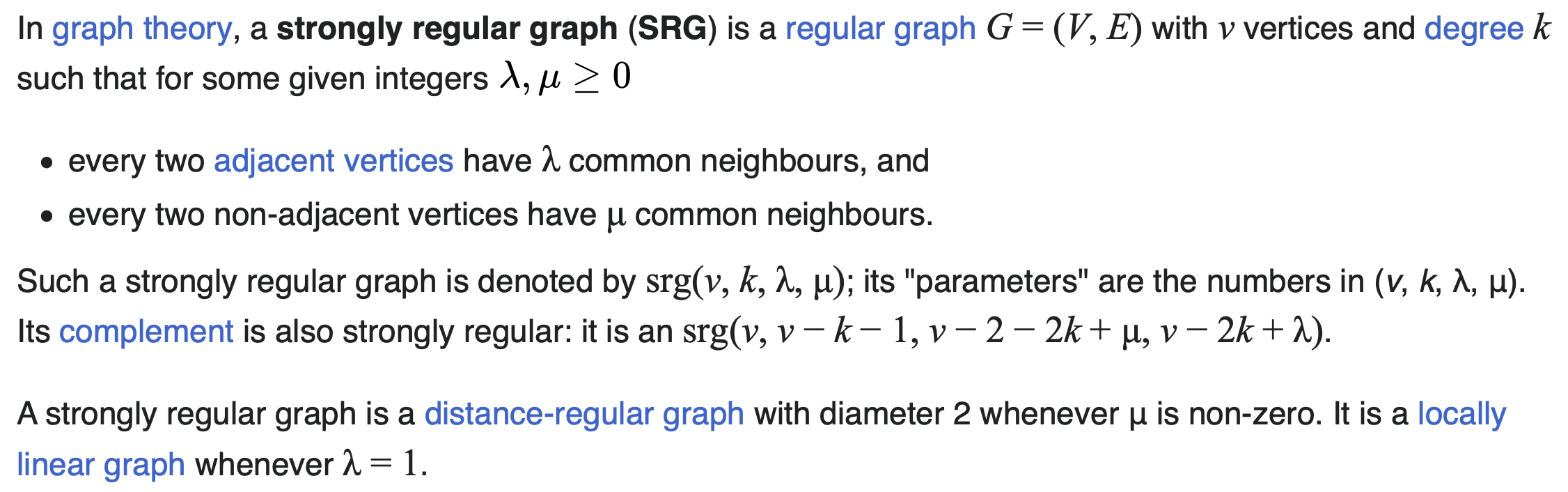
The orbits of G acting on Ω×Ω are called 2-orbits. If a rank 3 group has even order, then its non-diagonal 2-orbit induces a strongly regular graph on Ω, which is called a rank 3 graph. The strongly regular graph is defined here.
It is mentioned here and I give a proof as following.
\begin{proof}
Claim: any adjacent points has a common neighborhood of a constant cardinality. Suppose O is an 2-orbit and (b,c1),(b,c2)∈O. Let S be the neighborhood of a and b,c1,c2∈S. Then the cardinality of common neighborhoods of b,c1 and b,c2 can be expressed as ∣Sg1∩Sg12∣ and ∣Sg2∩Sg22∣ respectively, where g1:(a,b)→(b,c1) and g2:(a,b)→(b,c2). Since g1g2−1∈Ga, Sg1g2−1=S. Then $$
|S^{g_1}\cap S^{g_1^2}|=|S\cap S^{g_1}|=|S\cap S^{g_2}|=|S^{g_2}\cap S^{g_2^2}|
and we prove the claim.
Now we prove the claim for non-adjacent points. Suppose $(c_1,c_2)$ and $(c_3,c_4)$ are not in the set $S$. Then there is $g_1,g_2,g$ satisfying $g:(c_1,c_2)\to (c_3,c_4)$ and $g_i:a\to c_i,i=1,2$. It remains to show $|S^{g_1}\cap S^{g_2}|=|S^{g_1g}\cap S^{g_2g}|$, which is trivial.
Since $G$ has even order, there is a $g\in G$ such that $g^2=1$. Then for $b:=a^g$, both $(a,b)$ and $(b,a)$ are in the set $S$ and so the graph is undirected graph.
`\end{proof}`
Note that an arc-transitive strongly regular graph need not be a rank $3$ graph, since its automorphism group might be intransitive on non-arcs. Note also that given a rank $3$ graph $\Gamma$ corresponding to the rank $3$ group $G$, we have $\mathrm{Aut}(\Gamma)=G^{(2)}$.
The main theorem describe the rank $3$ permutation group on a set $\Omega$ and its $2$-closure. The key point is to know which rank $3$ groups give rise to isomorphic graphs.
> [!theorem]
>
> ![[Pasted image 20240210015103.png]]
"The proof can be divided into three parts": which i did't understand.
Then it gives a standalone result:
> [!theorem]
>
> ![[Pasted image 20240211020323.png]]
# 2 Reduction to affine case