Rank 3 transitive decompositions of complete multipartite graphs-Pearce-Praeger.pdf
0 Abstract
A transitive decomposition of a graph is a partition of the edge or arc set giving a set of subgraphs which are preserved and permuted transitively by a group of automorphisms of the graph.
This paper deals with transitive decompositions of complete multipartite graphs preserved by an imprimitive rank 3 permutation group. We obtain a near-complete classification of these when the group in question has an almost simple component.
1 Introduction
Definition
A transitive decomposition of a graph is a pair , where is a partition of the arc set , such that there is a group of automorphisms of satisfying the following two conditions:
- leaves the partition invariant; and
- acts transitively in its induced action on .
We call a -transitive decomposition.
In Transitive decompositions of graph products - rank 3 grid type, we gave a characterization of transitive decompositions preserved by a primitive rank group of grid type.
Let and let be the size of the blocks in . Then acts as a group of automorphisms of the complete multipartite graph , whose vertex set is , and whose edges are the pairs of vertices that lie in different blocks in .
Main theorem
Theorem
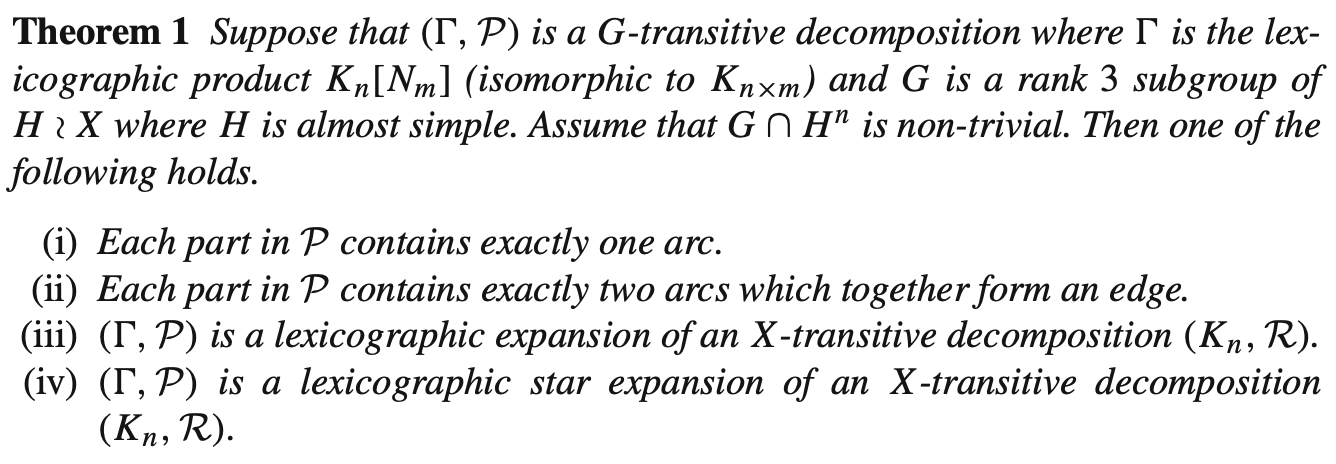
In (iii) and (iv), is -transitive because has rank by [[Finite permutation groups of rank #^06f0s7|this]]. These -transitive decompositions were characterized by On classifying finite edge colored graphs with two transitive automorphism groups-Sibley.
Key to the proof is a classification of imprimitive rank subgroups of on points with almost simple component , which is mentioned in On imprimitive rank 3 permutation groups.
Definitions for the theorem
Let be a graph with vertex set , and let denote the null graph with vertices and no arcs. We use lowercase Greek letters for the vertices of . Then is the graph with vertex set and arcs whenever . When , the graph is isomorphic to the complete multipartite graph .
Let be a graph, let be a partition of , and let be an integer. For each , let $$ R[N_m]={((i,\alpha),(j,\beta)):\alpha,\beta\in\mathrm{V}N_n,(i,j)\in R=\bigcup_{i,j\in R}(i,j)[N_m]},
and let $\mathrm{Lex}(\mathcal R,m)$ be the set of all such subsets $R[N_m]$ of the arc set of $\Sigma[N_m]$, for all $R\in\mathcal R$. ![[Pasted image 20240209134247.png]] ![[Pasted image 20240209142051.png]] ![[Pasted image 20240209134307.png]] # 2 Construction for transitive decompositions