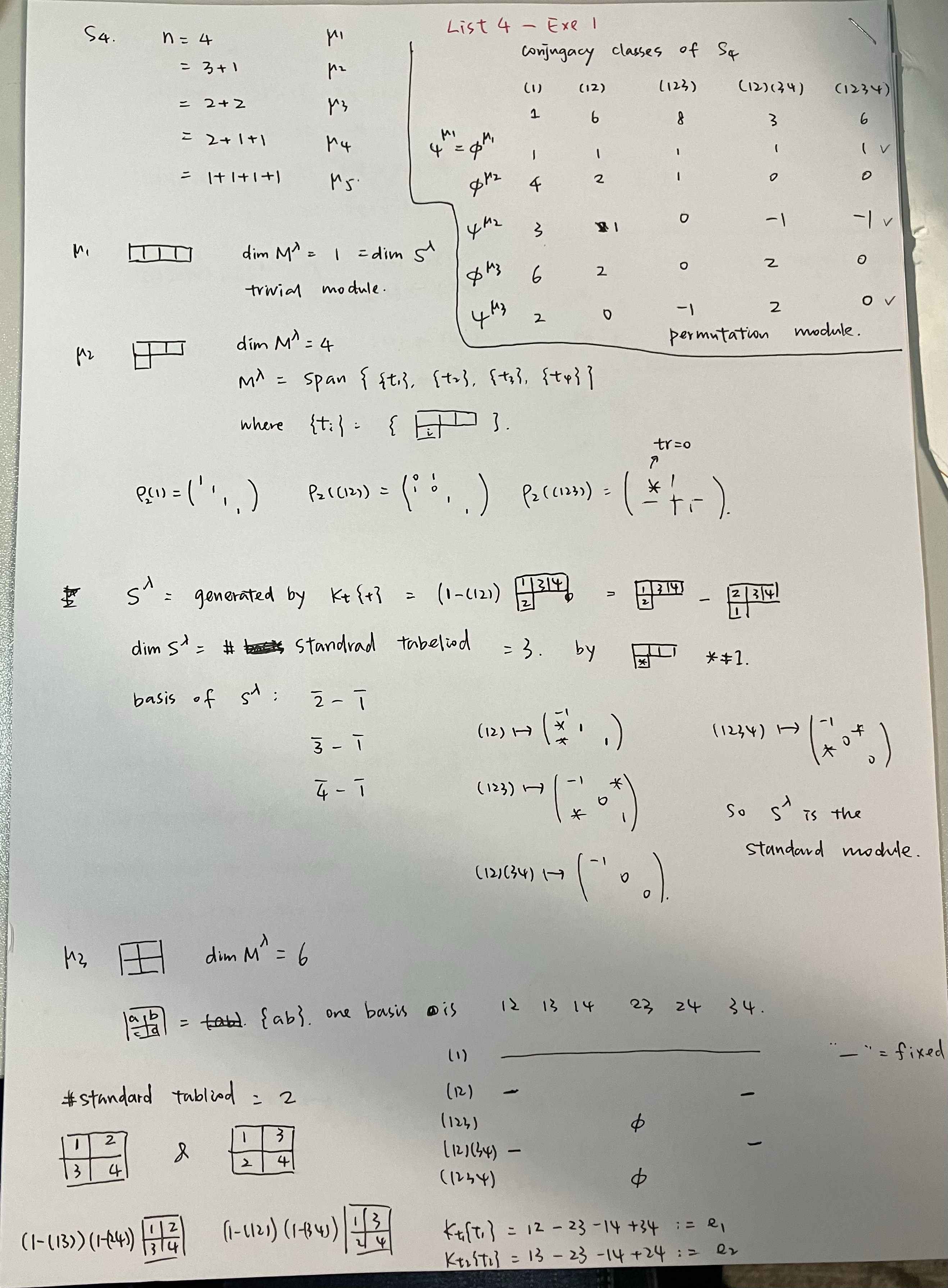
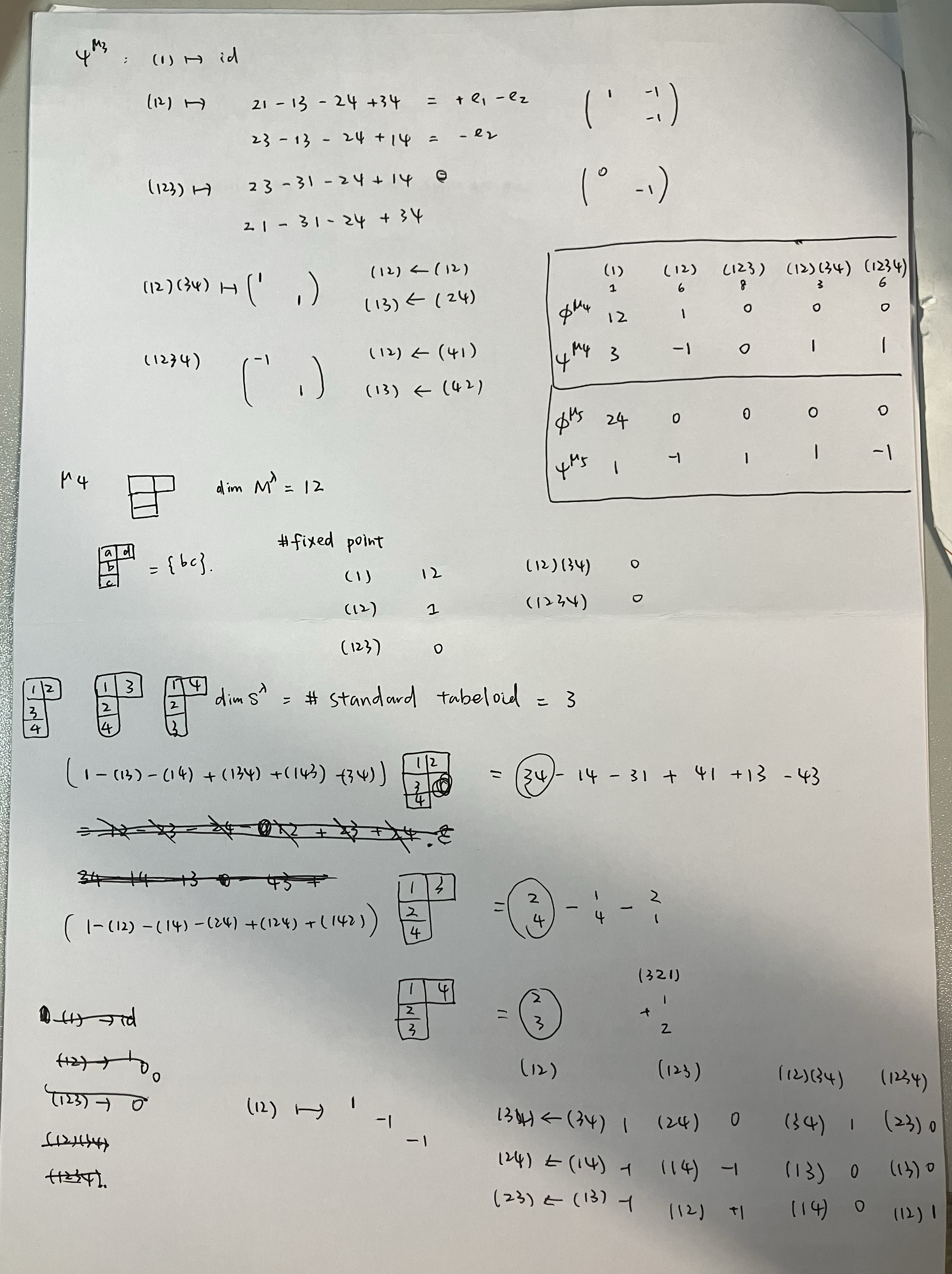
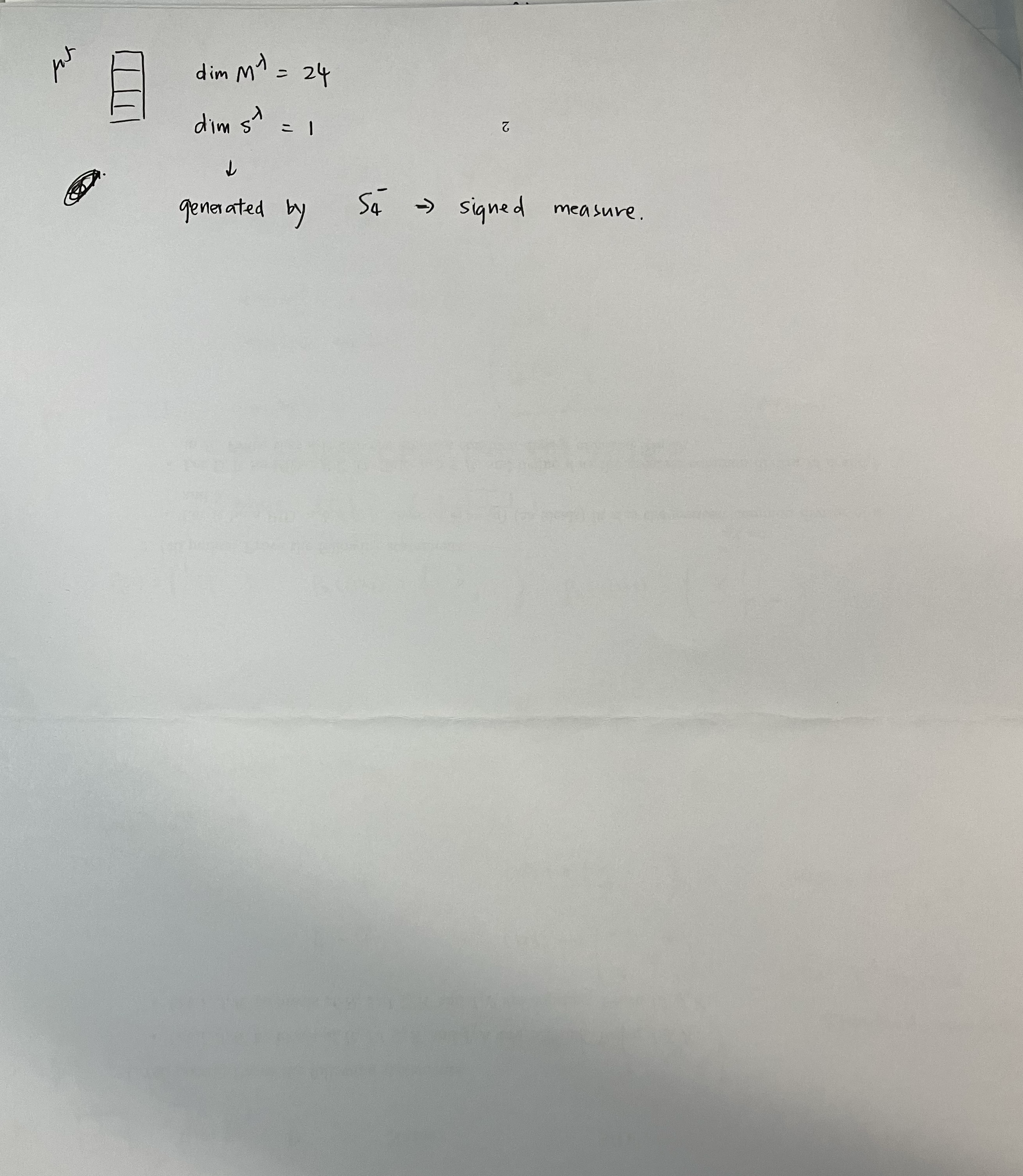
1. Find the characters of all permutation modules of and write the irreducible decompositions for all in terms of the Specht modules .

Pasted image 20241201232419.png
Pasted image 20241201232429.png
Pasted image 20241201232403.png
2. Use a basis of polytabloids of the Specht module to calculate representation matrices for representatives of all conjugacy classes in .

Note that there are two standard tableaus, then . Define

1 & 2 \\ 3 & 4 \end{matrix}\;\mbox{ and }\; t_2=\begin{matrix} 1 & 3 \\ 2 & 4 \end{matrix},$$ then $\mathcal{S}^{\left(2^2\right)}=\mathrm{span}\{v_{1},v_2\}$ where $v_1=e_{t_1}$ and $v_2=e_{t_2}$. With this basis, the representation matrices are $$(1)\mapsto\begin{bmatrix} 1 & \\ & 1\end{bmatrix},(12)\mapsto\begin{bmatrix} 1 & -1 \\ & -1\end{bmatrix},(123)\mapsto\begin{bmatrix} 0 & -1 \\ 1& -1\end{bmatrix},(12)(34)\mapsto\begin{bmatrix} 1 & \\ & 1\end{bmatrix},(1234)\mapsto\begin{bmatrix} -1 & 0 \\ -1 & 1\end{bmatrix}.$$ **3. For any Young diagram $\lambda=\left(\lambda_1, \ldots, \lambda_l\right)$ denote by $\lambda_i^{\prime}$ the number of boxes in column $i$ of $\lambda$ for all $i=1, \ldots, m$, where $m=\lambda_1$. Then $\lambda^{\prime}=\left(\lambda_1^{\prime}, \ldots, \lambda_m^{\prime}\right)$ is called the conjugate diagram to $\lambda$.Suppose that $\lambda, \mu \vdash n$. Prove that $\lambda \unrhd \mu$ if and only if $\mu^{\prime} \unrhd \lambda^{\prime}$.** `\begin{proof}` Assume that $\lambda=(\lambda_1,\cdots,\lambda_\ell)$ and $\mu=(\mu_1,\cdots,\mu_{s})$. By induction on $n$, it suffices to show $\lambda_1'\leqslant\mu_1'$. If it holds, then consider the Young diagrams $\lambda^{(1)}=(\lambda_1-1,\cdots,\lambda_{\ell}-1)$ and $\mu^{(1)}=(\mu_1-1,\cdots,\mu_{s}-1,1,\cdots,1)$ with $(s-\ell)$'s $1$ and disregarding the zeros in it. We still have $\lambda^{(1)}\unrhd \mu^{(1)}$ and then $\mu^{(1)}{}'\unrhd\lambda^{(1)}{}'$. Additionally by $\lambda_1'\leqslant \mu_1'$, we have $\mu'\unrhd\lambda'$. Now we prove $\lambda_1'\leqslant\mu_1'$. Lab each position of $\lambda$ and $\mu$ from $1$ to $n$ sequentially, row by row. Then the elements of first column of $\lambda$ and $\mu$ are $\lambda_1+1,\lambda_1+\lambda_2+1,\cdots,\lambda_1+\cdots+\lambda_{\ell-1}+1$ and $\mu_1+1,\mu_1+\mu_2+1,\cdots,\mu_1+\cdots\mu_{s-1}+1$. As $\lambda\unrhd\mu$, for any $i\in\{1,\cdots,\ell-1\}$ we have $\lambda_1+\cdots\lambda_i+1\geqslant\mu_1+\cdots+\mu_i+1$. As these elements are less than or equal to $n$, we have

|{\lambda_1+1,\lambda_1+\lambda_2+1,\cdots,\lambda_1+\cdots+\lambda_{\ell-1}+1}|\leqslant|{\mu_1+1,\mu_1+\mu_2+1,\cdots,\mu_1+\cdots\mu_{s-1}+1}|

and so $\lambda_1'\leqslant \mu_1'$. `\end{proof}` **4. The aim of this exercise is to compute the character table of $S_5$. For a partition $\mu$ let $\phi^\mu$ be the character of the permutation module $M^\mu$. Compute $\phi^\mu$ for all partitions of 5. By taking inner products of characters find the character table of $S_5$.** Note that $5=5=4+1=3+2=3+1+1=2+2+1=2+1+1+1=1+1+1+1+1$, then there are $7$ partitions of $5$, which are denoted by $\mu_1,\cdots,\mu_7$, respectively. By [[10.4 Complete List of Irreducible Modules#^i3a31d|^i3a31d]], we can compute $S^{\mu_i}$ as follows. - $M^{\mu_1}=S^{\mu_1}$ - $M^{\mu_2}=k_1S^{\mu_1}\oplus k_2S^{\mu_2}$ and $\dim S^{\mu_2}=4$. Hence $k_1=k_2=1$. - $M^{\mu_3}=k_1S^{\mu_1}\oplus k_2S^{\mu_2}\oplus k_3S^{\mu_3}$ and $\dim S^{\mu_3}=5$. We can compute that $k_1=k_2=k_3=1$. - $M^{\mu_4}=k_1S^{\mu_1}\oplus k_2S^{\mu_2}\oplus k_3S^{\mu_3}\oplus k_4S^{\mu_4}$. We can compute that $k_1=1$, $k_2=2$, $k_3=1$ and then get $S^{\mu_4}$. Repeat this procedure, then we get | | | | | | | | | |---|---|---|---|---|---|---|---| ||$(1)$|$(12)$|$(123)$|$(12)(34)$|$(1234)$|$(12)(345)$|$(12345)$| ||1|10|20|15|30|20|24| |$M^{\mu_1}$|1|1|1|1|1|1|1| |$M^{\mu_2}$|5|3|2|1|1|0|0| |$M^{\mu_3}$|10|4|1|2|0|1|0| |$M^{\mu_4}$|20|6|2|0|0|0|0| |$M^{\mu_5}$|30|6|0|2|0|0|0| |$M^{\mu_6}$|60|6|0|0|0|0|0| |$M^{\mu_7}$|120|0|0|0|0|0|0| ||||||||| |$S^{\mu_1}=M^{\mu_1}$|1|1|1|1|1|1|1| |$S^{\mu_2}=M^{\mu_2}-M^{\mu_1}$|4|2|1|0|0|-1|-1| |$S^{\mu_3}=M^{\mu_3}-M^{\mu_2}$|5|1|-1|1|-1|1|0| |$S^{\mu_4}$|6|0|0|-2|0|0|1| |$S^{\mu_5}$|5|-1|-1|1|1|-1|0| |$S^{\mu_6}$|4|-2|1|0|0|1|-1| |$S^{\mu_7}$|1|-1|1|1|-1|-1|1| [[List 4, exercise 4.numbers|This]] is used to compute inner products. `\end{proof}` **5. Consider the 5-dimensional Specht module $\mathcal{S}^{(2,2,1)}$ over $S_5$.** - **a). Calculate the representation matrices for all four generators $s_k=(k \;k+1)$ of $S_5$ in the basis of standard polytabloids $e_{t_i}$ with $i=1, \ldots, 5$, where**

t_1=\begin{matrix} 1 & 2 \ 3 & 4 \ 5 \end{matrix}, \quad t_2=\begin{matrix} 1 & 2 \ 3 & 5 \ 4 \end{matrix} , \quad t_3=\begin{matrix} 1 & 3 \ 2 & 4 \ 5 \end{matrix} , \quad t_4=\begin{matrix} 1 & 3 \ 2 & 5 \ 4 \end{matrix}, \quad t_5=\begin{matrix} 1 & 4 \ 2 & 5 \ 3 \end{matrix}.

- **b). By the branching rule, the restriction of $\mathcal{S}^{(2,2,1)}$ to the subgroup $S_4$ is a direct sum of two submodules, $\mathcal{S}^{(2,2,1)}=V \oplus W$. Find basis vectors of each of the submodules $V$ and $W$ in the form of linear combinations of standard polytabloids.** `\begin{proof}` a) By [[10.2 Tableaux, Tabloids and Specht Module#^b2c5aa|^b2c5aa]], we have $e_{\sigma t}=\sigma e_t$ and it deduces that

\begin{aligned} & \rho((12))=\left(\begin{array}{ccccc} 1 & &-1 & & \ & 1 & & -1& \ & & -1 & & \ & & & -1 & \ & & & & -1 \end{array}\right), &\rho((23))=\left(\begin{array}{lllll} & & 1 & 0 & \ & & 0& 1 & \ 1 & 0 & & & \ 0 & 1 & & & \ & & & & -1 \end{array}\right), \ & \rho((34))=\left(\begin{array}{lllll} 1 & &-1 & & \ & -1 & & & \ & & -1 & & \ & & & 0 & 1 \ & & & 1 & 0 \end{array}\right), &\rho((45))=\left(\begin{array}{llll} 0 & 1 & & & \ 1 & 0 & & & \ & & 0 & 1 & \ & & 1 & 0 & \ & & & & -1 \end{array}\right). \end{aligned}

b) By [[10.7 Branching Rule#^5voxbj|^5voxbj]],

\mathcal{S}^{(2,2,1)}=\mathcal{S}^{(2,1,1)}\oplus \mathcal{S}^{(2,2)}:=V\oplus W.

{e_t:t\in T_1}\mbox { and }{e_t:t\in T_2}

for $V$ and $W$, respectively, where

\begin{aligned} &T_1=\left{ \begin{matrix} 1 & 2 \ 3 \ 4 \end{matrix},;;\begin{matrix} 1 & 3 \ 2 \ 4 \end{matrix},;;\begin{matrix} 1 & 4 \ 2 \ 3 \end{matrix}\right}, \ &T_2=\left{ \begin{matrix} 1 & 2 \ 3 & 4 \end{matrix},;;\begin{matrix} 1 & 3 \ 2 & 4 \end{matrix} \right}. \end{aligned}

Now we finish the solution. `\end{proof}` **6. Prove the followings. ^xmv91w - **a). For variables $x_1, \ldots, x_n$ set $\Delta\left(x_1, \ldots, x_n\right)=\prod_{1 \leqslant i<j \leqslant n}\left(x_i-x_j\right)$ and prove the identity**

\sum_{i=1}^n x_i \Delta\left(x_1, \ldots, x_i+t, \ldots, x_n\right)=\left(x_1+\cdots+x_n+\binom{n}{2} t\right) \Delta\left(x_1, \ldots, x_n\right)

**where $t$ is another variable.** - **b). If $\lambda=\left(\lambda_1, \ldots, \lambda_n\right)$ is a partition of $n$, set $\ell_i=\lambda_i+n-i$ for $i=1, \ldots, n$. Use the previous part to show that the numbers**

F\left(\ell_1, \ldots, \ell_n\right)=\frac{n!}{\ell_{1}!\ldots \ell_{n}!} \prod_{1 \leqslant i<j \leqslant n}\left(\ell_i-\ell_j\right)

nF\left(\ell_1, \ldots, \ell_n\right)=\sum_{i=1}^n F\left(\ell_1, \ldots, \ell_i-1, \ldots, \ell_n\right)

- **c). Hence prove by induction that the number $f^\lambda$ of standard tableaux of shape $\lambda$ is given by**

f^\lambda=\frac{n!}{\ell_{1}!\ldots \ell_{n}!} \prod_{1 \leqslant i<j \leqslant n}\left(\ell_i-\ell_j\right) .

**(This also proves the hook length formula).** `\begin{proof}` a) Notice that the coefficient of $t$ of LHS is $c\cdot \Delta(x_1,\cdots,x_n)$ where

c=\sum_{i=1}^n x_i\left(\sum_{k=1}^{i-1}\frac{1}{x_i-x_k}-\sum_{k=i+1}^n\frac{1}{x_k-x_i}\right)=\sum_{i=1}^n\left(\sum_{k=1}^{i-1}\frac{x_i}{x_i-x_k}-\sum_{k=i+1}^n\frac{x_i}{x_k-x_i}\right).\tag{*}

For each fixed $s<k$, there are two terms with denominator $x_k-x_s$, that is, $\dfrac{x_k}{x_k-x_s}$ and $-\dfrac{x_s}{x_k-x_s}$. In $(*)$, there are $n(n-1)$ terms and they form $n\choose 2$ pairs in the form of $\left\{\dfrac{x_k}{x_k-x_s},\dfrac{-x_s}{x_k-x_s}\right\}$. It deduces that the coefficient of $t$ of LHS equals ${n\choose 2}\Delta(x_1,\cdots,x_n)$. In addition, it is easy to show when $t=0$ the equality holds, and so the constant parts of LHS and RHS are equal. Thus, it suffices to show the coefficients of $t^m$ with $m>1$ is equal to $0$. For any $m>1$, the coefficients of $t^m$ is the sum of the following elements $$S:=\left\{ \frac{(-1)^{p_i}x_i\Delta(x_1,\cdots,x_n)}{(x_i-x_{k_1})(x_i-x_{k_2})\cdots(x_i-x_{k_m})}:i\neq k_s,s\in\{1,\cdots,m\},p_i\mbox{ is the number of }(i,k_s)\mbox{ such that }i>k_s \right\}$$ and the sum of the terms in $S$ containing $x_{i}:=x_{k_0},x_{k_1},\cdots,x_{k_m}$ is

\frac{\sum_{i=0}^m(-1)^{p_{k_i}}x_{k_i}(\prod_{j<\ell,j,\ell\neq i}(x_{k_j}-x_{k_\ell}))}{\prod_{0\leqslant j<\ell\leqslant m}(x_{k_j}-x_{k_\ell})}\Delta(x_1,\cdots,x_n)

and we claim that it equals $0$. To show it, it suffices to show

\sum_{k=0}^m (-1)^kx_k\Delta(x_0,\cdots,\widehat x_k,\cdots,x_m)=0,

which can be proved by $$0=\det\begin{bmatrix} x_0 & x_1 & \cdots & x_m\\ 1 & 1 & \cdots & 1 \\ x_0 & x_1 & \cdots & x_m \\ \vdots & \vdots & & \vdots \\ x_0^{m-1} & x_1^{m-1} & \cdots & x_m^{m-1}\end{bmatrix}=\sum_{k=0}^m (-1)^kx_k\Delta(x_0,\cdots,\widehat x_k,\cdots,x_m).$$ Therefore, the coefficients of $t^m$ with $m>1$ is $0$. Now we finish the proof. b) By a) there is

\begin{aligned} \sum_{i=1}^nF(\ell_1,\cdots,\ell_i-1,\cdots,\ell_n)&=\sum_{i=1}^n\frac{n!}{\ell_1!\cdots(\ell_i-1)!\cdots\ell_n!}\Delta(\ell_1,\cdots,\ell_i-1,\cdots,\ell_n)\ &=\sum_{i=1}^n\frac{n!}{\ell_1!\cdots\ell_n!}\ell_i\Delta(\ell_1,\cdots,\ell_i-1,\cdots,\ell_n)\ &=\frac{n!}{\ell_1!\cdots\ell_n!}\sum_{i=1}^n\ell_i\Delta(\ell_1,\cdots,\ell_i-1,\cdots,\ell_n)\ &=\frac{n!}{\ell_1!\cdots\ell_n!}\left(\ell_1+\cdots+\ell_n-{n\choose 2}\right)\Delta(x_1,\cdots,x_n)\ &=nF(\ell_1,\cdots,\ell_n) \end{aligned}

as $\ell_1+\cdots+\ell_n=n+n(n-1)/2$. c) For a standard tableaux of shape $\lambda$, we assume that $\lambda=(\lambda_1,\cdots,\lambda_n)$ with $\lambda_1\geqslant\lambda_2\geqslant\cdots\geqslant\lambda_n\geqslant 0$ and $\lambda\vdash n$. Define $f(\lambda_1,\cdots,\lambda_n)=f^\lambda$. We aim to show $$f(\lambda_1,\cdots,\lambda_n)=\begin{cases} F(\ell_1,\cdots,\ell_n),&\lambda_1\geqslant\lambda_2\geqslant\cdots\geqslant\lambda_n\geqslant 0 \\ 0,&\mbox{otherwise.} \end{cases}$$ where $\ell_i=\lambda_i+n-i$. We use induction on $\sum_{i=1}^n\lambda_i$ to prove this. If $\lambda=(1,1,\cdots,1)$, then $f^\lambda=1$ and $F(\ell_1,\cdots,\ell_n)=1$ coincide. Now we assume that $(\lambda_1,\cdots,\lambda_n)\neq (1,\cdots,1)$, so $\lambda_n=0$ and $\ell_n=0$. For a standard tableaux of shape $\lambda$, it is easy to verify the recurrence relation

f^\lambda=\sum_{i=1}^{n-1}f(\lambda_1,\cdots,\lambda_i-1,\cdots,\lambda_{n-1}),

because $\lambda_n=0$ and we get a standard tableaux with $n-1$ blocks if $n$ is removed. Note that $F(\ell_1,\cdots,\ell_{n-1}, 0)=nF(\ell_1-1,\cdots,\ell_{n-1}-1)$. Then by induction hypothesis,

\begin{aligned} f^\lambda&=\sum_{i=1}^{n-1}f(\lambda_1,\cdots,\lambda_i-1,\lambda_{n-1})\ &=\sum_{i=1}^{n-1} F(\ell’1,\cdots,\ell’i-1,\cdots,\ell’{n-1})\ &=\frac{1}{n}\sum{i=1}^n F(\ell_1,\cdots,\ell_i-1,\cdots,\ell_{n})\ &=F(\ell_1,\cdots,\ell_n), \end{aligned}

where $\ell_i'=\lambda_i+(n-1)-i$. Now we finish the proof. `\end{proof}` **Remark.** Maybe with some values, $F$ is not defined. But I believe it can be avoided by extending $F$ suitably. **7. Prove the determinant formulas connecting symmetric functions:**

p_n=\left|\begin{array}{ccccc} e_1 & 1 & 0 & \ldots & 0 \ 2 e_2 & e_1 & 1 & \ldots & 0 \ \vdots & \vdots & \ddots & & \vdots \ \vdots & \vdots & \vdots & \ddots & \vdots \ n e_n & e_{n-1} & e_{n-2} & \ldots & e_1 \end{array}\right|, \quad n!e_n=\left|\begin{array}{ccccc} p_1 & 1 & 0 & \ldots & 0 \ p_2 & p_1 & 2 & \ldots & 0 \ \vdots & \vdots & \vdots & \ddots & \vdots \ p_{n-1} & p_{n-2} & \ldots & \ldots & n-1 \ p_n & p_{n-1} & \ldots & \ldots & p_1 \end{array}\right|

(-1)^{\mathrm{n}-1} p_n=\left|\begin{array}{ccccc} h_1 & 1 & 0 & \ldots & 0 \ 2 h_2 & h_1 & 1 & \ldots & 0 \ \vdots & \vdots & \ddots & & \vdots \ \vdots & \vdots & \vdots & \ddots & \vdots \ n h_n & h_{n-1} & h_{n-2} & \ldots & h_1 \end{array}\right|, \quad n!h_{\mathrm{n}}=\left|\begin{array}{ccccc} p_1 & -1 & 0 & \ldots & 0 \ p_2 & p_1 & -2 & \ldots & 0 \ \vdots & \vdots & \vdots & \ddots & \vdots \ p_{n-1} & p_{n-2} & \ldots & \ldots & -n+1 \ p_n & p_{n-1} & \ldots & \ldots & p_1 \end{array}\right| .

`\begin{proof}` i) By [[10.8 Symmetric Polynomials#^sbpikb|the Newton identity]], $n e_n=\sum_{r=1}^n(-1)^{r-1} p_r e_{n-r}$ and it deduces that

\begin{aligned} \left|\begin{array}{ccccc} e_1 & 1 & 0 & \ldots & 0 \ 2 e_2 & e_1 & 1 & \ldots & 0 \ \vdots & \vdots & \ddots & & \vdots \ \vdots & \vdots & \vdots & \ddots & \vdots \ n e_n & e_{n-1} & e_{n-2} & \ldots & e_1 \end{array}\right|&=\left|\begin{array}{ccccc} p_1 & 1 & 0 & \ldots & 0 \ p_1e_1-p_2 & e_1 & 1 & \ldots & 0 \ \vdots & \vdots & \ddots & & \vdots \ \vdots & \vdots & \vdots & \ddots & \vdots \ \sum_{r=1}^n(-1)^{r-1} p_r e_{n-r} & e_{n-1} & e_{n-2} & \ldots & e_1 \end{array}\right|\ &= \left|\begin{array}{ccccc} 0 & 1 & 0 & \ldots & 0 \ -p_2 & e_1 & 1 & \ldots & 0 \ \vdots & \vdots & \ddots & & \vdots \ \vdots & \vdots & \vdots & \ddots & \vdots \ \sum_{r=2}^n(-1)^{r-1} p_r e_{n-r} & e_{n-1} & e_{n-2} & \ldots & e_1 \end{array}\right|\ &= \cdots \ &=\left|\begin{array}{ccccc} 0 & 1 & 0 & \ldots & 0 \ 0 & e_1 & 1 & \ldots & 0 \ \vdots & \vdots & \vdots & & \vdots \ 0 & e_{n-2} & e {n-3} & \cdots & 1 \ (-1)^{n-1}p_n & e{n-1} & e_{n-2} & \ldots & e_1 \end{array}\right|\ &=(-1)^{n-1} (-1)^{n-1}p_n\ &=p_n. \end{aligned}

ii) Still by [[10.8 Symmetric Polynomials#^sbpikb|the Newton identity]], we have $(-1)^{n-1}ne_n=p_n-e_1p_{n-1}+\cdots+(-1)^{n-1}p_1e_{n-1}$. Define $$M=\left[\begin{array}{ccccc} p_1 & 1 & 0 & \ldots & 0 \\ p_2 & p_1 & 2 & \ldots & 0 \\ \vdots & \vdots & \vdots & \ddots & \vdots \\ p_{n-1} & p_{n-2} & \ldots & \ldots & n-1 \\ p_n & p_{n-1} & \ldots & \ldots & p_1 \end{array}\right],$$ and denote column vectors of $M$ as $C_1,\cdots,C_n$. Then there is

C_1-e_1C_2+e_2C_3+\cdots+(-1)^{n-1}e_{n-1} C_n=\begin{bmatrix}0 \ 0 \\vdots \ 0 \(-1)^{n-1}ne_n\end{bmatrix}

and so $$\det M=\left|\begin{array}{ccccc} 0 & 1 & 0 & \ldots & 0 \\ 0 & p_1 & 2 & \ldots & 0 \\ \vdots & \vdots & \vdots & \ddots & \vdots \\ 0 & p_{n-2} & \ldots & \ldots & n-1 \\ (-1)^{n-1}ne_n & p_{n-1} & \ldots & \ldots & p_1 \end{array}\right|=(-1)^{n-1}(-1)^{n-1}ne_n(n-1)!=n!e_n.$$ iii) & iv) Similarly, there is $nh_n=\sum_{r=1}^\infty p_rh_{n-r}$. Use the same method we can finish the proof. `\end{proof}` **8. a) Show that for a partition $\lambda=\left(\lambda_1, \ldots, \lambda_m\right)$**

s_\lambda\left(1, x, x^2, \ldots, x^{m-1}\right)=x^r \prod_{1 \leqslant i<j \leqslant m} \frac{x^{\lambda_i-\lambda_j+j-i}-1}{x^{j-i}-1},

**where $r=\sum_{i=1}^m(i-1) \lambda_i$.** **b) Deduce that**

s_\lambda(1,1, \ldots, 1)=\prod_{1 \leqslant i<j \leqslant m} \frac{\lambda_i-\lambda_j+j-i}{j-i}

**(This number coincides with the dimension of the irreducible representation of the group $\mathrm{GL}_m(\mathrm{C})$ associated with $\lambda$.)** `\begin{proof}` a) Define $y_1=x^{\lambda_1+m-1}, y_2=x^{\lambda_2+m-2},\cdots,y_m=x^{\lambda_m}$, then $$\mathscr s_\lambda=\frac{\left|\begin{matrix} 1 & y_1 & \cdots & y_1^{m-1} \\ 1 & y_2 & \cdots & y_2^{m-1} \\ \vdots & \vdots & & \vdots \\ 1 & y_m & \cdots & y_m^{m-1} \end{matrix}\right|}{\left|\begin{matrix} x_1^{m-1} & \cdots & x_m^{m-1} \\ x_1^{m-2} & \cdots & x_m^{m-2} \\ \vdots & & \vdots \\ 1 & \cdots & 1 \end{matrix}\right|},$$ where $x_i=x^{i-1}$ for $i=1,\cdots,m$. Then by Vandermonde matrix, we have

\begin{aligned} \mathscr s_\lambda&=(-1)^{m(m-1)/2}\frac{\prod_{i<j}(y_j-y_i)}{\prod_{i<j}(x_j-x_i)}\ &=(-1)^{m(m-1)/2}\frac{\prod_{i<j}x^{\lambda_j+m-j}(1-x^{\lambda_i-\lambda_j+j-i})}{\prod_{i<j}x^{i-1}(x^{j-i}-1)}\ &=\prod_{i<j}x^{\lambda_j+m-j-i+1}\frac{x^{\lambda_i-\lambda_j+j-i}-1}{x^{j-i}-1}\ &=x^{r}\prod_{i<j}\frac{x^{\lambda_i-\lambda_j+j-i}-1}{x^{j-i}-1} \end{aligned}

where $r=\sum_{i<j}(\lambda_j-j-i+m+1)$. Note that

\begin{aligned} r&=\sum_{i<j}(\lambda_j-j-i+m+1)\ &=(m-1)m(m+1)/2+\sum_{i=1}^{m-1}\sum_{j=i+1}^m (\lambda_j-j-i)\ &=(m-1)m(m+1)/2+\sum_{j=2}^m\sum_{i=1}^{j-1} (\lambda_j-j-i)\ &=(m-1)m(m+1)/2+\sum_{j=2}^m (j-1)\lambda_j-\frac{3}{2}\sum_{j=2}^mj(j-1)\ &=\sum_{j=2}^m (j-1)\lambda_j=\sum_{j=1}^m (j-1)\lambda_j \end{aligned}

as $\sum_{j=2}^mj(j-1)=(m-1)m(m+1)/3$. b) Note that

\lim_{x\to 1}\frac{x^{\lambda_i-\lambda_j+j-i}-1}{x^{j-i}-1}=\frac{\lambda_i-\lambda_j+j-i}{j-i},

then by a) we get $s_\lambda(1,1, \ldots, 1)=\prod_{1 \leqslant i<j \leqslant m} \dfrac{\lambda_i-\lambda_j+j-i}{j-i}$. `\end{proof}` **9. Since the generators $h_k$ of the algebra of symmetric functions $\Lambda$ are algebraically independent, we can specialize them in an arbitrary way and forget about the original variables $x_i$. In other words, we can take the generating function $H(t)$ to be an arbitrary power series in $t$ with the constant term 1 for the relations between symmetric functions to remain valid.** - **a) Show that**

H(t)=\prod_{k=1}^{\infty}\left(1-t^k\right)^{-1}

**is the generating function for the sequence $p(n)$, where $p(n)$ is the number of partitions of $n$.** - **b) By Euler's pentagonal number theorem, for the generating function $E(-t)$ we have**

E(-t)=\prod_{k=1}^{\infty}\left(1-t^k\right)=1+\sum_{m=1}^{\infty}(-1)^m\left(t^{\left(3 m^2-m\right) / 2}+t^{\left(3 m^2+m\right) / 2}\right)

p(n)=\sum_{\mathrm{m}=1}^{\infty}(-1)^{m-1}\left(p\left(n-\frac{3 m^2-m}{2}\right)+p\left(n-\frac{3 m^2+m}{2}\right)\right)

**where $n \geqslant 1$.** `\begin{proof}` a) Assume that $\prod_{k=1}^\infty (1-t^k)^{-1}=\prod_{k=1}^\infty(1+t^k+t^{2k}+\cdots+t^{mk}+\cdots)=\sum_{n=1}^\infty a_n t^n$. Each element in LHS with degree $n$ can be written as $t^{m_1\cdot 1}t^{m_2\cdot 2}\cdots t^{m_n\cdot n}=t^n$, and it corresponds to a partition where $n$ is written as a sum of integers $1 + 1 + \dots + 1 + 2 + \dots + 2 + \dots + n$, where the number of $1’$s is $m_1$, the number of $2$’s is $m_2$, and so on. Note that it is a 1-1 corresponding to elements in LHS and partitions, so $H(t)$ is the generating function for the sequence $p(n)$, where $p(n)$ is the number of partitions of $n$. b) Note that $H(t)E(-t)=1$. The coefficient of $t^n$ in $H(t)E(-t)$ is

p(n)+\sum_{m=1}^\infty \left((-1)^mp\left(n-\frac{3m^2-m}{2}\right)+(-1)^mp\left(n-\frac{3m^2+m}{2}\right)\right)=0

and so $p(n)=\sum_{\mathrm{m}=1}^{\infty}(-1)^{m-1}\left(p\left(n-\dfrac{3 m^2-m}{2}\right)+p\left(n-\dfrac{3 m^2+m}{2}\right)\right)$. `\end{proof}`