Problem(Mumford, page 9). Let be a closed algebraic set, and let be the hyperplane . Identify with in the usual way. Prove that is a closed algebraic subset of and show that the ideal of is derived from the ideal of in a very natural way. For details on the relationship between the affine and projective set-up and on everything discussed so far, read Zariski-Samuel, vol. 2, Ch. 7, and .
\begin{proof}
Assume that is a homogeneous ideal such that . For any homogeneous polynomial of degree , can be written as
where . Hence there is a map , where is the set of homogeneous polynomials. Define , and we claim that is derived from .
For any , there is and for all . That is, for all , and so . Conversely, for any , there is for any . It deduces that . Also it is clear that . Therefore, if we identify with the subset , then . That is, is a closed algebraic subset of .
\end{proof}
1.2.(Ha, page 7) The Twisted Cubic Curve. Let be the set . Show that is an affine variety of dimension . Find generators for the ideal . Show that is isomorphic to a polynomial ring in one variable over . We say that is given by the parametric representation .
\begin{proof}
Note that the generator for the ideal is . Since
is a integral domain, is a irreducible closed subsets of and so it is an affine variety. If there exists another irreducible closed subsets , then and . For any , can be identified as a polynomial and so is a set of finitely many points.
For any single point , notice that is a irreducible closed set as is an integral domain. Hence, if is a set of finitely many points and is irreducible, then for some . Therefore, the supremum of such that there exists a chain of distinct closed subsets of is , that is, is an affine variety of dimension . Since , it is isomorphic to a polynomial ring in one variable over .
\end{proof}
1.3.(Ha, page 7) Let be the algebraic set in defined by the two polynomials and . Show that is a union of three irreducible components. Describe them and find their prime ideals.
Solution. Notice that
where , and . Since and are integral domains, and are irreducible closed subsets. Furthermore, as , is also irreducible. Therefore,
where , and .
\end{proof}
1.9.(Ha, page 7) Let be an ideal which can be generated by elements. Then every irreducible component of has dimension .
\begin{proof}
Decompose into finitely many irreducible components . Each corresponds to a prime ideal which is minimal over . By Krull’s Principal Ideal Theorem, the height of . We also know
thus .
\end{proof}
2.16.(Ha, page 14)
- (a) The intersection of two varieties need not be a variety. For example, let and be the quadric surfaces in given by the equations and , respectively. Show that is the union of a twisted cubic curve and a line.
- (b) Even if the intersection of two varieties is a variety, the ideal of the intersection may not be the sum of the ideals. For example, let be the conic in given by the equation . Let be the line given by . Show that consists of one point , but that .
\begin{proof}
i) Note that . Since
either or . If , then . Otherwise, if , then . If , then . If , then are in arbitrary. Hence
Remark that and is a line. So it remains to show is a twisted cubic curve. Define , and , then we have , and . It deduces that
and so it is indeed a twisted cubic curve.
ii) Define and , then . Since , we have . In fact, , so there is .
\end{proof}
2.17.(Ha, page 14) Complete intersections. A variety of dimension in is a (strict) complete intersection if can be generated by elements. is a set-theoretic complete intersection if can be written as the intersection of hypersurfaces.
- (a) Let be a variety in , let ; and suppose that can be generated by elements. Then show that .
- (b) Show that a strict complete intersection is a set-theoretic complete intersection.
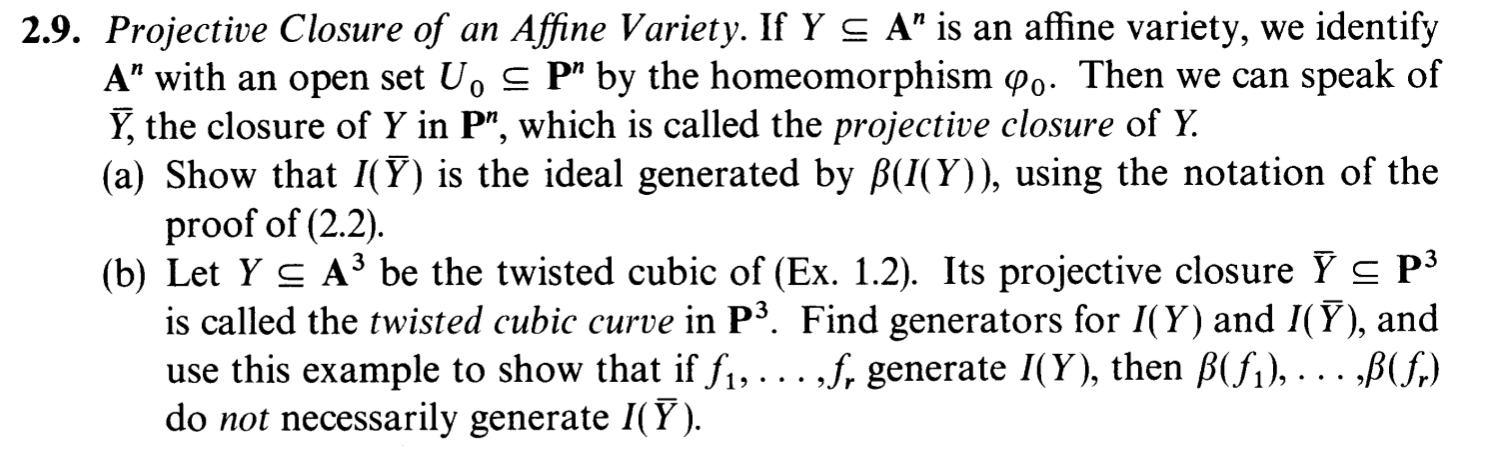
- *(c) The converse of (b) is false. For example let be the twisted cubic curve in (Ex. 2.9). Show that cannot be generated by two elements. On the other hand, find hypersurfaces of degrees 2,3 respectively, such that .
- **(d) It is an unsolved problem whether every closed irreducible curve in is a set-theoretic intersection of two surfaces. See Hartshorne [1] and Hartshorne , III, §5] for commentary.
\begin{proof}
a) By Exercise 1.9, each irreducible component of has dimension and so for .
b) If is a strict complete intersection, then and can be generated by elements. By a) we have .