Definition
Let be an incidence geometry where
- set of points
- set of blocks
- incidence relation
Define and .
De Bruijn–Erdős
If for all , any two distinct points are in precisely one block simultaneously, then or .
\begin{proof}
This proof is given by Conway.
Let denote the number of blocks through .
For a block , let denote the number of points on .
Suppose that . If , then . Suppose that , then . We also have
and
Hence
leading to a contradiction.
Therefore, .
\end{proof}
A - design is a point-block geometry where is a set of points and is a collection of -subsets of , with the property that every -subset of is contained in exactly blocks of .
Link to original
Examples.
- When , such design is called “Steiner system” . In particular, is a Steiner triple system. For instance, see here.
- is a - design
- is a - design
- is a - design
- Hermitian unital is a - design. Conversely, such design - in projective plane is called unital.
- A Hadamard matrix of order gives a - design.
- Let be a Hadamard matrix of order with the first row and the first column all ‘s.
- Let be the principal sub-matrix of with the first row and first column deleted.
- .
- .
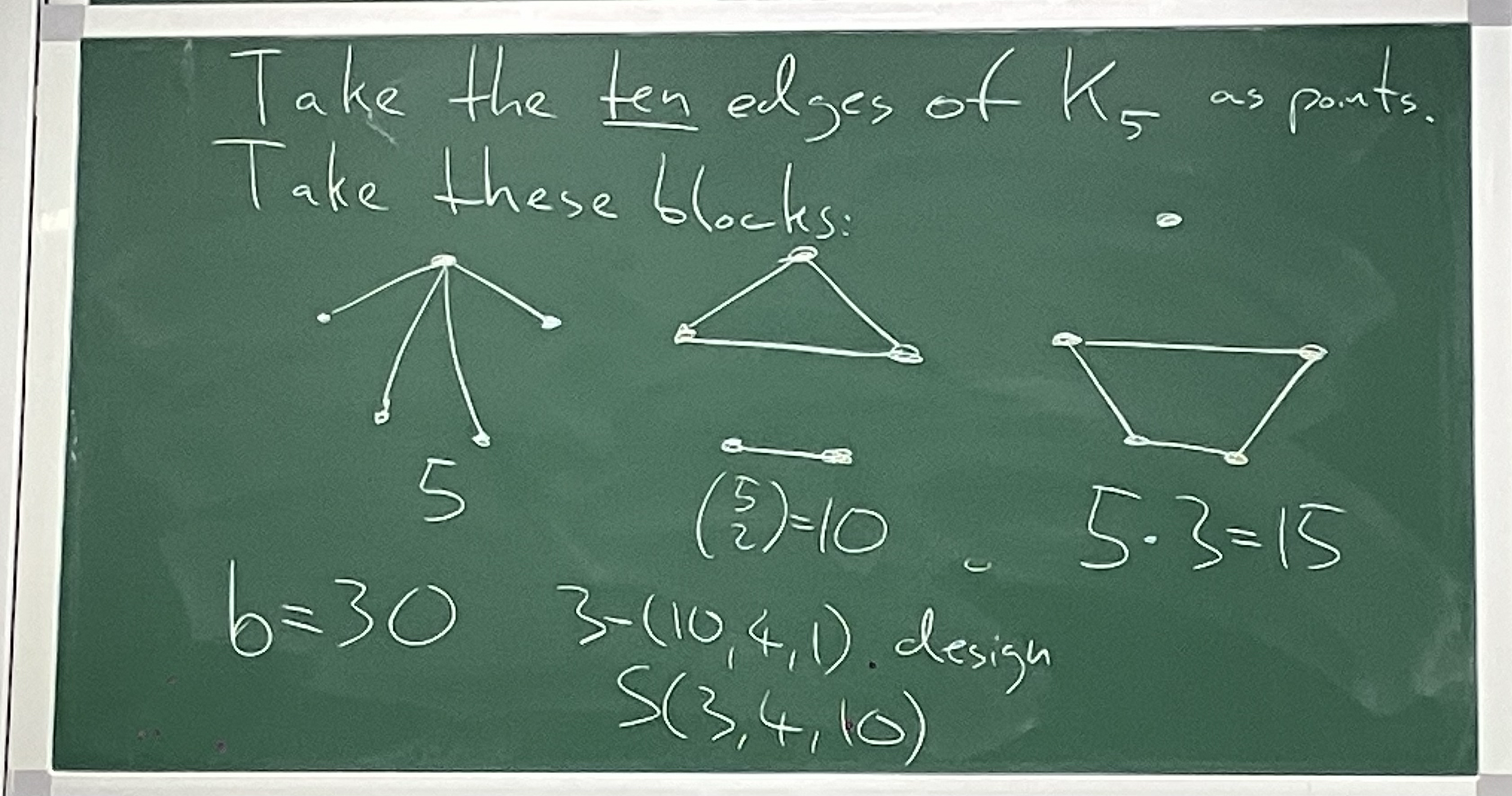
- Another example, :
Theorem
The number of blocks of a - design is
\begin{proof}
Count pairs , where , , .
\end{proof}
Theorem
Given with , the number of blocks incident with a fixed -subset of is
In the other words, a -design is also a -design.
\begin{proof}
Same as for ^dz2c5i, but with .
\end{proof}
Remark. Usually is denoted by , and is called replication number. The following equations is useful for -designs: and .
Example. Consider a - design . Then and so . Moreover, yields .
Remark. These conditions are sufficient. - designs eventually exist for fixed, plus divisible condition from ^25ec95. By Peter Keevash (2014). Explicit construction only for . For small , the divisibility conditions from the ‘s are not sufficient. Tits (1964) design does not exist.
Theorem
In a non-trivial Steiner system , we have .
\begin{proof}
In a Steiner system , any two distinct blocks have at most points in common.
Let be a set of points not contained in any block. (Here we use non-triviality)
For each , there exists a unique block containing .
Each such is incident with points not in .
Any point not in is incident with at most one (as ).
Hence .
\end{proof}
Incidence matrix , indexed by
Then . Moreover, . For Hermitian unital, . For , .
Theorem
For a - design with blocks and , we have .
\begin{proof}
Recall that .
So , then .
Thus has spectrum , .
Thus as .
Hence and so .
\end{proof}
Theorem
If a - design has and is even, then is a square.
\begin{proof}
Note that yields .
Then .
\end{proof}
Theorem
For , , , we have .
\begin{proof}
See A course in combinatorics - 2001 - van Lint, Wilson.pdf, theorem 19.8.
\end{proof}
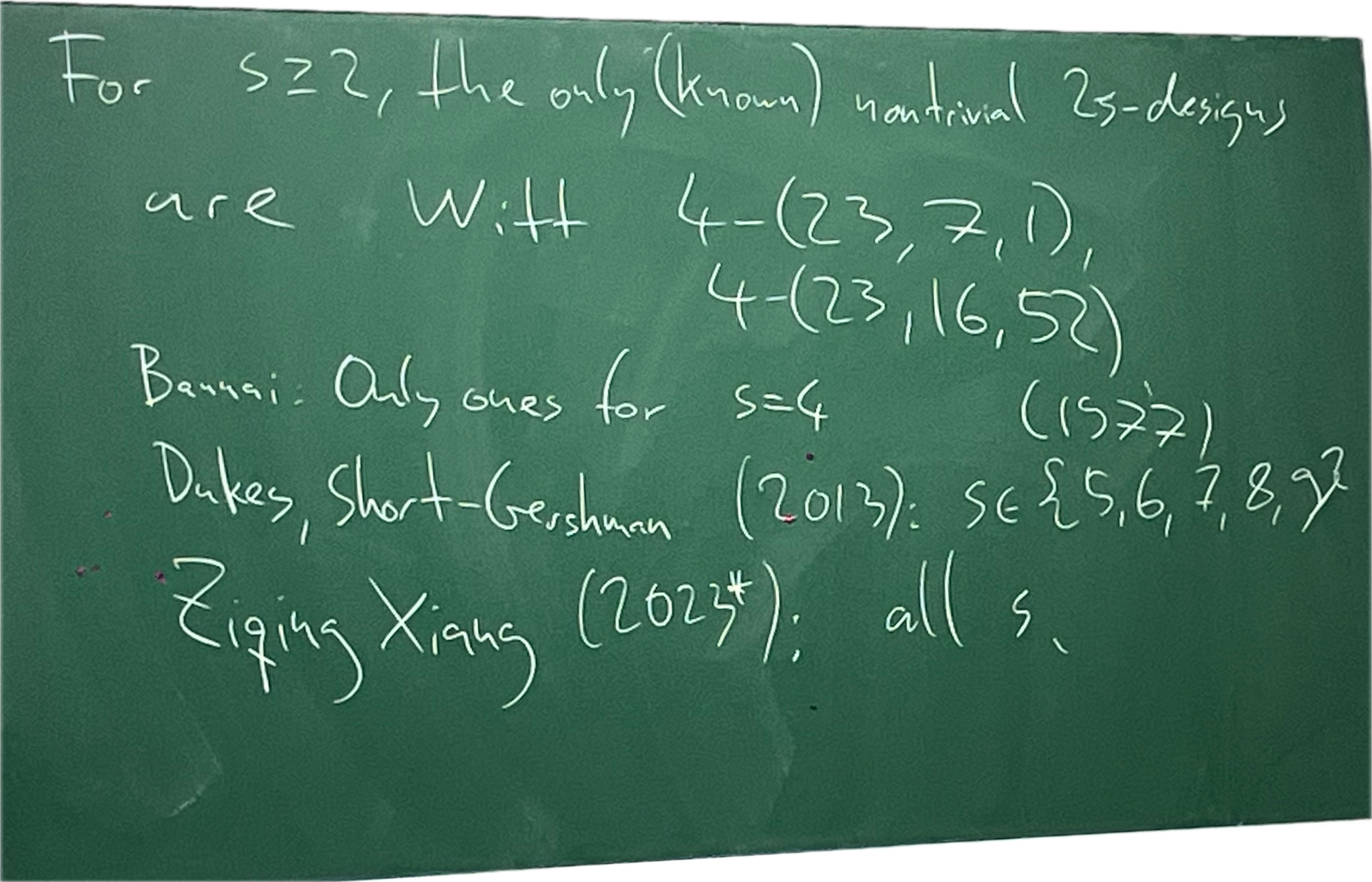
Examples of symmetric design:
- Hadamard matrices are - design
- projective planes are - design.
FI thinks that otherwise only a finitely many of symmetric designs is known.
Bruck-Ryser-Chowla
Let be positive integer such that , then a symmetric - design has the following necessary conditions
- even square
- odd has a solution .