a Notes from ChatGPT
The classical group series
is a bookkeeping device for the natural groups attached to a classical geometry.
The geometric viewpoint
Let be a finite-dimensional vector space over a finite field, equipped with a form or geometric structure .
The basic classical group is usually an isometry group, or closely related to one. That is, it consists of transformations preserving exactly.
The following table records some examples.
| group | structure being preserved | definition |
|---|---|---|
| the vector space structure | all invertible -linear transformations | |
| the vector space structure together with a choice of volume form | ||
| a non-degenerate alternating bilinear form | ||
| a non-degenerate Hermitian form | ||
| a non-degenerate quadratic form |
Recall that
- an alternating bilinear form is a map such that is linear in both variables and for all ;
- a Hermitian form is a map such that is linear in one variable and -semilinear in the other, and satisfies , where ;
- a quadratic form is a map satisfying for all and , and such that the associated polar form is bilinear. Remark that in characteristic the quadratic form contains more information than its polar bilinear form.
There are two natural ways to enlarge such an isometry group.
First, one may allow the form to be preserved up to a scalar. These elements are called similarities. For instance, in the symplectic case,
The group of similarities is called the conformal group. Thus one obtains groups such as , , and .
Second, one may also allow field automorphisms. A semilinear map with associated field automorphism is a semi-similarity if it preserves the form up to both a scalar and the field automorphism. For instance, in the symplectic case,
The group of semi-similarities is the conformal semilinear group. Thus one obtains groups such as , , and .
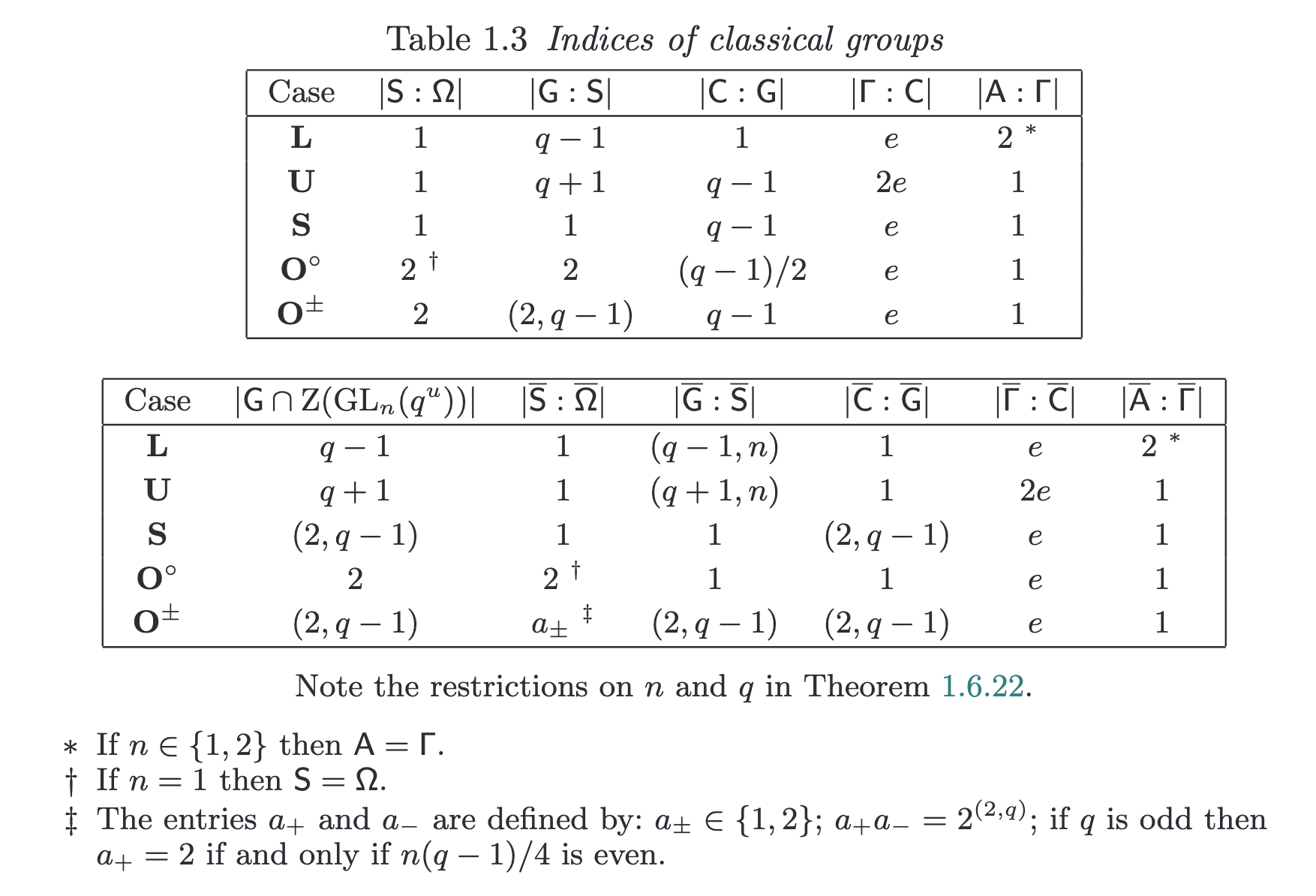
So the basic geometric pattern is
Explicitly,
- ;
- ;
- in the orthogonal case, one has intermediate groups such as and , but the broad geometric enlargement is ;
- the linear case is the analogue without a form: .
Remark. In suitable ambient groups, the groups and often appear when studying normalizers and automorphisms of the corresponding classical group. For the simplest case, see Normalizer.
The automorphism viewpoint
The groups in the classical group series also explain the standard types of outer automorphisms of finite classical groups.
Roughly speaking, the usual outer automorphisms have three sources:
- diagonal automorphisms
- field automorphisms
- graph automorphisms
These correspond to three different ways of enlarging the basic classical group.
Diagonal automorphisms
Diagonal automorphisms come from enlarging the classical group inside the same -linear or conformal world.
For example, diagonal automorphisms come from
- for ;
- for , while the induced diagonal automorphism group is with order ;
- for , whose order is ;
- the diagonal part is more delicate for orthogonal groups.
Field automorphisms
Field automorphisms come from leaving the purely -linear world and allowing semilinear transformations.
For example, field automorphisms come from
- for ;
- for ;
- the semilinear unitary group for ;
- the semilinear orthogonal or conformal orthogonal group for orthogonal groups.
Graph automorphisms
Graph automorphisms come from symmetries of the Dynkin diagram of the corresponding algebraic group.
Summary
The three standard sources of outer automorphisms can be summarized as follows:
| source | geometric/group-theoretic origin | typical automorphism |
|---|---|---|
| larger linear or conformal overgroups | passing from or to | diagonal automorphisms |
| semilinear transformations | passing from to | field automorphisms |
| Dynkin diagram symmetries | passing from to | graph automorphisms |