Note that if is affine, where is elementary abelian, then is 2-transitive if and only if is a transitive linear group (that is, acts transitively on the non-zero vectors of ).
Proposition
There are four infinite classes of finite transitive linear groups.
- ;
- and ;
- and ;
- and .
Sporadic finite transitive linear groups are listed in the following table.
Remark that the value for primitive identification is incorrect.
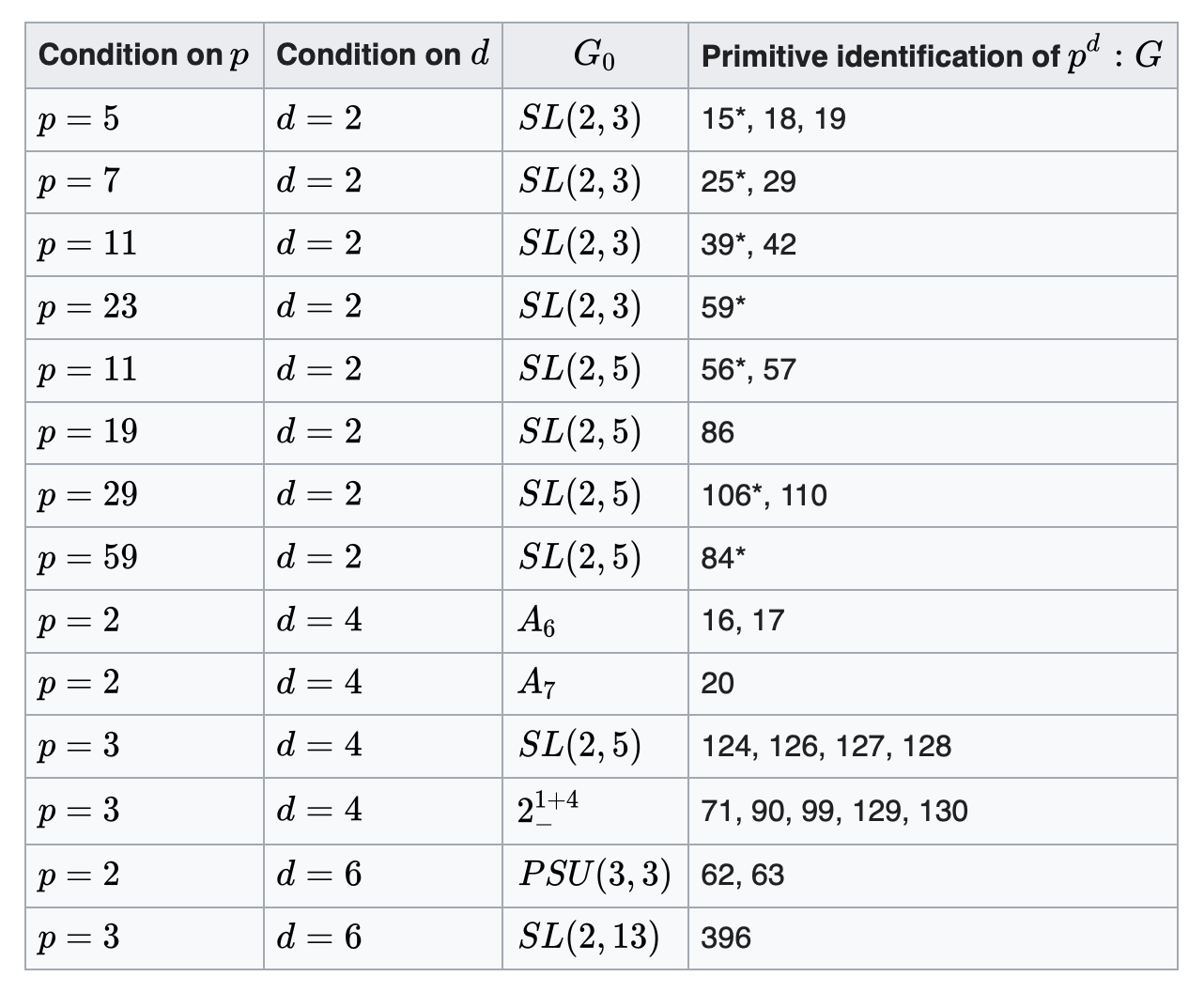
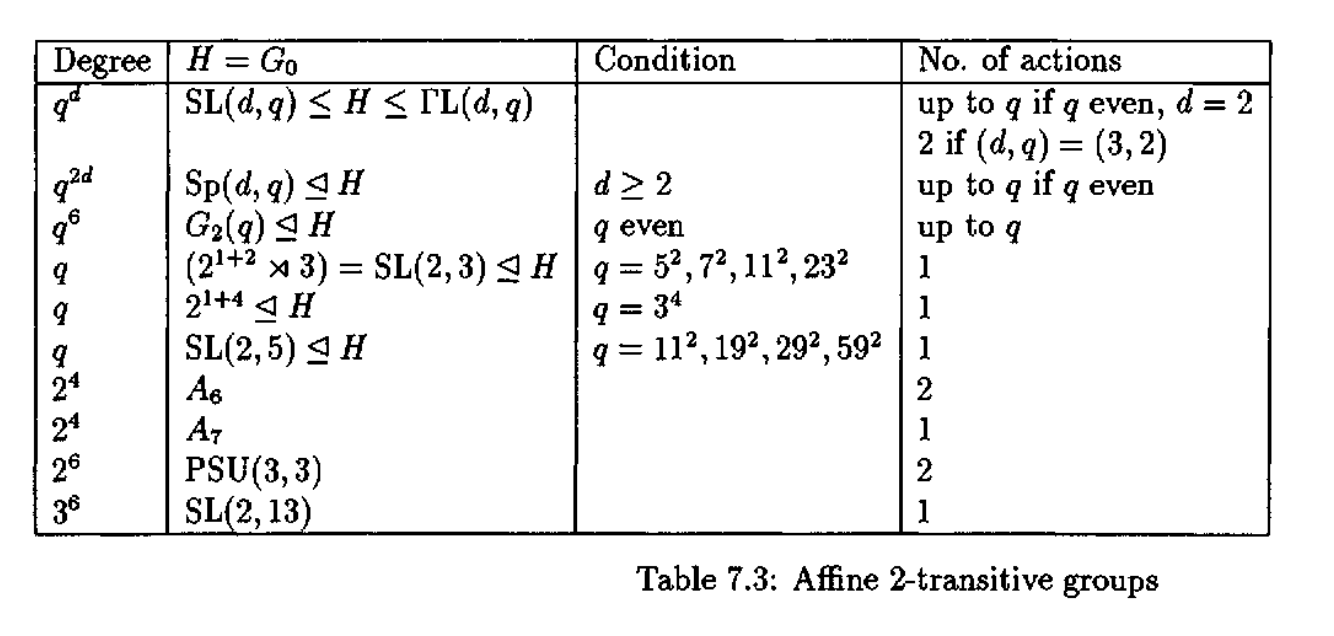
Cameron gives the number of actions of these -transitive affine groups. Remark that is missed. By magma, number of actions of on is .
G:=SL(2,5);
Irrs:=IrreducibleModules(G, GF(3));

M1:=Irrs[2];
M2:=Irrs[3];

Kernel(M1);
IsAbsolutelyIrreducible(M1);
CM1:=CohomologyModule(G,M1);
CohomologyGroup(CM1,1);

Kernel(M2);
IsAbsolutelyIrreducible(M2);
CM2:=CohomologyModule(G,M2);
CohomologyGroup(CM2,1);
MatrixGroup(2, GF(5)) of order 1
false
Full Vector space of degree 0 over GF(3)
MatrixGroup(2, GF(5)) of order 2
Generators:
    [4 0]
    [0 4]
true
Full Vector space of degree 1 over GF(3)
The following theorem is used in Three Orbits Linear Groups.
Theorem
Let be a transitive linear group acting on with . Then one of the followings holds.
- is solvable and either , or has a normal subgroup isomorphic to or , and .
- is isomorphic to one of , and ( and even) with and . In this case, we say that is of classical type.
- is isomorphic to one of groups in , and . In this case, we say that is of sporadic type. Also see here.
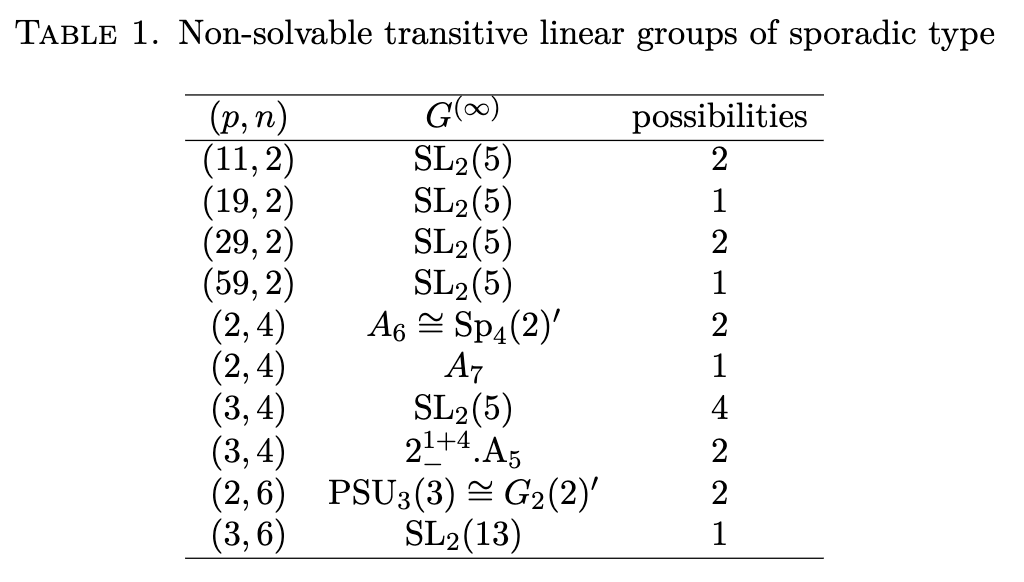
Here is a detailed table.
Proposition
Let be a -transitive affine group. Then is the unique minimal normal subgroup.
\begin{proof}
Let be a minimal normal subgroup of .
Since acting on is primitive, is transitive on by Orbits of Normal Subgroups Form a Block System.
Then .
Since is a normal subgroup with order , the subgroup is a minimal normal subgroup.
If there exists another minimal subgroup , then and so .
Note that , so does not exist.
Therefore, is the unique minimal normal subgroup.
\end{proof}