Let , and let . Define , i.e., , where . In such a basis, define
Simplicity
The only scalars in are . Hence
where and .
Theorem
If , then the group is simple, except for .
Theorem
Let . Then
\begin{proof}
See
\end{proof}
Normalizer
Definition
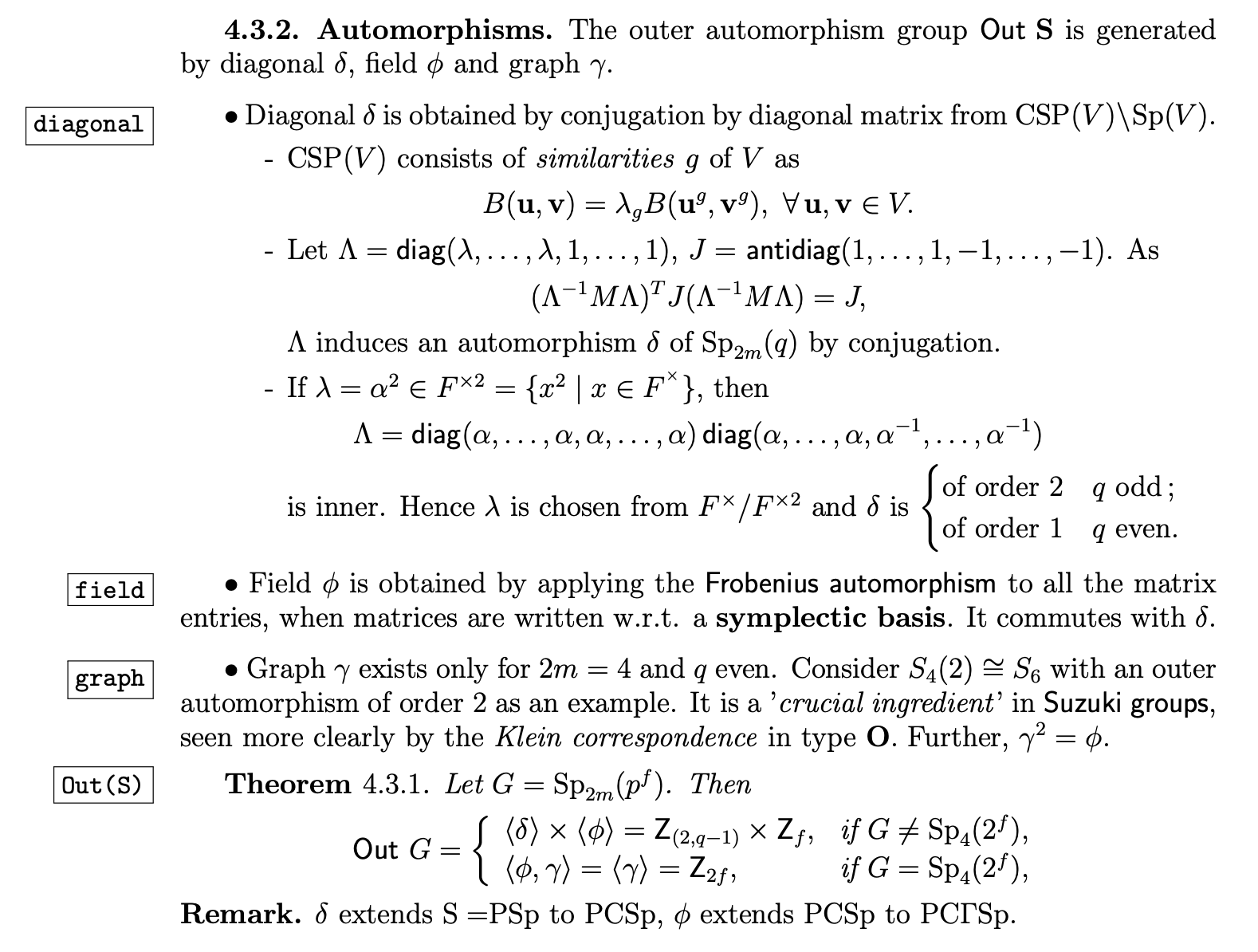
Let be a -sesquilinear form on . Then is an isometry of if for all . The element is a similarity of if there is a such that for all .
The isometry group of is the group of all isometries of , and the similarity group of is the group of all similarities of . The conformal group is the similarity group of .
We refer to the conformal symplectic group .
The following lemma shows that the conformal group is equal to the normalizer in the corresponding linear group of the quasisimple group.
Lemma
Let be an absolutely irreducible group consisting of isometries of a bilinear form . Then consists of similarities of .
Corollary
.
\begin{proof}
By ^91tcc7, we have .
Conversely, for any , there exists such that . Notice that for any and , there is
and so .
\end{proof}
Definition
The conformal semilinear group of is the group of all semi-similarities of . For , it is denoted by .
Theorem
.
\begin{proof}
For any , we have .
Then any can be written as for some .
Take , then
Hence and so normalizes .
Notice that (see here), then . That is, for each , there exists such that , where and . The map is a field automorphism. It follows that and is -semilinear.
Define , then by , is a bilinear alternating form. Since normalizes , is a -invariant alternating form. Hence there exists such that , and so . Therefore, and so .
Conversely, for any , there exists and such that . It suffices to show that for any , there is . Notice that
then we have .
Since every -semilinear transformation of is -linear, we know and so .
Now we finish the proof.
\end{proof}