[TOC]
Find group s.t. Cayley graph is
Problem. Express as a normal edge-transitive Cayley graph.
An easier problem
First, try to express as a normal edge-transitive Cayley graph. Suppose and is normal edge-transitive. Then is transitive on .
Recall:
Exm. Let . Then and acting on is transitive. Then where is a prime. See here.
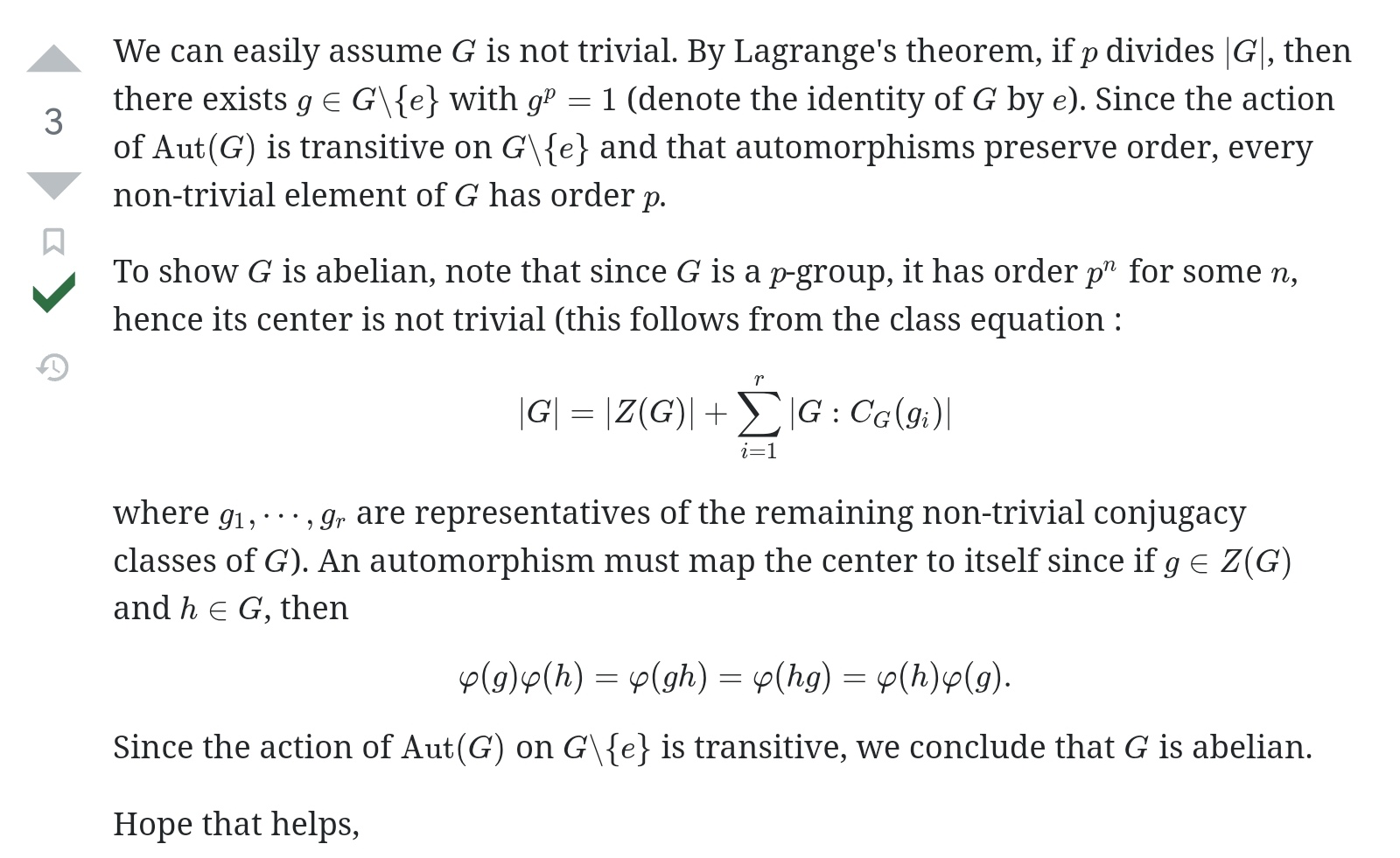
And we know is elementary abelian.
Back to the problem
Now suppose . Define as . Note that the complement graph of is also a Cayley graph, i.e. . Thus is a subgroup with . Assume is normal arc-transitive, then is transitive on . Hence elements of have the same order and are conjugate in a subgroup of . Simply, we say is a REA-group relative to .
Def. A finite group is a relative elementary abelian group if has a subgroup such that all elements of are conjugate in a subgroup of .
Properties of REA-group
Problem. Characterize REA-groups. Study and such that is transitive on and study and its subgroups which are transitive on .
Lemma. Let be a REA-group relative to . Then:
- each element of is of order for some prime and integer , which is independent of the choice of elements;
- an element of does not centralize an element of of order coprime to .
Proof. i) Let . If with , then and do not have the same order and so . Then yields , which is impossible. Hence for some prime . Since all elements in have the same order, for all .
ii) If centralize such that , then and , not possible.
Cor. If is abelian and REA, then is a -group.
Proof. By the lemma above, if order of elements of is and order of an element of is coprime to , then for all , contradiction.
nilpotent + REA ⇒ p-group
Lemma. Let such that . Then is a REA-group relative to .
Proof. Easy. Only need to show elements in are conjugate in .
Lemma. If is a REA-group relative to , then .
Proof. Let be a minimal counter-example. Then is not normal in . Since all elements of have order , define $$ T={g\in G:r\big||g|,r\neq p\mathrm{;is;a;prime}}.
Then $\lang T\rang\leq N$ and $\lang T\rang\space\mathrm{char}\space G$. Let $\overline G=G/\lang T\rang$. Then $\overline G$ is a REA-group relative to $N/\lang T\rang$. If $G$ is not a $p$-group, then $\lang T\rang$ is non-trivial. By $G$ minial counter-example, $N/\lang T\rang\lhd G/\lang T\rang$. Then $N\lhd G$, contradiction. Thus $G$ is a $p$-group. Let $Z(G)$ be the center of $G$. Then $1\neq Z(G)\space\mathrm{char}\space G$. Suppose $(G\backslash N)\cap Z(G)\neq\empty$. Then elements of $G/N$ are conjugate to some elements of center and so $G\backslash N\subset Z(G)$. Thus $G=Z(G)\cup N$, which is impossible. Fact: A finite group cannot be written as a union of two proper group. For example, suppose $G=H\cup K$ and for any $h\in H,k\in K$, consider $hk$. Hence $G\backslash N\cap Z(G)=\empty$ and $Z(G)\subset N$. Now $G/Z(G)$ is a REA-group relative to $N/Z(G)$ and $N/Z(G)\lhd G/Z(G)$, which is also impossible. $\blacksquare$ **Rmk.** $N$ is not necessarily a characteristic group. For example: ![[Pasted image 20240430191356.png]] **Lemma.** $G/N=Z_p^d$. **Proof.** For any $g\in G\backslash N$, if $|g|=p^e$, then $g^p\in N$. Thus each non-identity element of $G/N$ is of order $p$. Assume first that $G$ is a $p$-group. Then the commutator subgroup $G'$ is nontrivial (proof later). We claim that $G'\leq N$. Otherwise $G\backslash N\cap G'\neq\empty$. Since $G'$ is a characteristic subgroup, every element of $G\backslash N$ lies in $G'$, namely, $G\backslash N\subset G'$. Thus, $G=N\cup (G\backslash N)=N\cup G_0$, which is impossible. Hence, $G'\leq N$ and $G/N$ is abelian. Therefore, $G/N=Z_p^d$ for some positive integer $d$. Fact: $p$-group has non-trivial commutator is non-trivial. **Proof 1.** Suppose $G$ is a $p$-group, then $Z(G)$ is non-trivial. Then $G/Z(G)$ has definitely an order smaller than that of $G$. By induction,(G/Z(G))‘=G’Z(G)/Z(G)\subsetneq G/Z(G).
Hence $G'Z(G)\subsetneq G$, so $G'\subsetneq G$. **Proof 2.** Using the following proposition: - every $p$-group is nilpotent - a finite group is nilpotent iff all its maximal proper subgroup is normal - a proper maximal subgroup of a finite group has prime index and we get a proper maximal subgroup of a $p$-group is normal and has index $p$. Suppose $G$ is a $p$-group and $H$ is a proper maximal subgroup. Then $G/H$ is of order $p$ and so it is cyclic. Then $G'\leq H$ is a non-trivial subgroup of $G$. Suppose now that $G$ is not a $p$-group. Since the elements in $G\backslash N$ have the same order $p^e$, each element of $G$ of order not equal to $p^e$ lies in the normal subgroup $N$. Thus, the set
T={g\in G:|g|\neq p^e}
is a subset of the subgroup $N$, and $M:=\lang T\rang\leq N$. Clearly, $T$ generates a characteristic subgroup of $G$. By Lemma, $G/\lang T\rang$ is an REA group relative to $N/\lang T\rang$. Since $T$ contains all $p'$-elements of $G$, so does $N\geq \lang T\rang$. So, the factor group $G/N$ is a $p$-group. Therefore, the factor group $(G/M)/(N/M)$ is an elementary abelian $p$-group by the previous paragraph. So is $G/N$, because $G/N\cong (G/M)/(N/M)$ is elementary abelian, completing the proof. $\blacksquare$