Problem 1.
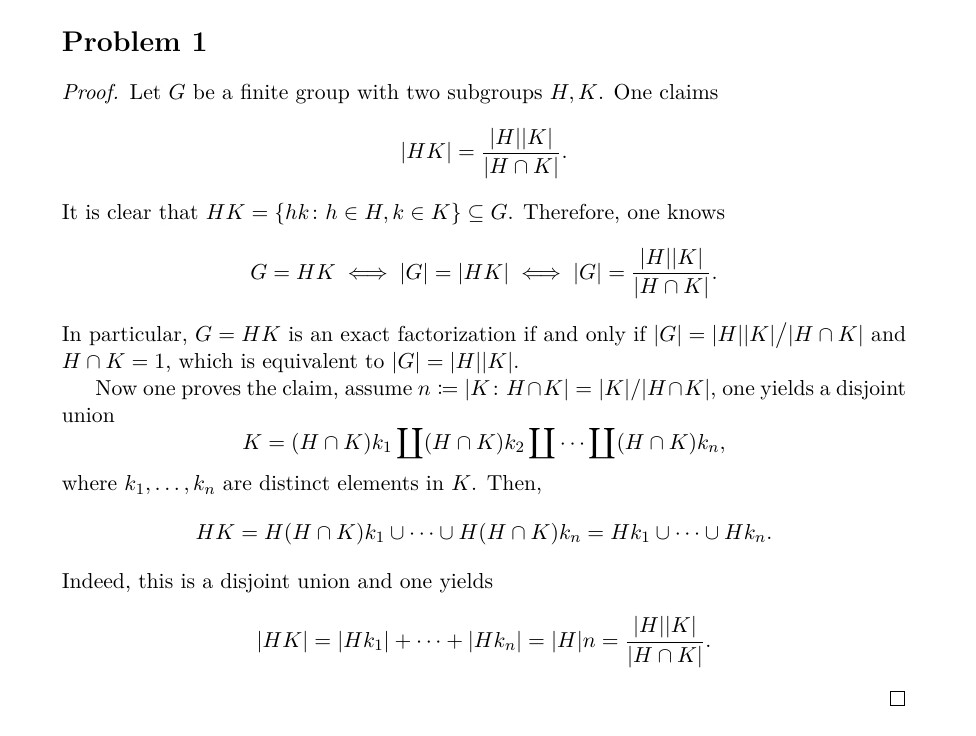
For subgroup of a finite group , prove that iff .
Proof. We have proved it in class. And this is a proof from Shuan yang Hu.
Problem 2.
(Recall Hall theorem: Let be a finite solvable group and let be the set of prime divisors of . Then for any subset , there exists a Hall -subgroup of .)
Prove that, for any Sylow -subgroup and Hall -subgroup of , we have that .
Proof. If is a Hall -subgroup of , then the order and index of are relatively prime, that is, . Suppose , where and are distinct primes. By Sylow theorem, . And the order of Hall -subgroup is . Since is a subset of and , .
Problem 3.
Let , and let . Prove that, for any subgroup , iff is transitive on .
- Let and . Prove that has a subgroup with , such that .
- Let and , where with being a prime-power. Then has a subgroup such that .
Proof. By Frattini’s argument. Let be the set of -space of , then . Since is -transitive on and is -transitive on , then and . Note that is simple, it is a subgroup of . But may not a subgroup of , so it cannot always be written as .
Problem 4.
Let and . Let and the images of under . Then .
Give an example to show may be trivial factorization.
Proof. Recall that is the group with elements and multiplication for . Select . As there is such that , and we obtain . Thus , and holds trivially. So .
For a trivial factorization, consider . For example where . Let . Then and is trivial.
Rmk. Here is an nontrivial example. Let such that and . Let . Let such that . Let . Then is -transitive on . Let .
Claim that . Otherwise, assume , then $$ L\in{Z_p:Z_{(p-1)/2},D_{p-1},D_{p+1},A_4,S_4,A_5}.
Since $L>S_3$ and $12\big||L|$, $L$ does not exist. So $M=T$. Claim that $N=T$. Let $N=\lang S\rang$. Since $g,a$ and $b$ normalize $N$, $1\neq N\lhd\lang g,a,b\rang=M=T$. By $T$ simple, $N=T$. Let $\Gamma=\mathrm{Cay}(T,S)$. Then $T$ is connected and $\~H<\mathrm{Aut}(\Gamma)$. And $G:=\^T:\~H=\^T\times\check H$. The group $G$ is $2$-arc-transitive on $\Gamma$. And $T=G/\check H$ is $2$-arc-transitive on $\Gamma_{\check H}$. Then $\^T\cong \overline G=\overline{\^T}\overline{\~H}=\overline{\^T}$. *Furthermore, we obtain that $\Gamma_{\check H}$ is non-Cayley, which I don't know how to prove.* For example, when $p=5$, $\Gamma_{\check H}$ is Petersen. ### Problem 5. Let $G=HK$ with $H,K$ both abelian. Prove that $G$ is a meta-abelian group. Is this true that if $H,K$ are metacyclic then $G=HK$ metacyclic? Why? **Def.** If the commutator subgroup $G'$ is abelian, we say $G$ is metabelian. **Proof.** i) First, we show that $[H,K]$ is normal. For any $hkh^{-1}k^{-1}\in[H,K]$, we have $(hkh^{-1}k^{-1})^{h_0}=hk^{h_0}h^{-1}(k^{h_0})^{-1}$. Suppose $k^{h_0}=k'h'$, then $(hkh^{-1}k^{-1})^{h_0}=hk'h^{-1}k'^{-1}$. Similarly, consider $h^{k_0}=h''k''$ and then $(hkh^{-1}k^{-1})^{k_0}=h''kh''^{-1}k^{-1}$. Then claim that $[G,G]=[H,K]$. For any $g_1,g_2\in G$, suppose $g_1=h_1k_1$ and $g_2=k_2h_2$. Then $g_1g_2g_1^{-1}g_2^{-1}=h_1k_2k_1h_2k_1^{-1}h_2^{-1}h_1^{-1}k_2^{-1}=[h_1,k_2][k_1,h_2]^{h_1^{-1}k_2^{-1}}\in[H,K]$. Therefore, $[G,G]=[H,K]$. Finally, prove $[G,G]=[H,K]$ is abelian. For any $h\in H,k\in K$, $[h,k]^{\~h\~k}=[h,k]^{\~k\~h}$. Then $[h,k]$ and $[\~h,\~k]$ are commute. ii) Product of cyclic groups may not metacyclic. Consider $G=D_6\times D_6=Z_6Z_6$. Note that $G$ is not metacyclic. Otherwise, assume $A\lhd G$ is cyclic and $G/A$ is cyclic. Then $A\geq G'=C_3\times C_3$ is not cyclic, contradiction. **Rmk.** Similarly, we can prove that nilpotent*nilpotent=solvable. ### Problem 6. Prove that $G=\mathrm{PSL}_2(p)\times\mathrm{PSL}_2(p)$ is a product of two meta-cyclic groups iff $p\equiv 3\mod 4$. ### Problem 7. Let $G=HK$ where $H$ is a simple group and $|K|\leq 100$. Prove that, there are only finitely many possibilities such that $H$ is not a normal subgroup of $G$. **Proof.** Since $H$ is simple and not a normal subgroup of $G$, $H$ is core-free in $G$. Hence, the right multiplication action of $G$ on $[G:H]$ is faithful, i.e. $G\leq\mathrm{Sym}([G:H])$. Recall that $G=HK$ implies $K$ is a transitive subgroup of $\mathrm{Sym}([G:H])$. Then by $|K|<100$, one has the lengths of orbits of $K$ are less than $100$. Therefore, $G\leq\mathrm{Sym}([G:H])\leq S_{100}$, that is, there are only finitely many possibilities. ### Problem 8. Prove that most arc-transitive cubic graphs are non-Cayley graphs. (Recall Tutte's theorem: If $\Gamma$ is a $G$-arc-transitive cubic graph, then the vertex stabilizer $G_v$ is a subgroup of $S_4\times S_2$.) **Proof.** We cannot finish this problem completely, but we can prove something related to it. Suppose $\Gamma=\mathrm{Cay}(G,S)$ is an arc-transitive cubic graph, where $G$ is a finite group and $S$ is a $3$-subset of $G$. Then for any vertex $\alpha\in V\Gamma$, $X:=\mathrm{Aut}\Gamma=GX_\alpha$. Let $C=\mathrm{Core}_X(G)$. Then there are three cases. i) If $C=1$, $G$ is core-free in $X$. Thus $X$ acting on $\Omega:=[X:G]$ is faithful and so $X\leq\mathrm{Sym}(\Omega)\leq S_{48}$ by Tutte's theorem. So there are only finitely many possibilities of $G$. ii) If $C=G$, then $\Gamma$ is a normal arc-transitive graph. iii) If $1<C<G$, we consider the quotient graph $\Gamma_C$. Since $\mathrm{val}(\Gamma_C)\big |\mathrm{val}(\Gamma)$, we have $\mathrm{val}(\Gamma)=1$ or $3$. If $\mathrm{val}\Gamma_C=1$, then $\Gamma_C$ is a single edge. Then $\Gamma$ is a bipartite graph, that is, any $C$-orbit is a independent set, because $C$-orbits is a block system and $\Gamma$ is arc-transitive. This graph is called *binormal Cayley graph*. If $\mathrm{val}\Gamma_C=3$, then $\Gamma$ is a cover of $\Gamma_C$ and $\Gamma_C$ is a arc-transitive cubic graph. Since $G/C$ acting on $V\Gamma_C$ is regular, $\Gamma_C$ is a Cayley graph and $G/C$ is core-free. By i) we know there are finitely many possibilities of $G/C$. ### Problem 9. For suitable integer $n$, express the complete graph $K_n$ as a normal edge-transitive Cayley graph. > **Lemma.** $\Gamma$ is a normal edge-transitive Cayley graph iff $\mathrm{Aut}(G,S)$ is transitive on $\{\{g,g^{-1}\}:g\in S\}$. > > **Proof.** For any $g_1,g_2\in S$, suppose $g_1$ and $g_2$ are not conjugate in $\mathrm{Aut}(G,S)$. There is $\hat g h\in N$ such that $\{1,g_1\}^{\hat g h}=\{1,g_2\}$ where $\hat g\in\hat G$ and $h\in\mathrm{Aut}(G,S)$. Then $g^h\neq 1$ and $(gg_1)^h=1$, $g=g_1^{-1}$ and $(g_1^{-1})^h=g_2$. Thus $g_1$ and $g_2^{-1}$ are conjugate in $\mathrm{Aut}(G,S)$. **Proof.** Suppose $K_n=\mathrm{Cay}(G,G\backslash\{1\})$ is normal edge-transitive. Then $\mathrm{Aut}(G,G\backslash\{1\})$ is transitive on $D:=\big\{\{g,g^{-1}\}:g\in G,g\neq 1\big\}$ and so all non-trivial elements of $G$ have the same order. So there is a prime $p$ such that $|g|=p$ for all $g\neq 1$. Since $G$ is a $p$-group, $Z(G)$ is non-trivial. Since $Z(G)$ is a characteristic subgroup and $\mathrm{Aut}(G)$ is transitive on $D$, $Z(G)=G$. Thus $G=Z_p^d$ and $n=p^d$ for some positive integer $d$. When $G=Z_p^d$, $\mathrm{Aut}(G,G\backslash \{1\})=\mathrm{GL}(d,p)$ is transitive on $G\backslash\{1\}$. Therefore, $K_n=\mathrm{Cay}(G,G\backslash\{1\})$ is a normal edge-transitive Cayley graph. ### Problem 10. For suitable integers $n$, express the complete multi-partite graph $K_{n,\cdots,n}$ as a normal edge-transitive Cayley graph. ### Problem 11. Construct $2$-arc-transitive Cayley graphs $\Gamma$ such that $\Gamma$ have normal quotient graphs which are non-Cayley graphs. Does there exist a normal $3$-arc-transitive Cayley graph? **Proof.** i) Let $G=A_5$, acting on $\{1,2,3,4,5\}$, and let $H=\lang(123),(23)(45)\rang\cong S_3$ and $g=(24)(35)$. Let $S=g^H=\{(24)(35),(34)(15),(14)(25)\}$ and $\Gamma=\mathrm{Cay}(G,S)$. Claim that $\lang S\rang =G$ and hence $\Gamma$ is connected. Since $(24)(35)^{(34)(15)}=(23)(45)$ and $(24)(35)(34)(15)(14)(25)=(12345)$, we have $(23)(45),(12345)\in\lang S\rang$. And $A_5=\lang(23)(45),(12345)\rang$ yields $\lang S\rang=G$. Claim that $\Gamma$ is $2$-arc-transitive. Since $H$ is a maximal subgroup of $G$, we have $\mathrm{Inn}(G,S)=\~H$. Let $X=\^G:\mathrm{Inn}(G,S)$. Then $X=\hat G\times\check H\cong A_5\times S_3$. Since $\mathrm{Inn}(G,S)$ is $2$-transitive on $S$, $\Gamma$ is $(X,2)$-arc-transitive. Thus $\Gamma$ is a $2$-arc-transitive graph. Moreover, let $N=\check H$, the quotient graph $\Gamma_N$ is the Petersen graph, which is non-Cayley. ii) The answer is negative. ![[Pasted image 20240430191645.png]] **Rmk.** I think it is enough to consider these two arcs: $1-s_1-s_1s_2-s_1s_2s_3$ and $1-s_1-s_1s_2-s_1s_2s_1$. Since $\mathrm{Aut}\Gamma=\hat G:\mathrm{Aut}(G,S)$, there does not exist $\sigma$ mapping one $3$-arc to another. ### Problem 12. Prove that, for any integer $k\geq 3$, there are at most finitely many graphs of valency $k$ which are $4$-arc-transitive Cayley graphs. (Recall that, if $\Gamma$ is $(G,4)$-arc-transitive graph of valency $k\geq 3$ which is not $(G,5)$-arc transitive, then $G_v\rhd q^2:\mathrm{SL}_2(q)$ and $G_v^{\Gamma(v)}\rhd \mathrm{PSL}_2(q)$, with $k=q+1$.) **Proof.** Use three lemmas: - 1992, Praeger (theorem 1) - lemma 2, $X_v=A_7$ or $S_7$ - $\mathrm{Core}_XG$ acting on $V$ is transitive (the last part) ![[Pasted image 20240430191701.png]] ![[Pasted image 20240430191715.png]] ### Problem 13. Let $\Gamma$ be a self-complementary undirected graph of order $n$ with a complementing isomorphism $\sigma$. Prove that the order of $\sigma$ is divisible by $4$. **Proof.** Since $\Gamma$ is self-complementary, we have $n\equiv 0$ or $1\mod 4$. For the nontrivial cases, we can assume $n\geq 4$. If $|\sigma|$ iss divisible by some odd $m$, then $\sigma^m$ is also a complementing isomorphism of $\Gamma$, as $\sigma$ interchanges $\Gamma$ and $\overline\Gamma$. Replacing $\sigma$ by $\sigma^m$, we can assume $|\sigma|=2^e$ for some integer $e$. By the definition of a complementing isomorphism, $\sigma$ does not fix any pair of vertices in $\Gamma$. Clearly $e\geq 1$. For any $2$ distinct vertices $u,v$, let $w=u^\sigma,z=v^\sigma$, then $\{u,v\}^\sigma=\{w,z\}\neq\{u,v\}$. WLOG assume $w\neq u$. If $|\sigma|=2$, $\{u,w\}^\sigma=\{w,u\}$, which is a contradiction. Thus we have $|\sigma|$ is divisible by $4$. **Rmk.** I think my proof is easier than this. WLOG $|\sigma|=2^e$ for some positive integer $e$. If $e$ is $1$, then there is a vertex $u$ such that $u^\sigma=v,v^\sigma=u$. Then $\{u,v\}^\sigma=\{u,v\}$, whch is impossible. ### Problem 14. Prove that edge-transitive self-complementary graphs are normal Cayley graphs are normal Cayley graphs. ![[Pasted image 20240430191731.png]] ### Problem 15. Prove that, if a group $G$ has an automorphism $\sigma$ such that $\sigma^2$ fixes no non-identity element of $G$, *and each orbit of $\lang\sigma\rang$ on $G\backslash\{1_G\}$ is of even length*, then there exists a self-complementary Cayley graph $\Gamma=\mathrm{Cay}(G,S)$ such that $\sigma$ is a complementing isomorphism of $\Gamma$. **Proof.** Without the italic section, the problem has errors. We will prove it by three parts: - with the condition of "orbit with even length", we can construct a SC Cayley graph - if $\sigma$ is a complementing isomorphism of SC Cayley graph, orbits of $\sigma$ on $G\backslash\{1_G\}$ is of even length - a counter example such that $\sigma\in\mathrm{Aut}(G)$, $\sigma^2$ fixes no non-identity elements, but SC $\mathrm{Cay}(G,S)$ does not exist. > **Lemma.** $\sigma$ is a complementing isomorphism of Cayley graph $\Gamma=\mathrm{Cay}(G,S)$ iff $S^\sigma=G\backslash(S\cup\{1_G\}$. > > **Proof.** If $\sigma$ is a complementing isomorphism, then $(1,g)$ is either an edge of $\Gamma(1_G)$ or an edge of $\overline\Gamma(1_G)$. So $G=S\sqcup S^\sigma\sqcup\{1_G\}$. > > Conversely, assume $S^\sigma=G\backslash(S\cup\{1_G\})$, where $\sigma\in\mathrm{Aut}(G)$ and $S$ is a subset of $G$. Suppose $\Gamma=\mathrm{Cay}(G,S)$. For any $(x,y)\in E\Gamma$, we have $(x,y)^\sigma\notin E\Gamma$. Also $(z,w)\notin E\Gamma$ yields $(z,w)^\sigma\in E\Gamma$. Thus $\Gamma$ is self-complementary. i) Assume each orbit of $\lang\sigma\rang$ on $G\backslash\{1_G\}$ is of even length. Let $G=1_G\sqcup g_1^{\lang\sigma\rang}\sqcup\cdots\sqcup g_k^{\lang\sigma\rang}$ be an orbit decomposition of $\lang\sigma\rang$ on $G$. Since each orbit of $\lang\sigma\rang$ is of even length, that is, the order of $\sigma$ is even, we have $g_i^{\lang\sigma\rang}=g_i^{\lang\sigma^2\rang}\sqcup g_i^{\sigma \lang\sigma^2\rang}$ and $\sigma$ permutes $g_i^{\lang\sigma^2\rang}$ and $g_i^{\sigma \lang\sigma^2\rang}$. Let $S=g_1^{\lang\sigma^2\rang}\sqcup\cdots\sqcup g_k^{\lang\sigma^2\rang}$, then $S^\sigma=G\backslash(S\cup \{1_G\})$. And hence by lemma $\sigma$ is a complementing isomorphism of $\mathrm{Cay}(G,S)$. ii) On the other hand, assume $\sigma\in\mathrm{Aut}(G)$ and $\sigma^2$ fixes no elements of $G\backslash\{1_G\}$, and there is a SC $\Gamma=\mathrm{Cay}(G,S)$ with self-complementing isomorphism $\sigma$. Assume $g\in S$ and the orbit of $g$ under $\lang\sigma\rang$ is $\{g,g^\sigma,\cdots,g^{\sigma^k}\}$. Then $\{g^\sigma,g^{\sigma^3},\cdots\}\in G\backslash(S\cup\{1_G\})$ and $\{g,g^{\sigma^2},\cdots\}\in S$, and so $|g^{\lang\sigma\rang}|$ is even. If $1_G\neq g\notin S$, then $S^\sigma=G\backslash(S\cup\{1_G\})$ yields $g\in S^\sigma$. With the same argument $|g^{\lang\sigma\rang}|$ is even. Therefore, all orbits of $\lang\sigma\rang$ on $G\backslash\{1_G\}$ are of even length. iii) Counter example: $G=\lang x\rang=\lang(1234567)\rang\cong C_7$, $\sigma:x\to x^2$. Then $\sigma^2$ fixs no non-identity elements but $\mathrm{Cay}(G,S)$ is not SC because $7\not\equiv 0$ or $1\mod 4$.