Chapter 2 Manifolds
charts, atlas, diffeomorphism, pull-back
(感谢李展,我居然都学过)
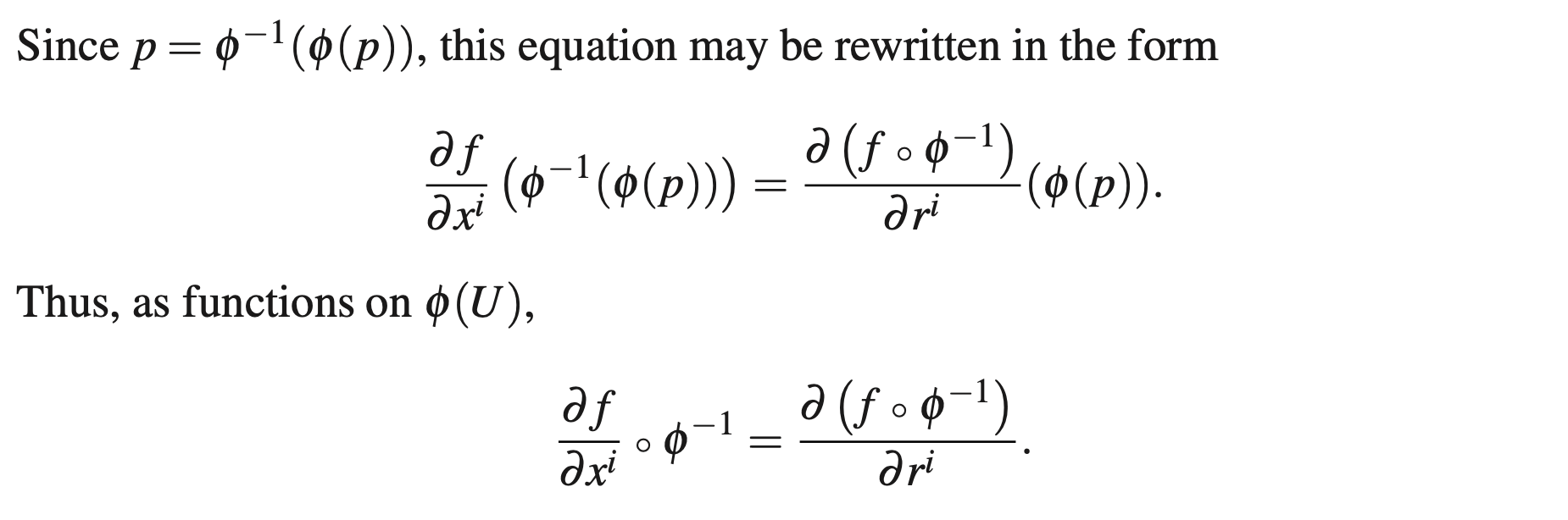
Partial Derivatives
The notation is a little complex…
Chapter 3 The Tangent Space
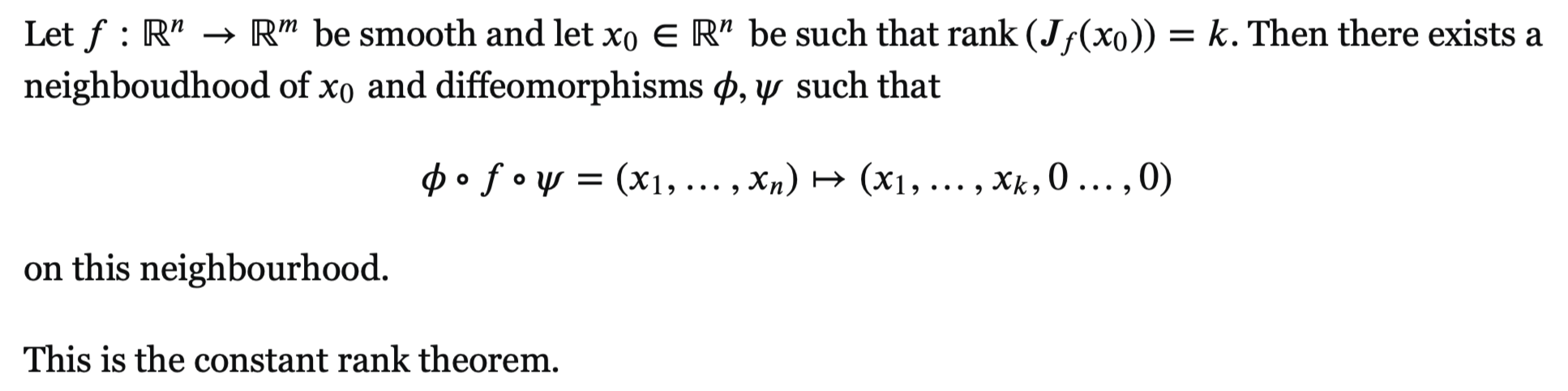
rank
Thm. (regular level set theorem) Let be a smooth map between manifolds of dimension and respectively. A non-empty regular level set where is a sub-manifold of of dimension equal to .
What is rank? See here.
From the rank of the differential, one obtains three local normal forms for smooth maps: the constant rank theorem, the immersion theorem, and the submersion theorem, corresponding to constant-rank differentials, injective differentials, and surjective differentials respectively.
Vector bundle and tangent bundle
I learn definitions from here.
bump function
Using bump functions, we give several criteria for a vector field to be smooth.
others
The chapter ends with integral curves, flows, and the Lie bracket of smooth vector fields.
Chapter 4 Lie Groups and Lie Algebras
A Lie group is a homogeneous space in the sense that left translation by a group element g is a diffeomorphism of the group onto itself that maps the identity element to g. Therefore, locally the group looks the same around any point. It is not surprising that the tangent space at the identity of a Lie group should play a key role. The tangent space at the identity of a Lie group G turns out to have a canonical bracket operation that makes it into a Lie algebra. The tangent space with the bracket is called the Lie algebra of the Lie group G. The Lie algebra of a Lie group encodes within it much information about the group.
Chapter 5 Differential Forms
A differential k-form assigns to each point a k-covector on its tangent space. Here a covector is an element of the dual space to the relevant vector space . That is, it is a linear function from to the underlying field of scalars.
In this chapter we give an introduction to differential forms from the vector bundle point of view.
- we start with 1-forms, which already have many of the properties of k-forms.
- We give various characterizations of smooth forms, and show how to multiply, differentiate, and pull back these forms.
- In addition to the exterior derivative, we also introduce the Lie derivative and interior multiplication, two other intrinsic operations on a manifold.
Differential graded algebra
Due to the existence of the wedge product, a grading, and the exterior derivative, the set of smooth forms on a manifold is both a graded algebra and a differential complex. Such an algebraic structure is called a differential graded algebra.
似乎好像没看懂。。
1-form
Suppose is a differential manifold. Define tangent space a real vector space that intuitively contains the possible directions in which one can tangentially pass through . Define cotangent space and is called a covector. Define covector field as a -form on , which is a function $$ \begin{align} w:M&\to \mathrm{Hom}(T_pM,\mathbb{R}), \ p&\mapsto w_p. \end{align}
To describe cotangent space, we can give it a basis. ![[Pasted image 20231214124251.png]] Don't be confused by notation $dx^i$. They are just defined by dual basis, that is, $dx^i(\partial/\partial x^j)=\delta_{ij}$. Then it comes to push forward and pull back. Suppose $F:N\to M$ is a $C^\infty$-map of manifolds, then at each point $p\in N$ the **differential**F_{*,p}:T_pN\to T_{F(p)}M
is a linear map that **pushes forward** vectors at $p$ from $N$ to $M$. The **codifferential**, that is, the dual of the differential, mapping $T^*_{F(p)}M$ to $T_p^*N$. Denote the codifferential $(F_{*,p})^\vee$ or $F^*$. $F^*$ is defined pointwise by(F^w)p(X_p)=w{F(p)}(F_(X_p))
for all $X_p\in T_pN$. And $w$ is a $1$-form on $M$. We have the following property: ![[Pasted image 20231214130201.png]] ## k-form An alternating $k$-tensor on $V$ is also called a $k$-covector on $V$. And alternating $k$-tensor is defined [[Pasted image 20231214131549.png|here]], which is denoted by $A_k(V)$ or $\wedge^k(V)$. **Def.** A $k$-covector field on $M$ is a function $\omega$ that assigns to each point $p\in M$ a $k$-covector $\omega_p\in \wedge^k(T_p^*M)$. A $k$-covector field is also called a differential $k$-form, a differential form of degree $k$, or simply a $k$-form. ![[Pasted image 20231214132400.png]]![[Pasted image 20231214132412.png]] Furthermore, define the $k$-th exterior power of the cotangent bundle $\wedge^k(T^*M):=\cup_{p\in M}(T_p^*M)$. It has a differentiable structure. The vector space of all $C^\infty$ $k$-forms on $M$ is usually denoted by $\Omega ^k(M)$. Also define pull back, which is omitted here. ### Wedge product Wedge product of two alternating tensors is also a alternating tensor.![[Pasted image 20231214140736.png]] Then there are properties: - If $\omega$ and $\tau$ are $C^\infty$ forms on $M$, then $ω ∧ τ$ is also $C^\infty$. - If $F$ is a $C^\infty$ map, then $F^*(\omega\wedge\tau)=F^*\omega\wedge F^*\tau$. ### Invariant forms on a Lie group ![[Pasted image 20231214142109.png]] **Prop.** Every left-invariant $k$-form $\omega$ on a Lie group $G$ is $C^\infty$. ## The exterior derivative & The Lie derivative and interior multiplication ![[Pasted image 20231214143041.png]] # Chapter 6 Integration > There are actually two theories of integration on manifolds, one in which the integration is over a sub-manifold and the other in which the integration is over what is called a singular chain. For simplicity we will discuss only integration of smooth forms over a sub-manifold. ## Oriented > For integration over a manifold to be well defined, the manifold needs to be oriented. ## Stokes’s theorem I think we have learnt it before. See [here](https://en.wikipedia.org/wiki/Generalized_Stokes_theorem). # Chapter 7 De Rham theory >Poincare proved in 1887 that for $k = 1,2,3$, a $k$-form on $\mathbb{R}^n$ is exact if and only if it is closed, a lemma that now bears his name. Vito Volterra published in 1889 the first complete proof of the Poincare lemma for all $k$. >The extent to which closed forms are not exact is measured by the de Rham cohomology, possibly the most important diffeomorphism invariant of a manifold. >Roughly speaking, de Rham cohomology measures precisely **the extent to which the fundamental theorem of calculus fails** in higher dimensions and on general manifolds. 我猜用不到这里。先不看了。