TLDR
Any irreducible finite dimensional representation of , or any finite dimensional -module, is isomorphic to a , which is uniquely determined by its dimension. Furthermore, any finite dimensional -module can be written as a direct sum of irreducible -submodules.
Irreducible representations of
Notice that
Define , and .
Lemma
Let be an -module. Suppose satisfies . Then:
- , .
- When , then .
- When and , , the space is a -dim irreducible -module and .
\begin{proof}i) & ii) By induction.
iii) By i) and ii), it is easy to verify a -module. For any element , , then for some . And so acting on generates the whole space , i.e. is irreducible.
\end{proof}
Proposition
Let be the -module given by , where
These are the only finite dimensional irreducible -modules.
\begin{proof}Let be a finite dimensional irreducible -modules. We will show there is a s.t. . Let be an eigenvector of with maximal eigenvalue . Since , there must be . On the other hand, has only finitely many eigenvalues and , it follows that there exists s.t. and . Then
is an irreducible -module of dimension . By irreducibility of , there is and so .
\end{proof}
Completely reducibility
We want to show that finite dimensional representations of are completely reducible. To show it, we need the following criterion.
The criterion for completely reducibility
the criterion for complete reducibility
Suppose is finite dimensional complex Lie algebra with . Then the followings are equivalent:
- For any finite dimensional -modules , there exists a complementary -submodule of such that .
- For any finite dimensional -modules with , there is .
- For any finite dimensional -modules with irreducible and , .
\begin{proof}i) → ii) → iii) is trivial.
To show iii) → ii), we do induction on . When , is irreducible and we apply iii). Assume ii) holds when . Now suppose . If is irreducible, we merely apple iii). Otherwise, choose an irreducible -submodule . Consider . Applying induction hypothesis, one get where the summand corresponds , where is a -submodule containing . Applying iii) to , we get with . Now .
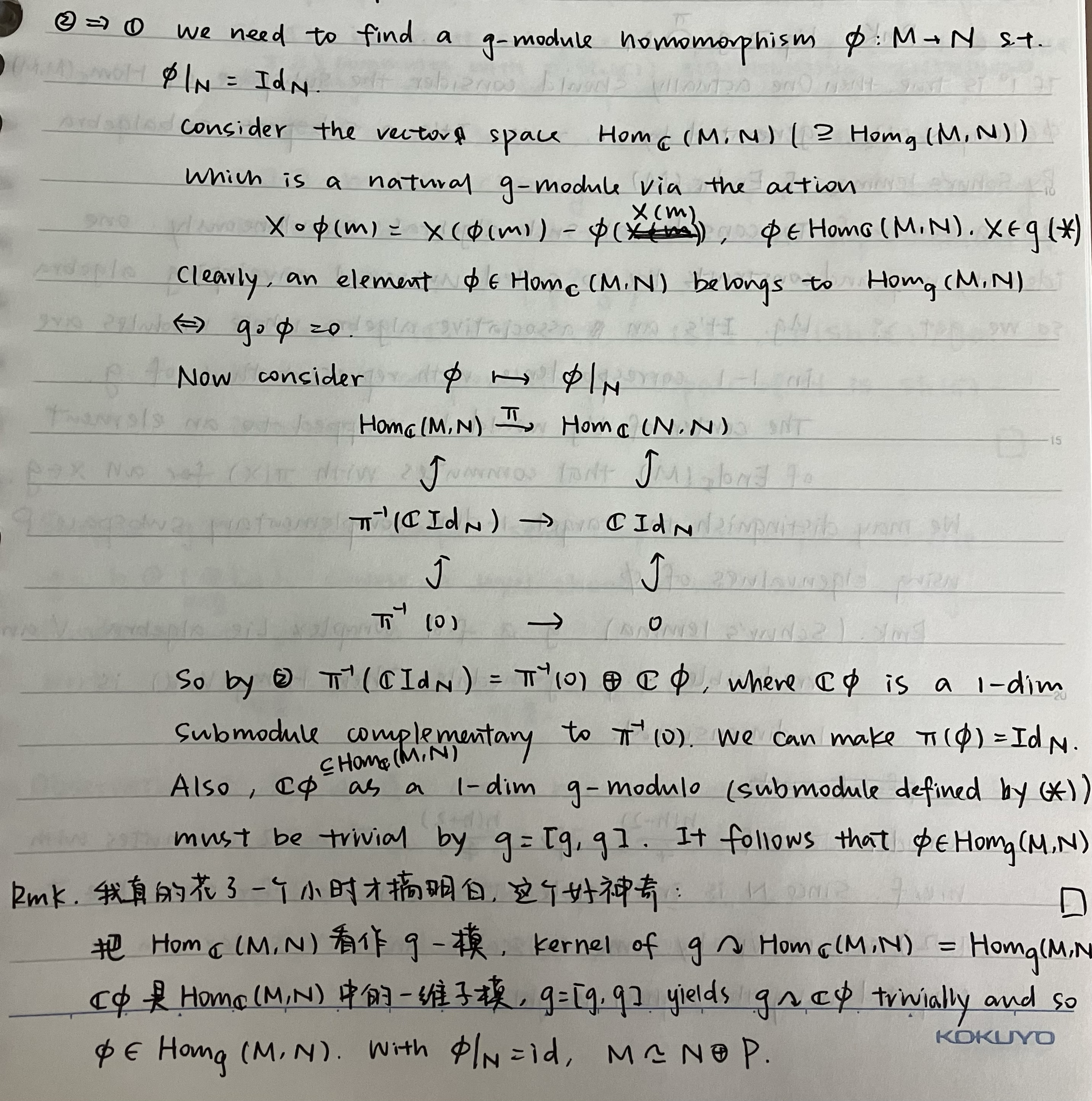
To show ii) → i), we need to find a -module homomorphism such that . Consider the vector space containing , which is a natural -module via the action
Clearly, an element belongs to iff .
Now consider
There are
and
So by ii) we have , where is a -dimensional submodule complementary to . We can make . Also, as a -dimensional -module must be trivial by . It follows that .
Notes on the class is attached here.
\end{proof}
Main theorem
Now we can prove the following theorem.
Theorem
Every finite dimensional representation of is completely reducible.
\begin{proof}By the criterion for complete reducibility, it suffices to show for any finite dimensional -module with irreducible and , there is .
Observation: denotes the action of on by . If is in the algebra generated by and commutes with , then is a -module homomorphism. By Schur’s lemma, acts on by scalar. (Schur’s lemma is proved by consider the kernel of , by algebraically closed there exists a such that and so .)
We may distinguish the target -dimensional complementary subspace using eigenvalues of .
Consider . Then commutes with . Since is irreducible, it is for some . acts on by some scalar and it’s scalar can be computed using the highest weight vector . Since
acts on by .
Case 1: If , in this situation, acts on by a non-zero scalar . On the other hand, is a trivial -module by and acts by the zero vector. Whence has an eigenvalue . Thus the -eigenspace of must be -dimensional. Because commutes with , for -eigenvector , is -invariant. Thus .
Case 2: If , is the -dimensional trivial -module. Choosing a basis of and extending it to a basis of , then the matrix representation of is
Because , . Hence any complementary subspace of is -invariant and so we find s.t. .
\end{proof}