Text-Ex. 6.1.
- i) Let be a Noetherian A-module and a module homomorphism. If is surjective, then is an isomorphism.
- ii) If is Artinian and is injective, then again is an isomorphism. (For (i), consider the submodules ; for (ii), the quotient modules .)
\begin{proof}
i) Since is surjective, is also surjective for any . Define , then we have a chain . There exists such that for any as is Noetherian. It deduces that for any nonzero . Note that , so is injective. Therefore, is an isomorphism.
ii) Similarly, as is also injective and is Artinian, there exists such that for any . It deduces that is an isomorphism. For any , there is , otherwise there exists such that , which is impossible by injective. Thus, yields and so , which is a contradiction. Therefore, , is an isomorphism and so is surjective.
\end{proof}
Text-Ex. 6.6. Prove that the following are equivalent:
- i) is Noetherian.
- ii) Every open subspace of is quasi-compact.
- iii) Every subspace of is quasi-compact.
\begin{proof}
i)→ii) Assume that is Noetherian. For open subspace and its open cover , the chain has to stop by a.c.c. Hence has a finite subcover and so is quasi-compact.
ii)→iii) For any subspace and its open cover , notice that each is induced from an open set with . Define , then is open and is an open cover. There exists a finite subcover with for some . Then is a finite subcover of . Hence every subspace of is quasi-compact.
iii)→i) If there exists a family of open sets does not satisfy a.c.c., that is, is not stationary, then has an open cover and does not have a finite subcover (Otherwise the chain stops at some ). It is impossible.
\end{proof}
Text-Ex. 6.7. A Noetherian space is a finite union of irreducible closed subspaces. (Consider the set of closed subsets of which are not finite unions of irreducible closed subspaces.) Hence the set of irreducible components of a Noetherian space is finite.
\begin{proof}
Let be the set of closed subsets of which are not finite unions of irreducible closed subspaces. Since is Noetherian, there exists a minimal element in . Note that is reducible and it can be written as a union of two closed subspace, that is, . Since is the minimal element in , both and can be written as finite union of irreducible closed subspaces. It deduces that can be written as finite union of irreducible closed subspaces, which is a contradiction.
\end{proof}
Proposition 2.9, (ii). Let be a sequence. It is exact iff for any -module , the induced sequence
is exact.
\begin{proof}
ii) "→" Assume that is exact. It is enough to show is injective and . If , then . Since is injective, we have and so is injective. Note that as , so . For any , we aim to find such that . For any , define . Since and is injective, is well-defined and . Hence .
"←" Assume that is exact. It suffices to show is injective and . If is not injective, then . Let and apply it to . The inclusion map is included in and , which contradicts with injective. Take and satisfies , that is, . Conversely, take and
is exact. Since is an element of and , there is and so there exists such that . Then for any , we have and . Now we finish the proof.
\end{proof}
Proposition 2.10. Consider a commutative diagram where both rows are short exact.
Then we have an exact sequence
Prove the sequence is exact at the two places and .
\begin{proof}
Notice that are restriction of . We can check that and induce maps and . So it suffices to construct . For any , take and so . Then define such that and is what we desired. It is easy to check this map is well-defined.
It remains to check the sequence is exact. For convenience, define
For any , there exists such that . By the definition of , we know and so . It deduces that . Conversely, for any , there exists such that . By the definition of , there is and . Thus . Now we have proved .
For any , there is and so for any given preimage . Then there is such that . By the definition of , we know . In addition, since , . It yields that . Conversely, for any , there exists such that and such that and for any given . By the definition of , there is and so , . Now we have proved .
\end{proof}
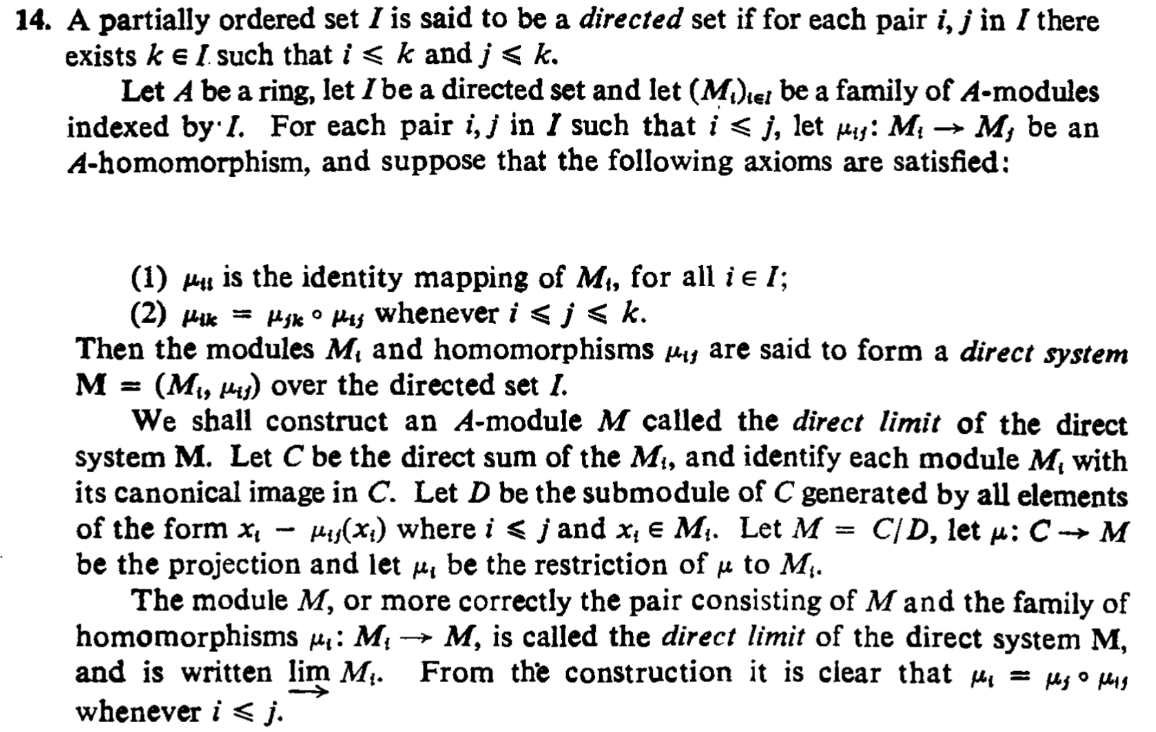
Text-Ex. 2.15. In the situation of Exercise 14, show that every element of can be written in the form for some and some . Show also that if then there exists such that in .
\begin{proof}
For any , let be the preimage of , i.e. . Since , only finitely many and we define . Notice that for any , there is . Let be the maximal element of . Since is a direct set, is well-defined. Then for each , and . It deduces that with .
If , then and so . Since , either with or with . For the former case, yields that and . For the latter one, yields that and , and then .
\end{proof}
Text-Ex. 2.16. Show that the direct limit is characterized (up to isomorphism) by the following property. Let be an -module and for each let be an module homomorphism such that whenever . Then there exists a unique homomorphism such that for all .
\begin{proof}
Define . Since , only finitely many and makes sense. Define . Note that for some , and by , . It deduces that is well-defined. For any and , we have and so for all . Now we finish the proof.
\end{proof}