Text-Ex. 2.12. Let be a finitely generated -module and a surjective homomorphism. Show that is finitely generated. (Let be a basis of and choose such that . Show that is the direct sum of and the submodule generated by .)
\begin{proof}
Let be a basis of . Since is surjective, there exist such that for . Define , which is a -submodule of . For any , can be written as with . It deduces that satisfies and . Hence, . Also note that as iff for all . Therefore, .
Because is finitely generated, we suppose , then each with and . Notice that and are -submodules of , then we have and . So is finitely generated.
\end{proof}
Text-Ex. 2.13. Let be a ring homomorphism, and let be a -module. Regarding as an -module by restriction of scalars, form the -module . Show that the homomorphism which maps to is injective and that is a direct summand of . (Define by , and show that .)
\begin{proof}
Define . Note that and are -submodules of . For any , we have and . Therefore,
yields that . Take , then and for some . Remark that with , then and so . Hence is a direct summand of .
For any , we have and , so . If , then . Therefore, is injective.
\end{proof}
Tensoring Back: Round-trip and Structure
Let be a ring homomorphism, and let be a -module. We view as an -module via restriction of scalars, then form the -module
Define by , and define by . Then
so is injective and splits. Hence,
i.e., embeds as a direct summand in .
Summary: This “pullback-then-pushforward” operation reveals that survives inside , not just as a submodule, but as a direct summand. It’s a structural reflection of how scalar restriction and extension interact.
Text-Ex. 19. A sequence of direct systems and homomorphisms
is exact if the corresponding sequence of modules and module homomorphisms is exact for each . Show that the sequence of direct limits is then exact. (Use Exercise 15.)
\begin{proof}
We aim to show, if and are direct systems and there are families and of -module homomorphisms such that
are exact for all , then the sequence of direct limits
is also exact. It suffices to show .
If , then . By Exercise 15, each element of can be written in the form . For any ,
Assume satisfies , then and so , where . By Exercise 15, each element of can be written in the form .
If , then there exists such that . By the definition of and (see exercise 18), the diagram
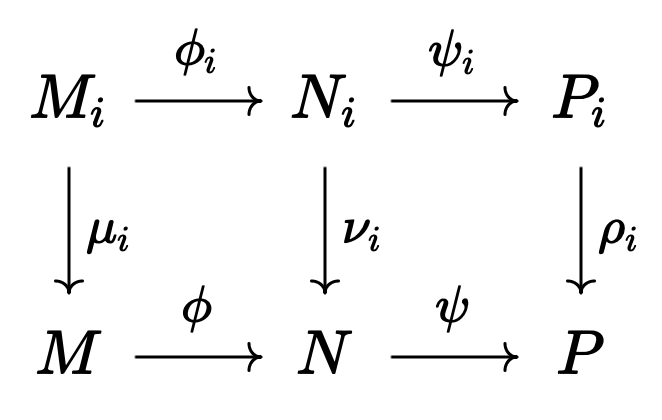
commutes. By Exercise 15, for some and then . It deduces that
Therefore, .
If , by exercise 15, there exists such that and then . Hence or for . Then with or . For the former case, and so there exists such that . Hence and so .
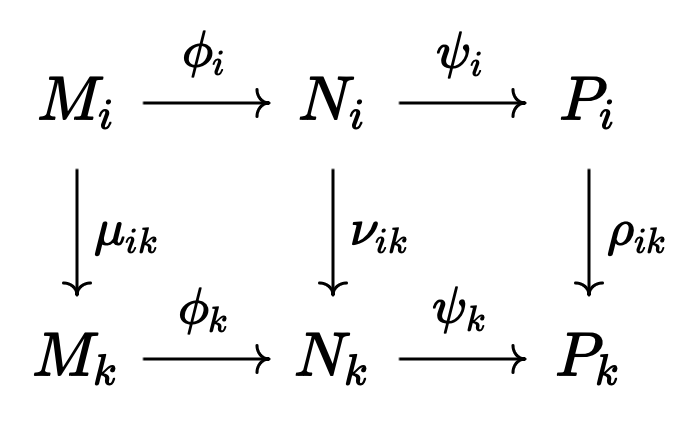
For the latter case, and so there exists such that . Hence and so . Therefore, .
\end{proof}