1. Find a representation of over which is irreducible but not one-dimensional.
Solution. Define and where . If is reducible, then there exists a vector such that for some . However, since the eigenvalues of are , does not exist. Therefore, is a irreducible representation with dimension .
\end{proof}
2. Decompose the regular representation of (left action of on ).
Solution. Firstly, assume that . Let be the -module corresponding its regular representation. Then by Maschke’s theorem, there exists such that . Since is non-abelian, it has at least irreducible module which is not one-dimensional. Note that , so with and .
Note that the trivial representation and the sign representation are two non-isomorphic one-dimensional representations, and the standard representation of is also irreducible. It follows that , are modules corresponding to trivial representation and sign representation, respectively. And are isomorphic, which correspond to the standard representation.
- ?
\end{proof}
3. Let be the dihedral group, the group of symmetries of a regular -gon.
- (i) If is odd, construct two distinct one-dimensional representations of . In is even, construct four distinct one-dimensional representations of .
- (ii) If is odd, construct distinct two-dimensional irreducible representations of . In is even, construct distinct two-dimensional irreducible representations of .
Solution. We divide the problem into parts: is odd and is even.
(i) When is odd, define and
where . Then and are two distinct one-dimensional representations of . Now consider two-dimensional representations . Note that and are similar, they have the same eigenvalues. Let . Define and . Then , are all two-dimensional irreducible representation.
(ii) When is even, define as in (i). Define by . Define by . It is easy to verify that are representations of . Thus, all one-dimensional representations of are . Similarly, let be the two-dimensional representation defined above. Then is a set of distinct two-dimensional irreducible representations.
\end{proof}
4. Show that the representations constructed in the previous exercise are all irreducible representations of the dihedral group.
\begin{proof}
Since and , the representations constructed in the previous exercise are all irreducible representations of the dihedral group.
\end{proof}
5. Let and be two vector spaces. Denote by the -vector space of linear maps . Let and be representations of in and respectively. Show that the mapping
defines structure of a module on .
\begin{proof}
If , then . To show , we only need to show that for all . Since and are representations of , we have that and . Therefore, the mapping defines structure of a -module on
\end{proof}
6. For a vector space denote by the dual space of . If is a representation of in then using the notation of previous exercise we call representation of in the dual representation of . Verify that .
\begin{proof}
Trivial.
\end{proof}
7. Show that there is a -dimensional real representation of the quaternion group for which
Show that this representation is not irreducible and determine .
\begin{proof}
Since and , we have that . Then are -invariant subspaces for and so the representation is not irreducible. Since and are not identity, we have that .
\end{proof}
8. If is a prime and is a non-trivial finite -group, show that there is a non-trivial -dimensional representation of . More general show this holds for a finite solvable group.
\begin{proof}
Since finite -group is finite, we only need to show a finite solvable group has a non-trivial one-dimensional representation. Let be a maximal normal subgroup of . If is solvable, then for some prime and for some with . Define as if . Then is a non-trivial 1-dimensional representation of .
\end{proof}
9. Let be a prime. We now consider the two maps and given by
Show that these define representations of (over and (over ). Are they irreducible? Are they indecomposable?
\begin{proof}
They are not irreducible but indecomposable.
\end{proof}
10. Let be a finite dimensional complex vector space, and let be the group of invertible linear transformations of . Show that and with are representations of . Show that they are irreducible.
\begin{proof}
The definition of (symmetric power) and (exterior power) are written as follows.

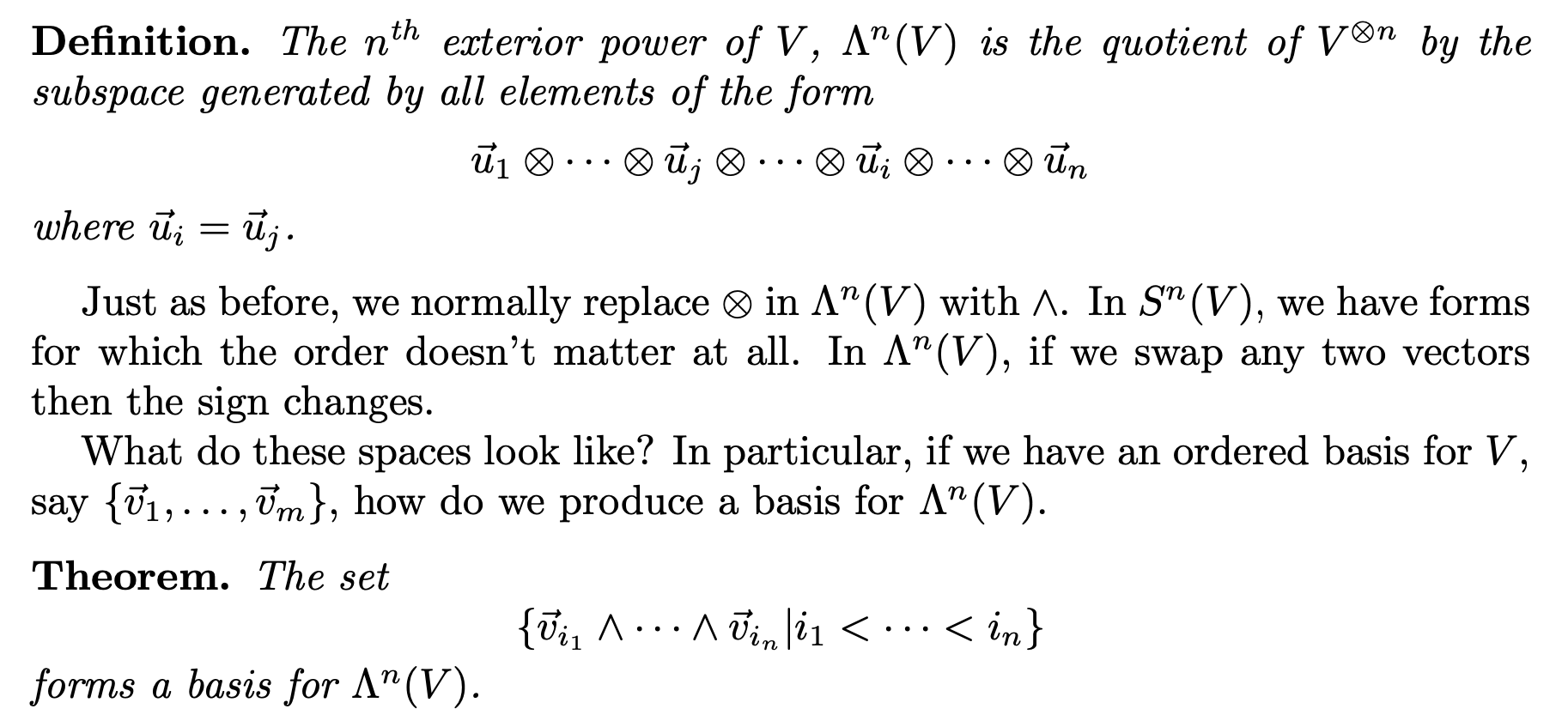
It is easy to verify they are representations of . It suffices to show they are irreducible. Note that is irreducible, as is transitive on elements of (each element determine a set of basis). Similarly, for a set of basis , the basis of is . And is a cyclic module as for any there exists such that .
\end{proof}
11. Let be a set and let be the set of -valued functions on . Consider a left action on . For every and set . Prove that is a representation of in . Define a right action by , and consider the representation of in associated with this action. Check that and are equivalent representations.
\begin{proof}
It is easy to check that is a representation. Now we show that and are equivalent representations. Note that is defined as . Since , we have that and are equivalent where the identity map satisfying for all .
\end{proof}
12. Let be a field of characteristic different from . Let be a finite group of even order and let be a subgroup of order with generator . Consider the regular representation of , which comes from the natural left action of on . Consider the action of the generator by multiplication of basis vectors on the right. Denote the and eigenspaces for this action by respectively. Show that the subspaces are -subspaces and that
Deduce that as -representations.
\begin{proof}
Assume that and , then . It is easy to verify that is a linear transformation and , then has two eigenvalues . Since the matrix of is trace , we have that . Furthermore, they are -subspaces as acts on by multiplication on the right.
\end{proof}
13. Let be an associative algebra, and let be a representation of . By one denotes the algebra of all homomorphism of representations . Show that , the algebra with opposite multiplication.
\begin{proof}
I am not sure whether we can assume has a multiplicative identity. But I do assume it anyway.
For any , we have and hence it is a right multiplication by some . Furthermore, if for every , then and so . Thus .
\end{proof}
14. Let be an irreducible finite dimensional representation of algebra , and let be any linearly independent vectors. Then for any there exists an element such that .
\begin{proof}
Assume that . Define where is a set of basis of . Since for all and is a bijection, then and are isomorphic -modules. Let be the corresponding representation. Then is a sub-module of . By ^ey40pv, we have that for some . Suppose is an isomorphisms between -modules, then by Proposition 2.2 there exists a matrix such that for all .
Note that there exists a non-zero vector such that . It follows that for any , . Take , then , which contradicts with linearly independent. Thus and so is surjective. For any , there exists such that . Then there is an such that and . Now we finish the proof.
\end{proof}
- 15. Let be an algebra over a field . The center of is the set of all elements which commute with all elements of . Show that if is an irreducible finite dimensional representation of , then any element acts in by multiplication by some scalar . Show that is a homomorphism.
16. Let . Show that the only irreducible representation of is , and every finite dimensional representation of is a direct sum of copies of .
\begin{proof}
For every , let be the matrix with in the th row of the th column and ‘s everywhere else. Let be a finite dimensional representation of .
For any , since , we have that . Assume that for some . It follows that and so for any . Therefore, . In addition, it is easy to verify that is an isomorphism for every by invertible.
For every , denote . Then is a sub-representation of isomorphic to . Let be a basis of , then is a direct sum of copies of .
\end{proof}
Exercise 1. If is a morphism of two -modules, then is a submodule of and is a submodule of .
\begin{proof}
Let and be representations of in and , respectively.
i) For any and any , we have that . Thus for all . Therefore, is a submodule of .
ii) For any , there exists such that . Then for any , . It yields that for all . Therefore, is a submodule of .
\end{proof}
Exercise 2. Suppose , are representations of in and , respectively. Define as . Show that is a representation in .
\begin{proof}
Assume that and , then . Let , be bases of and , respectively. Then there is a basis of such that . For any ,
and so . Also, it is easy to verify . Therefore, is a representation in .
\end{proof}
Exercise 3. Suppose is a -module. Let , and let is a representation of on . For any , define . Prove that:
- is a representation of in .
- If , then and .
\begin{proof}
i) For any and any ,
In addition, we have that and so . Therefore, is a representation of in .
ii) Since , we assume that and is a basis of . For , define as , where is the Kronecker delta. If there exist such that , then for all . Thus are all zero and so are linear independent. Note that for any with , there is . So is a basis of . Therefore, .
Define as . It is easy to verify that is a linear transformation. Since is bijective, then is an isomorphism and so .
\end{proof}