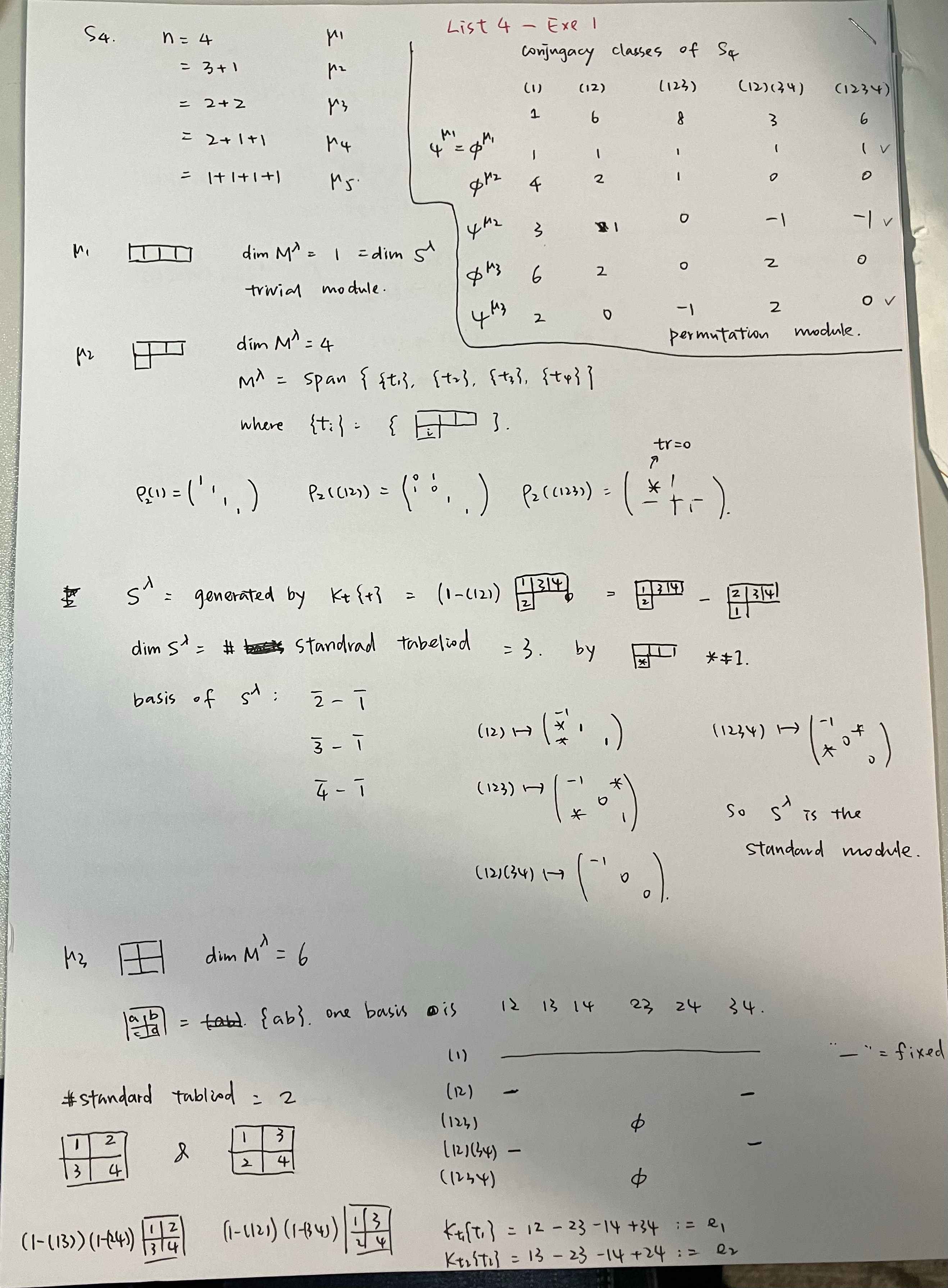
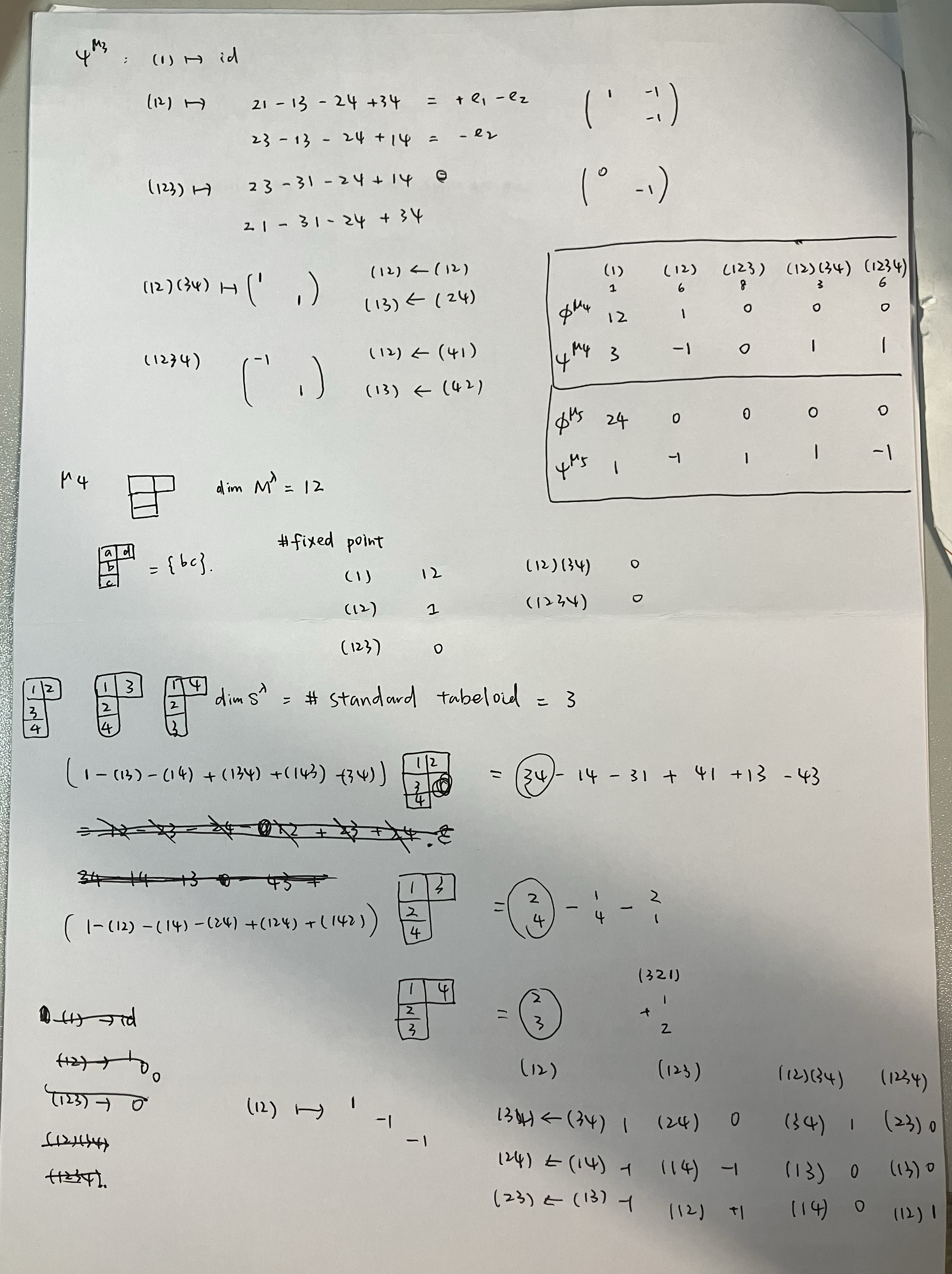
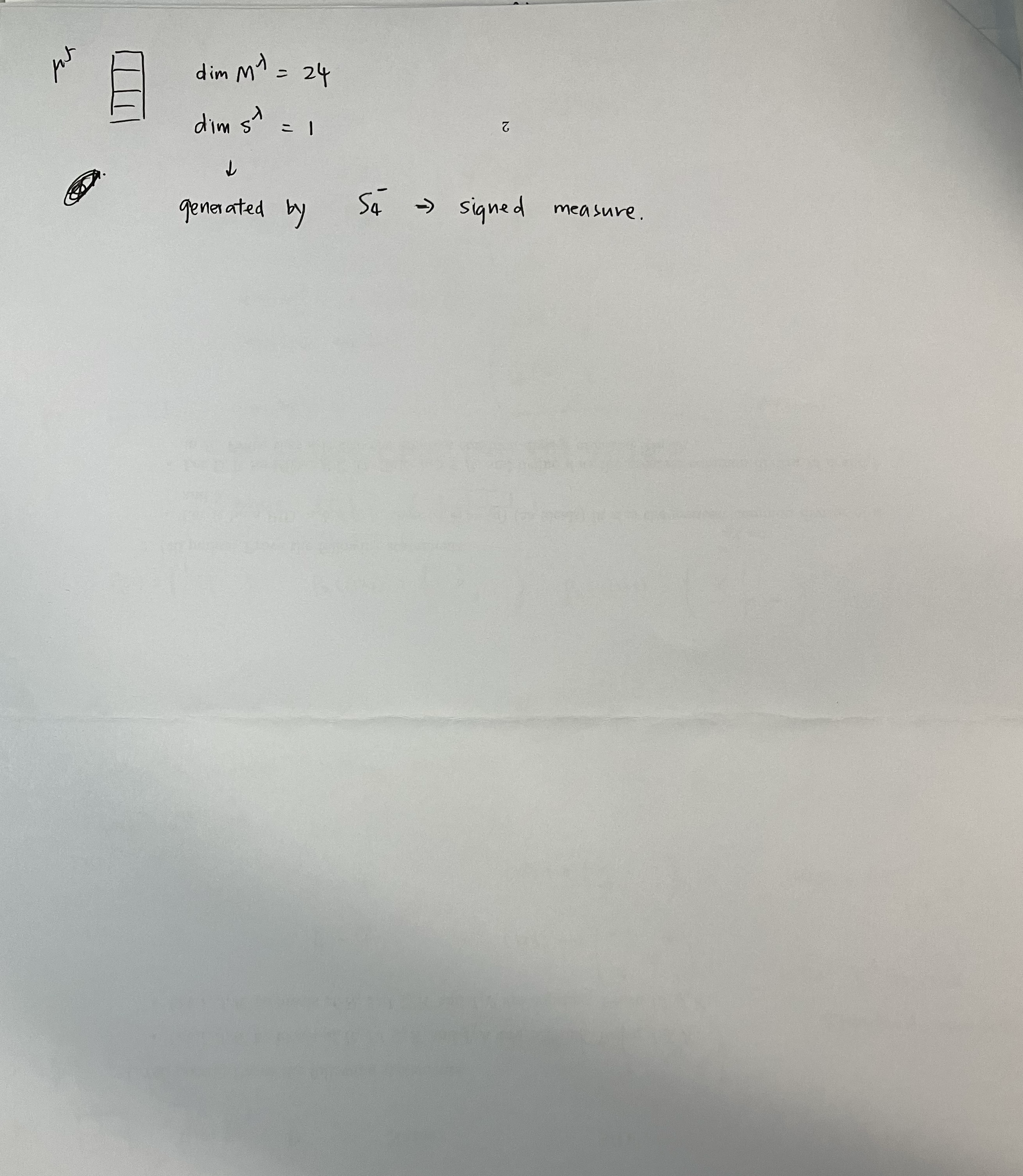
1. Find the characters of all permutation modules of and write the irreducible decompositions for all in terms of the Specht modules .
Pasted image 20241201232419.png
Pasted image 20241201232429.png
Pasted image 20241201232403.png
2. Use a basis of polytabloids of the Specht module to calculate representation matrices for representatives of all conjugacy classes in .
Note that there are two standard tableaus, then . Define
then where and . With this basis, the representation matrices are
3. For any Young diagram denote by the number of boxes in column of for all , where . Then is called the conjugate diagram to .Suppose that . Prove that if and only if .
\begin{proof}
Assume that and . By induction on , it suffices to show . If it holds, then consider the Young diagrams and with ‘s and disregarding the zeros in it. We still have and then . Additionally by , we have .
Now we prove . Lab each position of and from to sequentially, row by row. Then the elements of first column of and are and . As , for any we have . As these elements are less than or equal to , we have
and so .
\end{proof}
4. The aim of this exercise is to compute the character table of . For a partition let be the character of the permutation module . Compute for all partitions of 5. By taking inner products of characters find the character table of .
Note that , then there are partitions of , which are denoted by , respectively.
By ^i3a31d, we can compute as follows.
- and . Hence .
- and . We can compute that .
- . We can compute that , , and then get .
Repeat this procedure, then we get
| 1 | 10 | 20 | 15 | 30 | 20 | 24 | |
| 1 | 1 | 1 | 1 | 1 | 1 | 1 | |
| 5 | 3 | 2 | 1 | 1 | 0 | 0 | |
| 10 | 4 | 1 | 2 | 0 | 1 | 0 | |
| 20 | 6 | 2 | 0 | 0 | 0 | 0 | |
| 30 | 6 | 0 | 2 | 0 | 0 | 0 | |
| 60 | 6 | 0 | 0 | 0 | 0 | 0 | |
| 120 | 0 | 0 | 0 | 0 | 0 | 0 | |
| 1 | 1 | 1 | 1 | 1 | 1 | 1 | |
| 4 | 2 | 1 | 0 | 0 | -1 | -1 | |
| 5 | 1 | -1 | 1 | -1 | 1 | 0 | |
| 6 | 0 | 0 | -2 | 0 | 0 | 1 | |
| 5 | -1 | -1 | 1 | 1 | -1 | 0 | |
| 4 | -2 | 1 | 0 | 0 | 1 | -1 | |
| 1 | -1 | 1 | 1 | -1 | -1 | 1 |
This is used to compute inner products.
\end{proof}
5. Consider the 5-dimensional Specht module over .
- a). Calculate the representation matrices for all four generators of in the basis of standard polytabloids with , where
- b). By the branching rule, the restriction of to the subgroup is a direct sum of two submodules, . Find basis vectors of each of the submodules and in the form of linear combinations of standard polytabloids.
\begin{proof}
a) By ^b2c5aa, we have and it deduces that
b) By ^5voxbj,
Since the set of standard polytabloids is a basis of a Specht module, there are bases
for and , respectively, where
Now we finish the solution.
\end{proof}
**6. Prove the followings.
- a). For variables set and prove the identity
where is another variable.
- b). If is a partition of , set for . Use the previous part to show that the numbers
satisfy the recurrence relation
- c). Hence prove by induction that the number of standard tableaux of shape is given by
(This also proves the hook length formula).
\begin{proof}
a) Notice that the coefficient of of LHS is where
For each fixed , there are two terms with denominator , that is, and . In , there are terms and they form pairs in the form of . It deduces that the coefficient of of LHS equals . In addition, it is easy to show when the equality holds, and so the constant parts of LHS and RHS are equal. Thus, it suffices to show the coefficients of with is equal to .
For any , the coefficients of is the sum of the following elements
and the sum of the terms in containing is
and we claim that it equals . To show it, it suffices to show
which can be proved by
Therefore, the coefficients of with is . Now we finish the proof.
b) By a) there is
as .
c) For a standard tableaux of shape , we assume that with and . Define . We aim to show
where . We use induction on to prove this.
If , then and coincide. Now we assume that , so and . For a standard tableaux of shape , it is easy to verify the recurrence relation
because and we get a standard tableaux with blocks if is removed. Note that . Then by induction hypothesis,
where . Now we finish the proof.
\end{proof}
Remark. Maybe with some values, is not defined. But I believe it can be avoided by extending suitably.
7. Prove the determinant formulas connecting symmetric functions:
and
\begin{proof}
i) By the Newton identity, and it deduces that
ii) Still by the Newton identity, we have . Define
and denote column vectors of as . Then there is
and so
iii) & iv) Similarly, there is . Use the same method we can finish the proof.
\end{proof}
8. a) Show that for a partition
where .
b) Deduce that
(This number coincides with the dimension of the irreducible representation of the group associated with .)
\begin{proof}
a) Define , then
where for . Then by Vandermonde matrix, we have
where . Note that
as .
b) Note that
then by a) we get .
\end{proof}
9. Since the generators of the algebra of symmetric functions are algebraically independent, we can specialize them in an arbitrary way and forget about the original variables . In other words, we can take the generating function to be an arbitrary power series in with the constant term 1 for the relations between symmetric functions to remain valid.
- a) Show that
is the generating function for the sequence , where is the number of partitions of .
- b) By Euler’s pentagonal number theorem, for the generating function we have
Deduce the recurrence relation
where .
\begin{proof}
a) Assume that . Each element in LHS with degree can be written as , and it corresponds to a partition where is written as a sum of integers , where the number of s is , the number of ’s is , and so on. Note that it is a 1-1 corresponding to elements in LHS and partitions, so is the generating function for the sequence , where is the number of partitions of .
b) Note that . The coefficient of in is
and so .
\end{proof}