Lecture Notes: Prof. Efim Zelmanov on Jordan Algebras and Exceptional Lie Algebras (December 17, 2025).
Preliminary
The Cayley-Dickson Construction
The foundation begins with the sequence of division algebras:
Remark that octonions are the largest normed division algebras, which is non-associative.
Derivations and Inner Derivations
Recall that we defined derivations before.
Link to original(ab)\mathcal{D} =(a\mathcal{D} )b+a(b\mathcal{D} ).
Inner derivations are derivations constructed specifically from the multiplication operators of the algebra itself.
Case 1: Lie Algebras For a Lie algebra , the inner derivation is defined by the adjoint action: . A classical result states that for any semi-simple Lie algebra, all derivations are inner, i.e., .
Case 2: Non-associative / Jordan Algebras For a non-associative algebra (such as a Jordan algebra), we typically define inner derivations using the commutators of multiplication operators. Let denote the left multiplication operator (). We define the generator:
By ^70d2f4, we know the span of all such operators
is a Lie algebra.
Examples: from Jordan Algebra to Lie Algebra
Derivations of Octonions:
Note that . The group of symmetries (automorphisms) of the Octonions forms the exceptional Lie group , whose dimension is .
Derivations of the Albert Algebra:
Recall the Albert algebra
where and . Hence, we know .
Link to original
The trace of is . Although the algebra is non-associative, the trace form is associative, i.e. .
This invariance is crucial for the algebraic structure. The derivations (infinitesimal symmetries) of the Albert Algebra form the exceptional Lie algebra , that is,
where inner derivations is defined by commutators of multiplication operators
and its dimension is .
From Lie Algebra to Jordan Algebra: the TKK Construction (Tits-Kantor-Koecher)
Assume the Lie algebra contains an -triple satisfying
The adjoint action of , i.e. induces a short grading (3-grading) on
where .
Define the Jordan product as follows. We focus on the space (the “top” component), and take an element (from the “bottom” component) as a pivot. For any vectors , define a new product
then the bracket lands in , and .
J. Tits, 1962
- The pair forms a Jordan Algebra.
- This establishes a one-to-one correspondence between Jordan algebras and certain graded Lie algebras.
Remark. This explains why the “top corner” of the Exceptional Lie Algebras (like the structure acting on the 56-dimensional space) often reveals Jordan algebra structures.
Method 1: the TKK Algebra
Recall that
Define and (Jordan triple product).
Link to original
In fact, the triple product of Jordan algebra is defined as
Furthermore, if the Jordan algebra is special, then and .
Motivation: Rectangular Matrices
Consider a linear space spanned by matrices. We cannot multiply two such matrices directly, but we can define a triple product using the transpose , and the corresponding triple product is
It makes a Jordan triple system, even though it is not a Jordan Algebra.
Jordan Pairs
Instead of a single space, we have a pair of spaces acting on each other via the triple product:
Constructing the Lie Algebra (the TKK Algebra)
Now we construct a Lie algebra from a Jordan pair.
Define as
For and , we define their Lie bracket to be an operator in the middle layer . Physically, represents the inner derivation generated by these elements.
The middle layer acts on the top layer via Jordan triple product, that is, we define the Lie bracket as . A similar action applies to .
Method 2: Tits Construction
Generic Norms and Traces
Recall that Octonions are non-associative. We define the associator to measure this failure
Although associators of and are non-zero, we can still define generic trace and generic norm such that Cayley-Hamilton theorem holds.
Rank 2: The Octonions is non-associative but alternative, and its trace satisfies , it has a characteristic equation
Rank 3: The Albert algebra is a commutative (Jordan) algebra, and it has a characteristic equation
The Trace-Zero Subspaces ( and )
To construct the Lie algebra, we need to decompose the algebras into their scalar parts (trace) and vector parts (trace-free).
For the Composition Algebra (Rank 2, e.g., ), define the trace-zero subspace
and define a product by projecting the standard multiplication onto the trace-zero space
When , has dimension .
For the Jordan Algebra (Rank 3, e.g., ), Define the trace-zero subspace
When , has dimension .
Tits Construction of
Define , , and define as the trace-zero subspaces of and . Then we have
where
- has dimension ,
- has dimension ,
- has dimension .
Therefore, the dimension of is , which perfectly matches the dimension of .
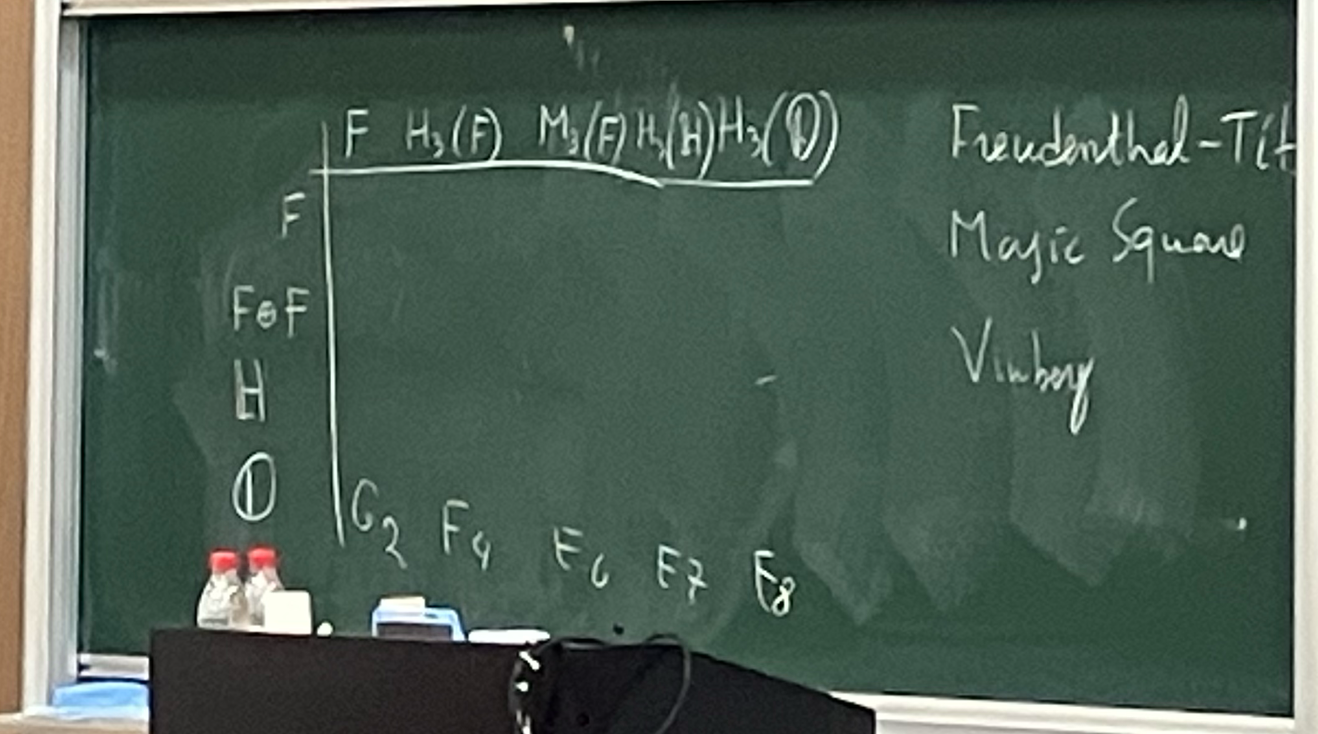
The Freudenthal-Tits Magic Square
The construction above is not limited to . By varying the composition algebra and the Jordan algebra in the Tits construction formula
we can generate all the exceptional Lie algebras.
This classification is visualized in the Freudenthal-Tits Magic Square.