Recall the definition of left -module.
Link to original
- .
Similarly we can define right -module, where . A left module can be converted to a right module and vice versa, by considering . In particular, if is commutative, then a left module is also a right module.
For any , define . Then is a group homomorphism and . It deduces that
is a ring homomorphism. It is a motivation of the following theorem.
Theorem
Let be an abelian group. Then is an -module iff there is a ring homomorphism .
Example. If is an ideal of , then is a left -module. In particular, is a left -module and -submodule is an ideal of .
Submodule
Definition
Let be -submodule of . Then is an -submodule of . Define
and it is a -submodule. For any subset , define
and it is also a -submodule.
Facts.
- A submodule of finitely generated module may not finitely generated. Similarly, recall that subring of Noetherian ring is not Noetherian.
- A ring is a -module itself. Its submodules are just its ideals. Let us consider and . Note that is finitely generated by and is not finitely generated.
- If is a Noetherian ring, then all submodule of a finitely generated module is finitely generated.
Quotient Module: Universal Property
Proposition
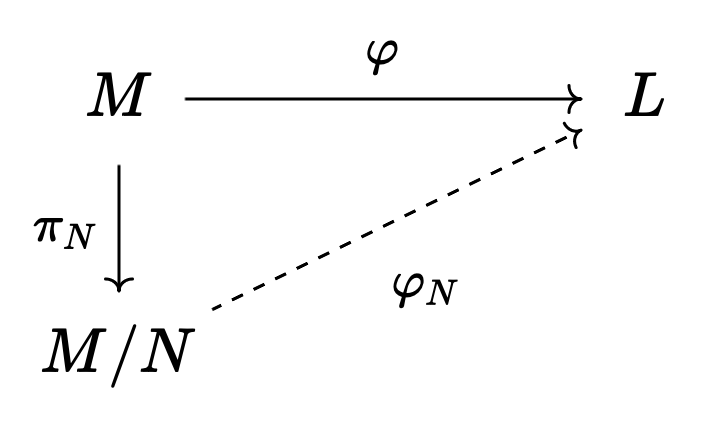
Let be an -module, and let be an submodule of . Let be an -module and a morphism such that . Then there exists a unique morphism such that the following diagram commutes.
Moreover, .
Remark. Modules and are defined as above. The pair is unique in the following sense. If is a pair such that
-
is an -module
-
is a surjective morphism satisfying and the property of described as above proposition, that is, for any morphism with , there exists a unique morphism such that the diagram
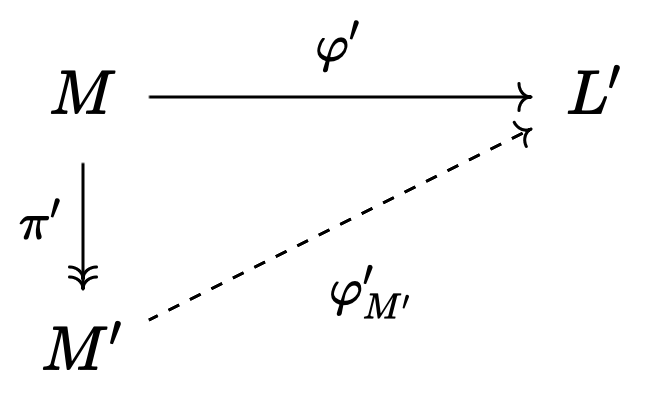
commutes.
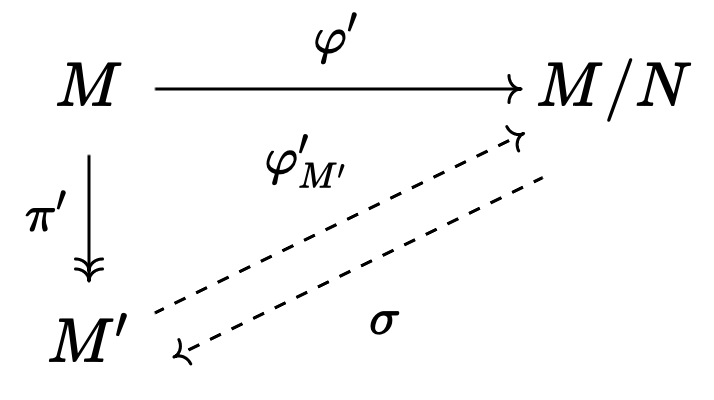
Take , then there exists a unique isomorphism such that the following diagram commutes, where .
Definition
Let be a -homomorphism. Define and . Furthermore, there exists a unique isomorphism such that the following diagram commutes.
Definition
Let be an -module, and let be an ideal of . Denote by the submodule of generated by .
Proposition
Let be a -module.
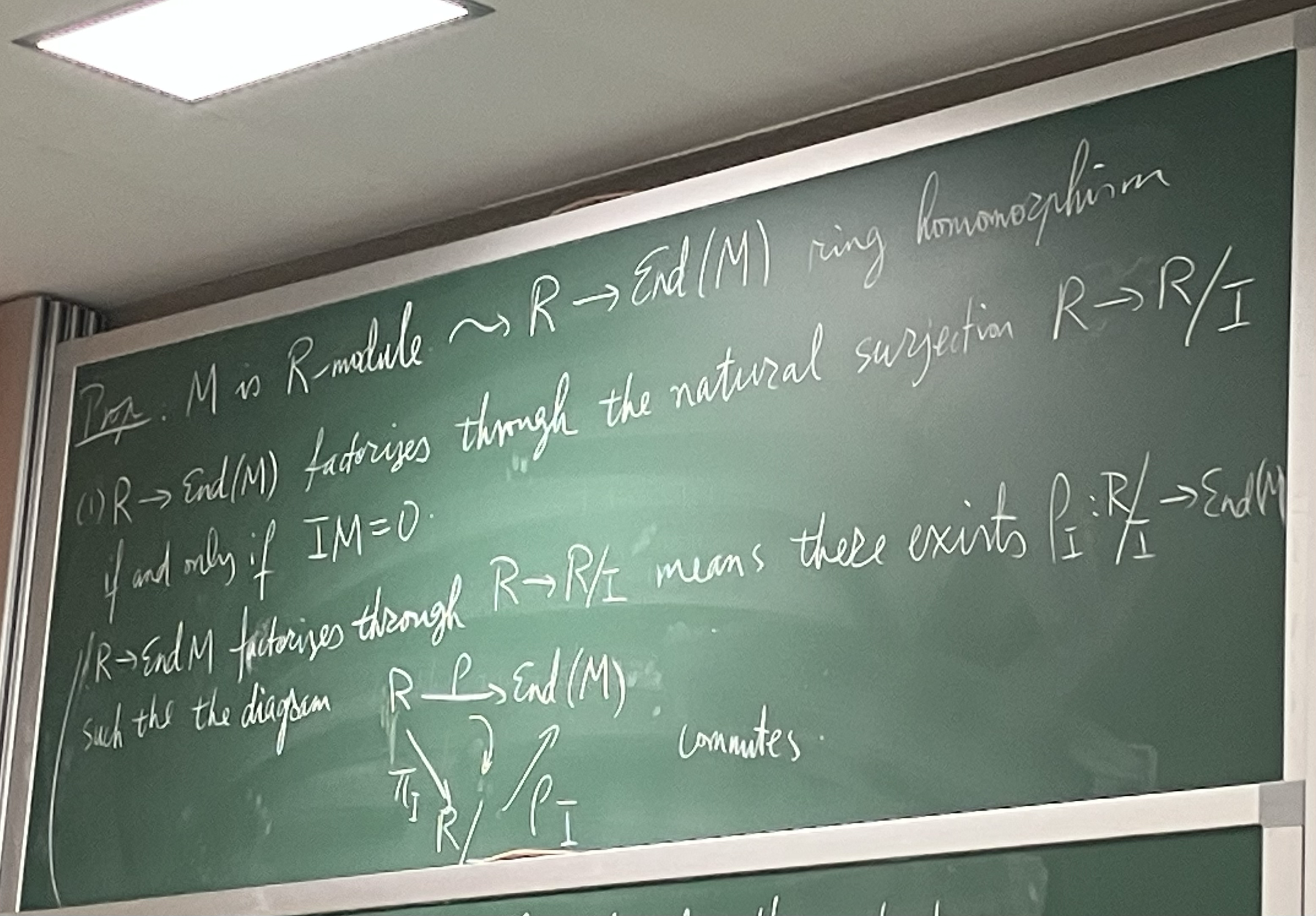
- factorizes through the natural surjection iff . See here.
- The module is naturally endowed with a structure of -module.
- Let be an -homomorphism, then and induces a morphism of -modules .
\begin{proof}
See ^xy300k.
\end{proof}
Free Module
Theorem
Let be a commutative ring with , and let be a finitely generated free -module. Then any basis of has the same cardinality.
\begin{proof}
See ^n0vjji.
\end{proof}
Definition
Let be a set. Write and . Let be a -module. Take , be a family of elements of . The submodule generated by also denoted by . Then we have a morphism of -modules
Then
- injective iff are linearly independent
- surjective iff , generate
- isomorphism iff is free with a basis
Lemma
Let be a free -module with basis . For any -module , the map is a bijection.
Proposition
Let be a free -module.
- Let be an epimorphism of -modules. For any -morphism , there exists a morphism such that the diagram commutes.
- In particular, for any -module , any epimorphism has a section, that is, there is a morphism such that . In that case, is injective, and .
\begin{proof}
See ^03hqr6.
\end{proof}
Definition
Let be a module. If , then is called a direct summand of .
- We say nonzero is simple if has only two submodules and .
- We say is indecomposable if cannot express as with and .
Let be a direct summand of a free -module. Show whenever is an epimorphism and is a morphism, there exists unique such that the diagram commutes.
Tensor Product
The tensor product of two modules and “linearizes the bilinear map”.
Definition
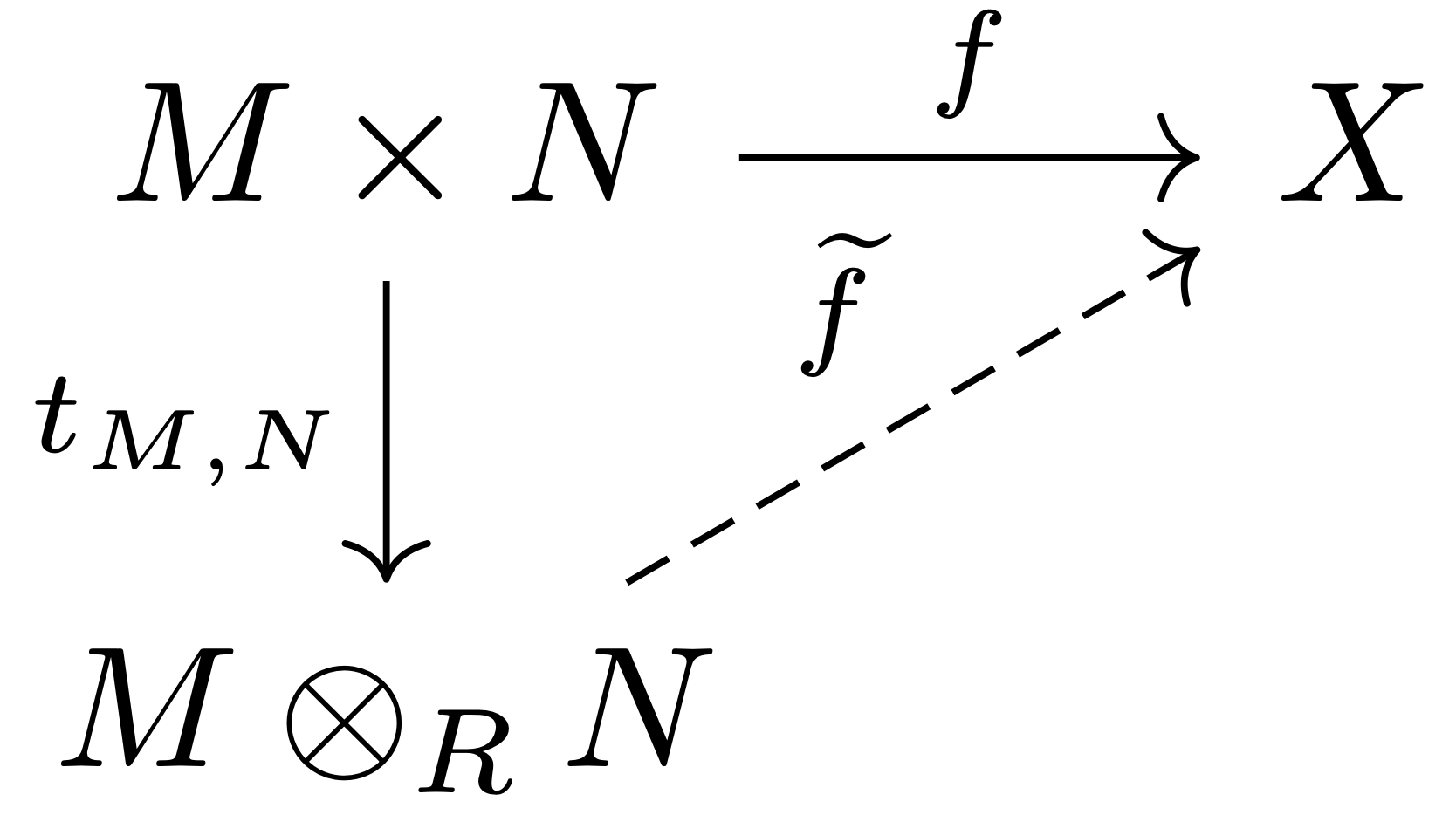
Let and be -module. The tensor product of and is pair where is an -module and is a bilinear map, usually denoted which satisfies the following universal properties: whenever is a -module and is a bilinear map, there exists a unique -morphism such that the following diagram commutes
Remark. Up to isomorphism, tensor product is unique.
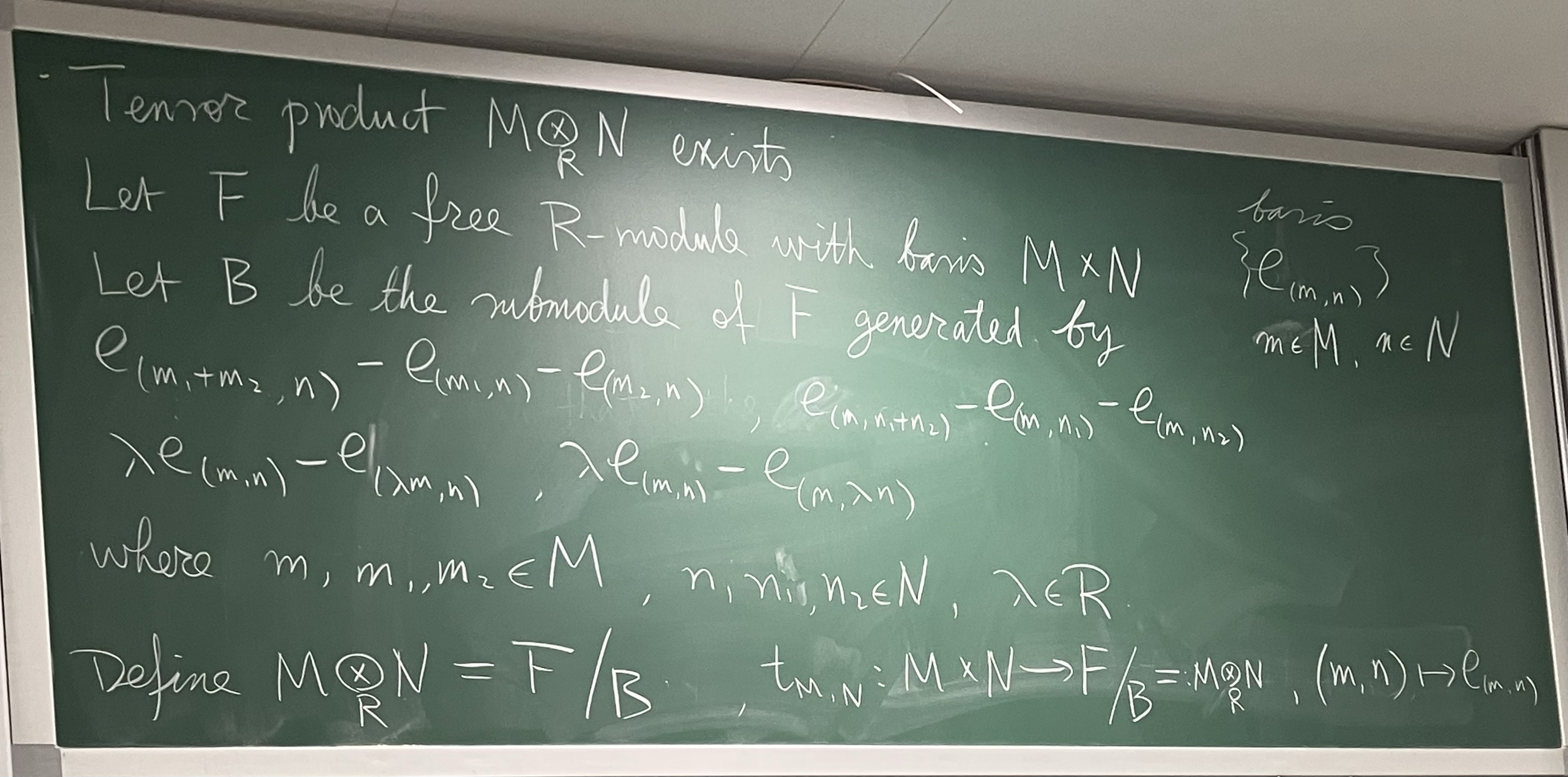
Existence of tensor product: See here.
Proposition
Fix , then the map is a morphism of -modules. Its image is a submodule of , is isomorphic to a quotient of .
Proposition
We have unique isomorphisms
- and ;
- ;
- ;
- and .
Theorem
Let be -module, we have a canonical isomorphism , where , and for any .
Remark. The meaning of “canonical” is 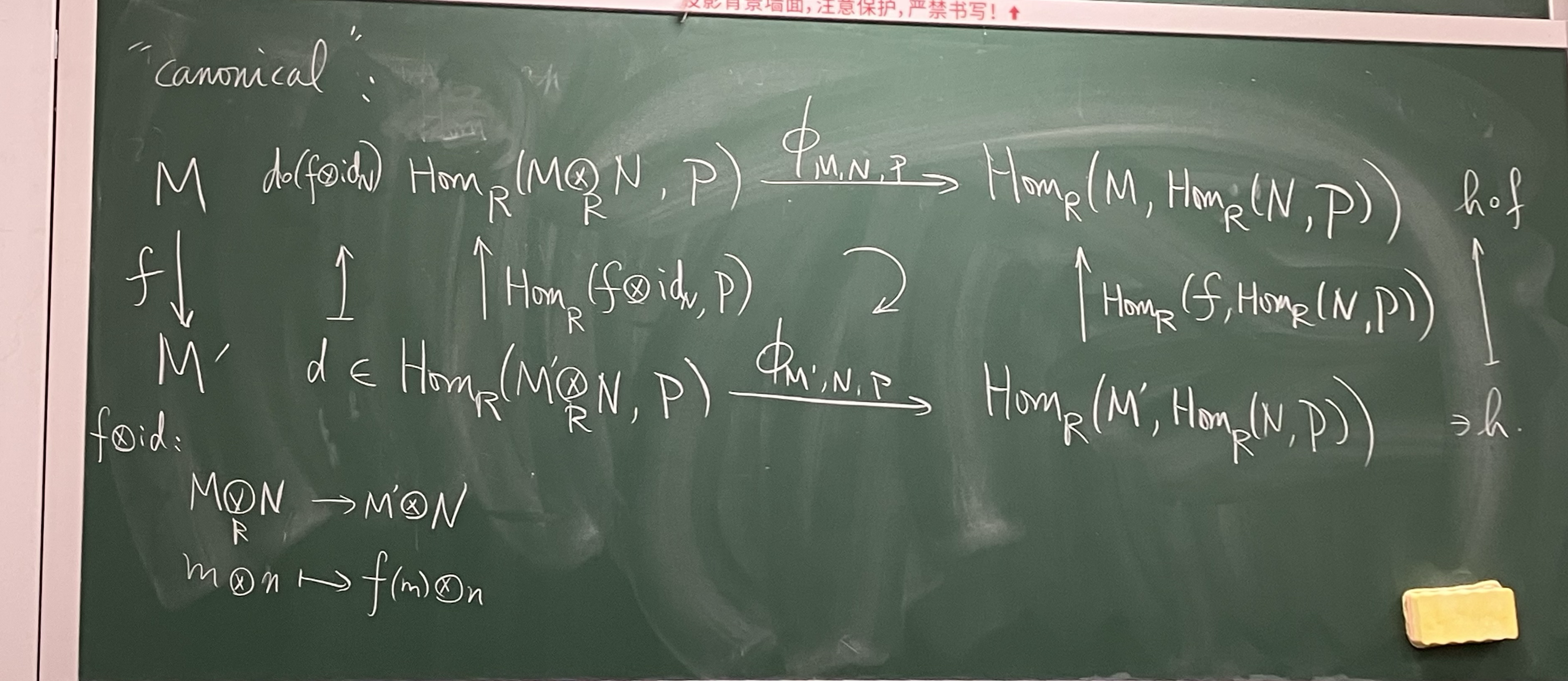
Definition
Define
In particular, .
Proposition
Let be finite generated free -module. Define , then .
\begin{proof}
See ^ahhdq2.
\end{proof}
Proposition
- Assume that is a subring of a ring . Let be an -module. Then the bilinear map defines a structure of -module on the -module .
- More generally, let be a ring homomorphism. View as an -module defined by . The bilinear map defines a -module structure on the -module .
Example. Let be an -dimensional -space, i.e., , then .
Lemma
Let be an ideal of and let be an -module. The morphism of -module induces an isomorphism .
CounterExample. See here.
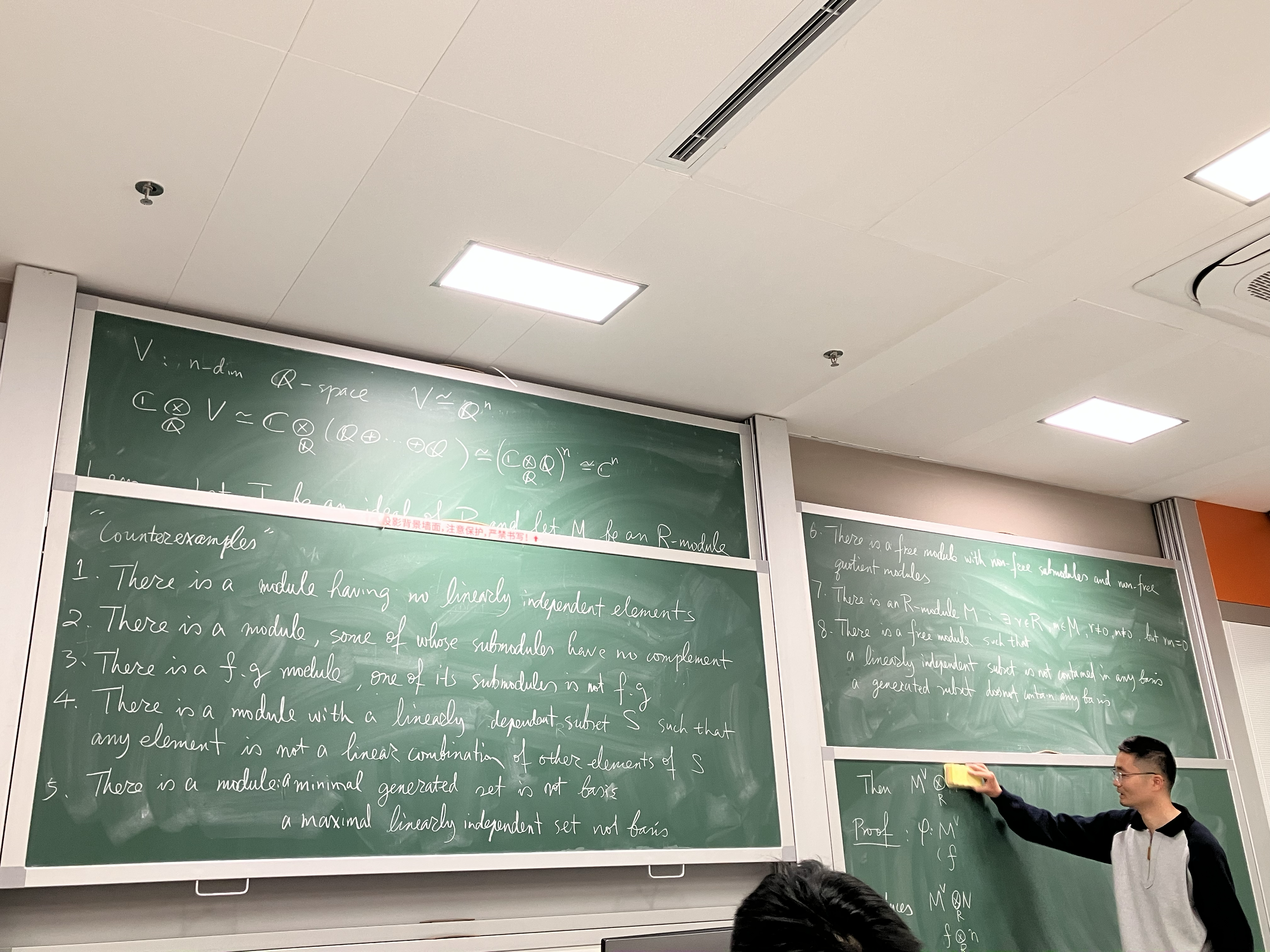
- There is a module having no linearly independent elements.
- There is a module, some of whose submodules have no complement.
- There is a finitely generated module, one of its submodule is not finitely generated.
- There is a module with linearly independent subset such that any element is not a linear combination of other elements of .
- There is a module: a minimal generated set is not basis, and a maximal linearly independent set not basis.
- There is a free module with non-free submodules and non-free quotient modules.
- There is an -module : there exists , with such that .
- There is a free module such that
- linearly independent subset is not contained in any basis;
- a generated subset does not contain any basis.
Categories
Definition
A category consists of
- a class of object;
- for each pair , a set , whose elements are called morphisms from to ;
- for each triple of objects one has a map .
It is assumed that the objects and morphisms satisfy the following conditions.
- If , then and are disjoint.
- If and , , then .
- (Unit) For every object , we have an element such that for any and for any .
Example. See here.