Noetherian and Artinian
Link to original
- Every submodule of is finitely generated.
If the -module satisfies condition in ^4af1b0, then we say is a Noetherian ring.
Link to original
Lemma
For an -module , TFAE:
- Every decreasing sequence of submodules is stationary.
- Every non-empty family of submodules has a minimal elements.
Say the ring is a Noetherian ring (rep. Artinian ring) if is a Noetherian (rep. Artinian) -module.
Link to original
Remark. If is a Noetherian (or Artinian) module, we also say that satisfies the maximal (or minimal) condition on submodules.
Link to original
- is Artinian iff and are Artinian.
If are Noetherian (Artinian) -module, then so is .
Link to original
If is Noetherian, then any finitely generated -module is a Noetherian -module.
Link to original
Composition Series of Modules
Say its length is . Say a chain is a composition series if no extra submodule can be inserted, that is, is a simple module for all .
Link to original
has a finite length composition series iff is Noetherian and Artinian.
Link to original
Theorem
Fact (Jordan-Holder theorem for modules of finite length). if and are any two composition series of , there is a one-to-one correspondence between the set of quotients and the set of quotients , such that corresponding quotients are isomorphic. The proof is the same as for finite groups.
Link to original
Schur Lemma and Socle
Schur lemma
Let and be simple -modules. Then unless in which case the endomorphism ring is a division ring.
Lemma
Let be a ring with identity . Suppose that is an -module that can be expressed as the sum of finitely many simple submodule. If is any submodule of , then there is a subset such that .
In particular, is a direct summand of , and is semisimple.
Theorem
Let be an -module. TFAE:
- is semisimple;
- is a sum of simple -modules;
- any -submodule of is a direct summand of .
\begin{proof}
See here.
\end{proof}
Corollary
Let be the -module with composition series of finite composition length.
- The sum of all the simple submodule of is a semisimple module that is the unique largest semisimple submodule of .
- The sum of all submodules of isomorphic to some given simple module is a submodule isomorphic to a direct sum of copies of . It is the unique largest submodule with this property.
Definition
The unique largest semisimple submodule of is called the socle of , denote .
Corollary
Let be a semisimple submodule where the are non-isomorphic simple -modules. Then each submodule is uniquely determined and characterized as unique largest submodule of expressed as a direct sum of copies of .
Theorem
Let be a ring with . Let be a direct sum of simple -modules such that for any . Then is isomorphic to the full matrix ring of degree over the division ring .
Projective Cover
Definition
An epimorphism of modules is called essential if no proper submodule of is mapped surjectively onto by . Equivalently, whenever is a map such that is an epimorphism, then is an epimorphism.
Definition
A projective cover of a module is an essential epimorphism where is projective.
Remark. Projective cover does not always exist.
Proposition
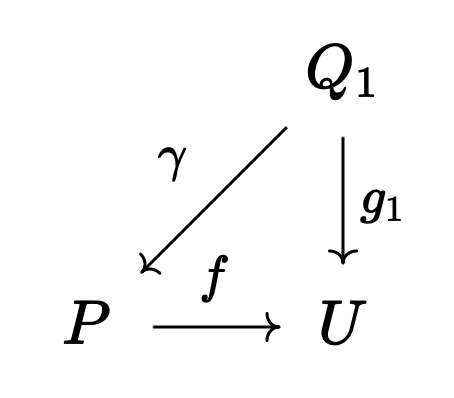
Suppose that is a projective cover of a module and is an epimorphism where is projective. Then so that has the component with respect to the direct sum decomposition and satisfies that the diagram commutes
where is an isomorphism.
If any exists, the projective covers of a module are all isomorphic, by isomorphisms that commute with the essential epimorphism.
\begin{proof}
See ^9so7ao.
\end{proof}