1. Let be an Artinian ring. Then there are only a finite number of maximal ideals, and the intersection of them coincides with .
\begin{proof}
Since is semisimple, it is a direct sum of finitely many simple Artinian rings. Thus, has finitely many two-sided ideals. Recall that the ideals of is - corresponds to the ideals of containing . Thus, to show has finitely many two-sided maximal ideal, it is enough to show each maximal two-sided ideal contains . By definition, is the intersection of all left maximal ideals of .
Assume that there exists a two-sided maximal ideal such that . Then . Since is a proper two-sided ideal, is also a proper left ideal and so it is contained in some maximal left ideal . Remark that and , which is a contradiction. Therefore, all two-sided maximal ideals of contain . We have proved that has finitely many maximal ideals.
Define as the intersection of all two-sided maximal ideal. By the argument above, we have . On the other hand, each two-sided maximal ideal is contained in a left maximal ideal, which deduces that .
Therefore, , i.e., the intersection of all two-sided maximal ideals coincides with .
\end{proof}
2. If is an epimorphism of rings, then .
\begin{proof}
For any , has left inverse for all , i.e. there exists such that . It deduces that has left inverse of all . Since is epimorphism, has left inverse for all . Therefore, and so .
\end{proof}
3. Let be a finite-dimensional algebra over a field. Suppose that is an -module, and that a certain simple -module occurs as a composition factor of with multiplicity . Suppose that there exist nonzero homomorphisms and . Prove that is a direct summand of .
\begin{proof}
Define and , then are -submodules of . Since is simple, and . It deduces that and is an -submodule of . We aim to show . If , then has an -submodule isomorphic to . It is impossible because and occurs as a composition factor of with multiplicity . Therefore, . Furthermore, yields that . Now we finish the proof.
\end{proof}
4. Suppose that , and are modules for a finite-dimensional algebra over a field and is the projective cover of . Assume that these modules are finite-dimensional.
- (a) Show that is an essential epimorphism if and only if there is a surjective homomorphism so that the composite is a projective cover of . In this situation, show that must be a projective cover of .
- (b) Prove the following “extension and converse” to Nakayama’s Lemma: let be any submodule of . Then is an essential epimorphism .
\begin{proof}
a) Assume that is an essential epimorphism. Since is a projective cover, there exists such that . Then by ^q7sonb, is also essential. If is not surjective, then and , which contradicts with being an essential epimorphism.
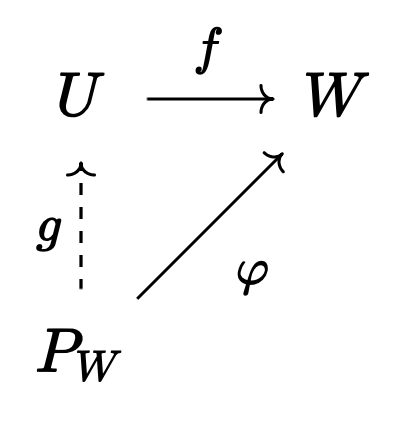
Conversely, assume that there is a surjective homomorphism so that the composite is a projective cover of . We aim to show is essential. If there exists such that , then . Since and is a projective cover, we have , which is a contradiction. Thus, is an essential epimorphism.
b) Assume that is an essential epimorphism. If there exists , then there exists a maximal submodule such that . It deduces that . Since is an essential epimorphism and , one have , which is impossible.
Conversely, assume that . We aim to show is an essential epimorphism, that is, for any , if , then . Otherwise, there exists with . Then there is a maximal submodule , and by , which is a contradiction. Thus, if is a submodule of such that , then . Now we finish the proof.
\end{proof}
Remark. The propositions used in exercise 4 is as follows.
Link to original
- Let be homomorphisms of Noetherian modules for , then are all essential epimorphisms iff is an essential epimorphism.