Spectrum
Definition
Let be a graph (directed or undirected, simple or with loops), and let be its adjacency matrix. We call the characteristic polynomial of graph (and sometimes write it as ), and we call all the eigenvalues of the spectrum of graph .
One can easily notice that, for a -regular graph , the followings hold:
- is an eigenvalue of ;
- If is connected, the multiplicity of is 1;
- For any eigenvalue of , we have .
Proposition
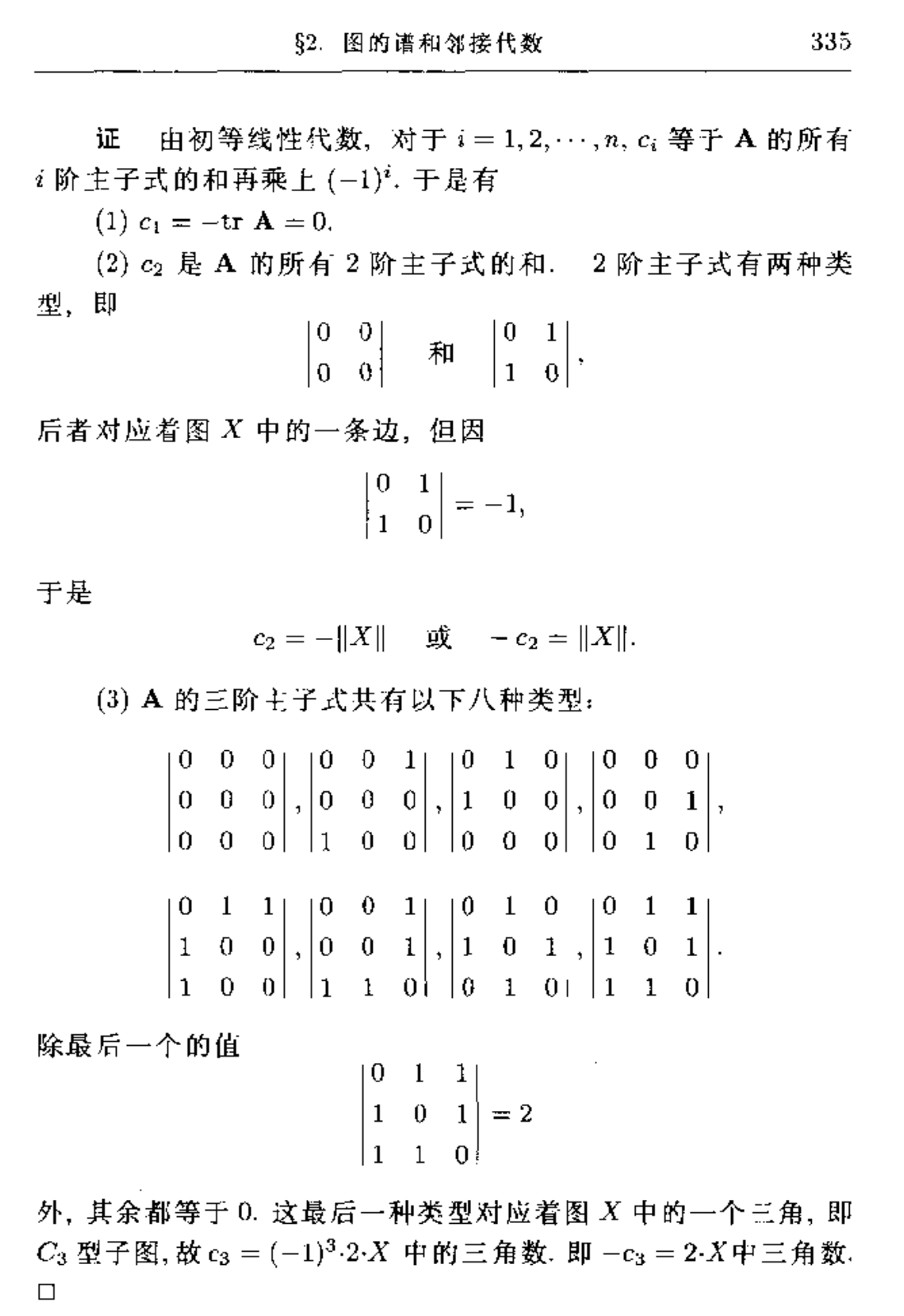
Let be the characteristic polynomial of a simple undirected graph . Then,
- ;
- ;
- is twice the number of -type subgraphs in .
\begin{proof}
See here.
\end{proof}
Proposition
Let be a positive integer. Then the -th entry of is equal to the number of paths of length from vertex to vertex .
\begin{proof}
We use induction on .
When , the conclusion follows directly from the definition of . When , because
by the induction hypothesis, we obtain the conclusion.
\end{proof}
Adjacency Algebra
Definition
Let be the adjacency matrix of a graph . Let
Then is a subalgebra of the full matrix algebra , called the adjacency algebra of graph (with respect to its adjacency matrix ).
Note that is equal to the degree of the minimal polynomial of , and is less than (number of points of ). Furthermore, we have the following proposition.
Proposition
Let be a connected graph, and let be the diameter of . Then .
\begin{proof}
We only need to prove that are linearly independent in . Since is connected and has diameter , we must have . There also exist two vertices such that , and there is a path of length from to . Let be such a path, where . Then, for , there exists a path of length from to , but there is no path of a shorter length. This shows that
Thus, is linearly independent of . In this way, by induction on , we can prove the linear independence of .
\end{proof}
Hoffman
A graph is regular and connected if and only if , where is the all-ones matrix.
\begin{proof}
"←" If , then is a polynomial of the adjacency matrix . Thus, . The -th entry of the left side is the degree of vertex , which is , while the -th entry of the right side is the degree of vertex , which is . Thus we have for all . This means is a regular graph.
Furthermore, if is disconnected, there exist two vertices with that are not connected by any path. Of course, they are not adjacent either. Therefore, by ^qo73tm, for any positive integer , the -th entry of is zero. As a result, the -th entry of any polynomial of is also zero, which contradicts .
"→" Let be a -regular connected graph. Recall that is an eigenvalue of . Let’s assume the minimal polynomial of is
Then we have . This shows that all columns of are eigenvectors of corresponding to the eigenvalue , or are zero vectors. However, since the multiplicity of is one, all columns are multiples of the vector . Also, since and is symmetric, must be a non-zero multiple of . Therefore, .
\end{proof}