Theorem
The followings are equivalent.
- is a tree;
- any two vertices are connected by a unique path;
- is connective with .
\begin{proof}
iii)→i) has a spanning tree , then .
Then and the proof is completed.
\end{proof}
Corollary
Let be a forest. Then the number of connected components of is .
Corollary
Let be a tree, and let with degree sequence . Then .
Theorem
There are different labeled trees on vertices.
\begin{proof}
We aim to find a bijection between trees on and .
The first proof due to H. Prüfer (1918), uses an algorithm that associates to any tree a ‘name’ (called the Prüfer code) that characterizes the tree.
An example of Prüfer code.
For the tree in Fig. 2.1, where , we have , ; these edges are the columns of the matrix below.
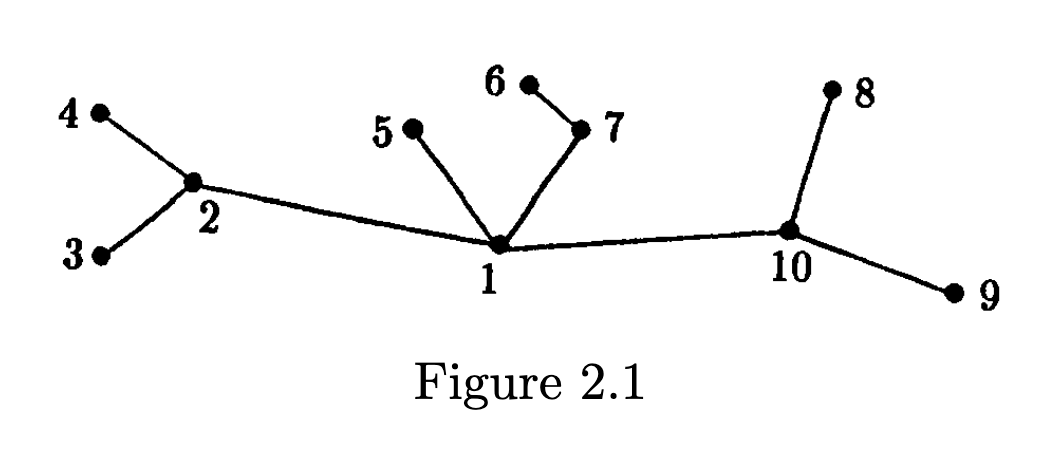
So .
To understand why is bijective, we first note some facts.
- The number of times a vertex occurs among is .
- Similarly, the number of times a vertex of occurs among is its degree in the tree less 1 .
- The monovalent vertices of are those elements of not in
In particular, is the least element of not in the name , and we can uniquely determine from and .
\end{proof}
Here is another proof.
\begin{proof}
Let be the number of trees with degrees .
Let .
Then we have
because .
Since
we have .
\end{proof}
Here is another proof.
\begin{proof}
Kirchhoff’s Matrix Tree Theorem
Number of spanning trees of , where are non-zero eigenvalues of , see ^snjg2a.
By Cauchy-Binct formula, .
不知道咋算的反正算出来了
\end{proof}