Chromatic Number
Definition
A proper coloring of a graph is a function from the vertices to a set of ‘colors’ (e.g. ) such that the ends of every edge have distinct colors. If , we say that is -colored.
The chromatic number of a graph is the minimal number of colors for which a proper coloring exists.
If , then is called bipartite. A graph with no odd polygons (equivalently, no closed paths of odd length) is bipartite as the reader should verify.
Brooks
Let and let be a graph in which all vertices have degree and such that is not a subgraph of . Then .
\begin{proof}
See A course in combinatorics - 1992 - van Lint, Wilson.pdf, page 24.
\end{proof}
Ramsey Theory on Graphs
Problem
Can we have a party with people such that no know each other and no do not know each other?
Definition
Define as the smallest integer such that all (edge)-colorings with colors of contain a monochromatic in color or a monochromatic in color . It also equals the smallest integer such that all graphs on vertices satisfy
- is a subgraph of ;
- is a subgraph of .
For example, , .
Proposition
.
\begin{proof}
Consider a graph on vertices without in and without in .
Let be a vertex.
Then cannot contain any and so .
Also cannot contain any and so .
Hence .
Now we finish the proof.
\end{proof}
Corollary
.
\begin{proof}
Note that .
Then by ^b25753 and by induction.
\end{proof}
Definition
Define with for colors.
Diagonal Ramsey Numbers
Theorem
.
- : Erdos, 1947
- : Erdos, Szekeres, 1935
Remark. In 2024, , see here. In 2025, an improvement lower bound of , see here.
\begin{proof}
By ^bxbn9o and Stirling’s formula,
we finish the proof of upper bound.
For the lower bound, consider a . There are different ways of coloring the edges red or blue. Now fix a subgraph . There are colorings for which that is monochromatic.
The number of colorings for which some is monochromatic is at most times as large (because we may count some colorings more than once). If this number is less than the total number of colorings, then there exist colorings with no monochromatic , i.e., . Using the fact that , we find that such a coloring certainly exists if (unless ).
This proves the following theorem.
\end{proof}
Off-diagonal Ramsey Numbers
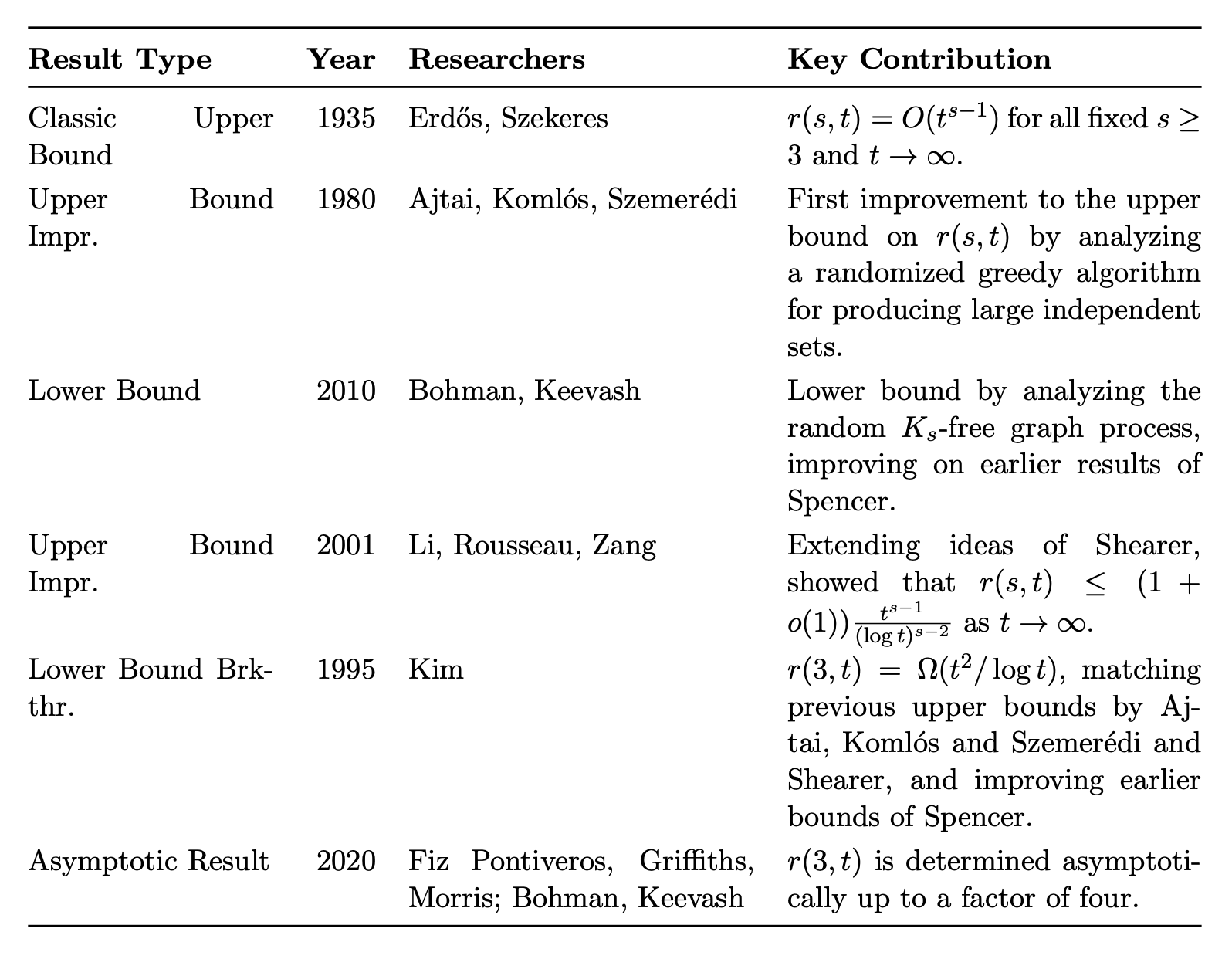
Reference table for off-diagonal Ramsey bounds (compiled by lyh).
Ramsey Theory on Structures and Spaces
Schur's theorem
Let be a positive integer, and let be the smallest integer such that colored in colors has monochromatic . Such exists.
\begin{proof}
We identify that colors with .
Define a coloring with with in color if has color .
If , then we find a monochromatic .
That is, , , is monochromatic.
WLOG assume and put , and .
Then .
\end{proof}
Definition
Define . We say is a combinatorial line if there exists and integers such that
Hales-Jewett
For all , there exists smallest such that any -coloring of contains a monochromatic combinatorial line.
\begin{proof}
By induction on .
The case of is trivial, and we now assume that .
For a line , we write for its first point and for its last point. We call focused at if for all . We call color-focused at if all the truncated lines are monochromatic and of pairwise different colors. Note that a line is determined by one point and a “direction”.
Suppose that is finite for all . Our goal is, for each , show there exists such that any -coloring of either
- contains a monochromatic combinatorial line, or
- contains color-focused lines.
Then will show the Hales-Jewett theorem by the pigeonhole principle.
Now we prove our goal by induction on : When , pick . Now suppose that is finite for all . We claim that
Suppose is -coloring , where . Then we can write as , where and . So can be identified as an -coloring , by associating each point with the entire -colored cube . For each , its color in is , which is indeed a function .
Since , there exists a line with coordinate set such that is monochromatic under . For any , we have , i.e. for all . Define for all , then we get a -coloring on .
Since , either under contains a monochromatic combinatorial line, or it contains color focused lines. If the former holds, then we already get a monochromatic combinatorial line in under and we have done. We now assume the latter holds, that is, there exists lines in which are color-focused at . Then define as follows:
- for , define in with first point and active coordinates ,
- for , define with first point and active coordinates ,
where
- is the set of active coordinates for the line in the subspace , that is, for any , the -th coordinate of points in varies synchronously from 1 to ,
- is the set of active coordinates for the line in the subspace .
It is easy to check that these lines are color-focused with focus .
Now we finish the proof.
\end{proof}