Definition
Let be a bipartite graph. A matching of is a set of pairwise disjoint edges.
Define , and we say is a maximum matching if .
Remark. Maximal matching may not maximum, just like maximal subgroups of a group have different orders.
Hall's Marriage Theorem
Let be a bipartite. Then iff for all .
\begin{proof}
“Only if” is clear.
Now assume that for all . Let be a matching with . We will construct a matching from with .
Let be in no edges of .
As , has a neighbor .
If is in no edge of , then and we have done.
Otherwise .
As , we can find a neighbor .
Then replace with , or repeat this procedure.
There exists one in no edge of , otherwise define as points in through the alternating path of , and , which is impossible.
\end{proof}
Definition
A vertex cover of a graph is a set such that each edge of contains at least one vertex of .
The following proposition is a generalization of ^jhp0cl.
Proposition
Let be a bipartite graph. Then
\begin{proof}
Put , then there exists such that .
Clearly, vertices cannot be matched, so .
Now we prove that . Let be a set of vertices such that . Put , where . Now for all , . So and by ^jhp0cl we find a matching of size . Throw away all edges of the matching using , and we get a matching of of size .
Now we finish the proof.
\end{proof}
Kőnig, 1931
In a bipartite graph , we have that
\begin{proof}
By ^vbxsbz, for some .
Note that is a vertex cover.
So .
On the other hand, for any vertex cover and any matching , because must cover each edge of .
Therefore, .
\end{proof}
Transversal Theory
Remark that there is a - corresponding between bipartite graph and family of sets in , where .
Definition
Let be a family of subsets of . A transversal of is an injective function such that .
The following theorem is equivalent to ^jhp0cl.
Theorem
Let be a family of subsets of . Then has a transversal iff for all .
Birkhoff, 1946
Let be a matrix with nonnegative entries such that each row/column has sum . Then is the sum of permutation matrices.
\begin{proof}
When , it is trivial.
When , we prove it by induction.
Define by .
For any -tuple in , the sum of the corresponding rows equals .
Every column of has sum , so the chosen rows must have nonzero entries in at least columns.
Therefore, for with , we have
Hence, by ^w6c21o, there exists a transversal of .
That is, there exists a permutation matrix with if .
Then is a matrix with nonnegative entries such that each row and column has sum .
By induction hypothesis, we finish the proof.
\end{proof}
Max Flow and Min Cut
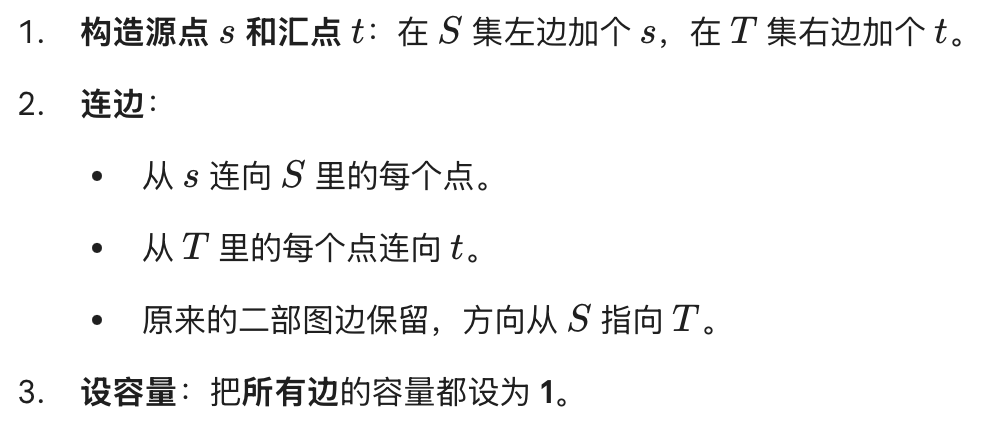
We can identify a bipartite to a - flow:
Max-flow min-cut theorem
The maximum value of an - flow is equal to the minimum capacity over all - cuts.
Remark that maximum flow is the maximum matching, and the minimal cut is the minimal vertex covering. So ^b9thzu is equivalent to ^92kx2v.
By reducing it to a flow problem, bipartite matching can be computed efficiently.