A sub-geometry of is a geometry with , and .
Link to original
Definition
An incidence geometry is a pair where is a set and is symmetric and transitive.
Definition
Let be an incidence geometry. A (maximal) flag in is a (maximal) chain with seen as a poset.
Definition
A geometry has rank if we can partition into antichains .
Definition
A projective plane is an incidence geometry of points and lines with the following properties:
- Every two points are incident with a unique common line.
- Every two lines are incident with a unique common point.
- There are four points, no three collinear.
Note that i) and ii) are dual, and iii) implies its dual.
Proposition
- Every point in a finite projective plane is incident with lines.
- Dually, every line is incident with points.
is called the order of the projective plane .
\begin{proof}
There exist a point and a line such that .
Note that the number of points incident with equals the number of lines incident with .
There also exists point such that , so the number of lines incident with equals the number of lines incident with .
The are arbitrarily chosen, so we finish the proof.
\end{proof}
Proposition
A finite projective plane of order has points and lines.
\begin{proof}
Each point has valency and each line incident with has points including .
Then .
\end{proof}
Prime Order Conjecture
For a prime , is the only projective plane of order .
Prime Power Conjecture
The order of a projective plane is necessarily a prime power.
Later we will investigate projective planes in higher dimension. There all are , where points are -spaces of , lines are -spaces and so on.
Bruck-Ryser-Chowla
If there is a projective plane of order and of , then is the sum of two squares.
\begin{proof}
See A course in combinatorics - 1992 - van Lint, Wilson.pdf.
\end{proof}
Remark. For example, a projective plane of order does not exist, proved by Clement Lam in 1989. Furthermore, the existence of projective plane of order is still open.
One More Construction
Definition
Let be a positive integer. A set of positive integer is called difference set of order if
- Each number in has a unique representation for .
Examples.
Theorem
Let be a different set of order . Then the following is a projective plane of order :
- the points are ;
- the lines are with , where module .
Remark. The projective plane induced from is Fano plane.
\begin{proof}
i) Let be points.
By definition of , there exist unique such that .
Put , then module .
Thus is a line through and .
Conversely, if , then and .
It deduces that , and so , .
Therefore, and the line through and is unique.
ii) Let and be distinct lines.
Then iff there exists such that .
Then are determined by and so is uniquely determined.
\end{proof}
Ovals
Definition
An arc in a projective plane is a set of points such that no three points are collinear.
Lemma
Let be an arc of a projective plane of order . Then and if is odd.
\begin{proof}
Take , then there are lines through and each line has at most one point in .
Hence .
If the equality holds, then no line intersects in point.
Take point .
Let denote number of secant lines through .
Then .
It is impossible for odd.
\end{proof}
Definition
- An arc of size is called an oval.
- An arc of size is called hyperoval.
- Conic is anything isomorphic to
Remark that conics are ovals when is odd.
We will prove later that each oval of is a conic when is odd, see ^mrpzaz. When is even, there exist some oval is not a conic, the following proposition is an example.
Proposition
The set is an oval in iff .
\begin{proof}
Every line incident with of the form is incident with precisely one more point of , namely, .
The line is a tangent.
The other lines are of the form .
The line is incident with iff .
If and , then , but also .
Thus, .
As , there exists such that .
Hence .
So determine and we do not have further solutions.
\end{proof}
Lemma
Let be an oval in a projective plane of order , where is odd. Then any point not in has or tangents.
\begin{proof}
Let be the number of points not in incident with tangents.
Clearly, .
Count , exterior point, tangent and . Then .
Now count , where exterior point, tangent and . Then .
Thus, .
Now is even, so any exterior point is on even number of tangents.
Therefore, when .
\end{proof}
Lemma
Let be an oval in a projective plane of order , with even. Then every point not in is on precisely or tangents. In particular, there is precisely one point on tangents.
\begin{proof}
See ^a8a6er.
\end{proof}
Definition
The point on tangents is called nucleus.
Corollary
Any oval in a projective plane of even order can be extended to an hyperoval by adding its nucleus.
Segre
An oval in with odd is a conic.
The definition of oval can be generalized to projective geometry of higher dimension.
MDS = Maximal Distance Separable Code
An arc of is a set of points such that no hyperplane contains more than points. If , then
- If even, or , then ;
- if odd, , then .
Subplanes
Definition
A projective plane is a subplane of if , and .
Bruck
If a projective plane of order contains a subplane of order , then either or .
\begin{proof}
Let be a tangent of , i.e. is a line of containing a single point of .
There are lines in that does not contain .
No two of these meet in the same point (otherwise their intersection is contained in .)
Thus .
(The existence of : for a point , there are lines in through and lines in through .
Hence there are lines of containing a single point of . )
Now we prove that if , then .
The total number of tangents of is , using the argument above.
It deduces that there are lines containing no point of .
If , then there is an external line .
Since all lines of intersect with with different intersection, we know and so .
\end{proof}
Definition
A projective subspace of order is called Baer subspace.
Remark. Note that each line intersects a Baer subplane in precisely or points.
Remarks.
- Hyperovals: or
- Baer subplanes: or ( points in total)
- Unitals: or ( points in total)
Unitals
Definition
A unital of a projective plane of order is a set of points such that every line intersects in or points.
Exercise. The Hermitian unital in :
\begin{proof}
Here we show that is a unital.
First show .
Count points of the form . Note that has solutions. If , then and so . Thus choices on . If , then has solutions for gives . In total, there are choices. So number of points of the form is .
Count points of the form . Here we solve , which has solutions. Furthermore, not on .
Therefore, .
Define .
So is a sesquilinear form.
Let , , i.e., . We claim that has points. Indeed, for with , we have
for .
Note that is a solution.
If , then has solutions with if .
Remark that follows from having full rank.
We are left with .
Counting shows that does not occur.
\end{proof}
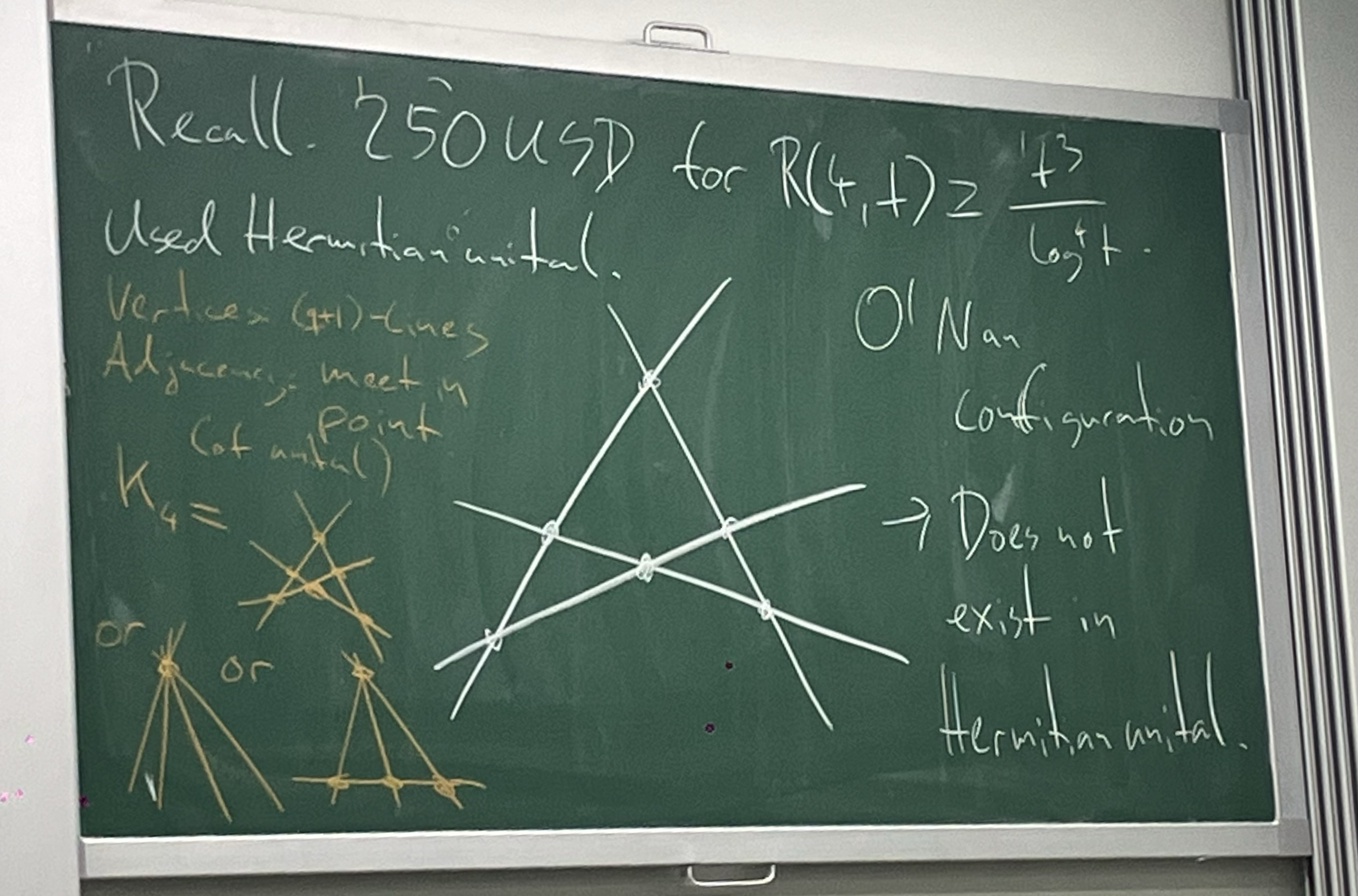
Remark. The Hermitian unital provides a crucial algebraic construction for establishing lower bounds on Ramsey numbers, specifically . By utilizing the fact that the Hermitian unital contains no O’Nan configurations, one can construct a -free graph that significantly improves the known lower bound for .
Blocking Sets
Definition
A blocking set in a projective plane is a set of points such that each line contains at least one point of . It is minimal if every point of lies on at least one tangent.
Remark. Trivial blocking set: a line.
Theorem
Let be a non-trivial minimal blocking set. Then
- ;
- equality holds in the lower bound if is a Baer subplane;
- equality holds in the upper bound only if is a unital.
\begin{proof}
We will show iii) as an exercise in the future.
Now only lower bound and ii). If a line contains at least points in , then we are done: take , then lies on other lines, each line contains one more point in . Thus .
Put , and suppose that no line contains more than points of . Let be the number of -secants of , i.e., the number of lines with . Then , , and , where . Since for all line , we have . Note that equations above yields
and so .
The equality holds if there is a line with .
Argument implies that and so is Baer subplane. (see here.)
\end{proof}
Tibor Szőnyi, 1980s
For prime , there exists minimal blocking set of size .
\begin{proof}
Uses .
\end{proof}
Remark.
- Hunte, Pohonta, Verstrate, Zhang, 2026, for prime. (Use a number theory construction.)
- Ih, Yue Zhou (2026) “local arcs” of size , improving coding theory bounds. See here.
For , define
Define as Gaussian coefficient or -binomial coefficient.
Theorem
The number of -spaces in equals .
\begin{proof}
Easy.
\end{proof}
Lemma
\begin{proof}
Count -spaces in two ways.
By ^ac91vg, -spaces .
Fix a hyperplane , then contains spaces.
A -space not in meets in a -space, there are .
Each spaces lies in -spaces not in .
\end{proof}
Theorem
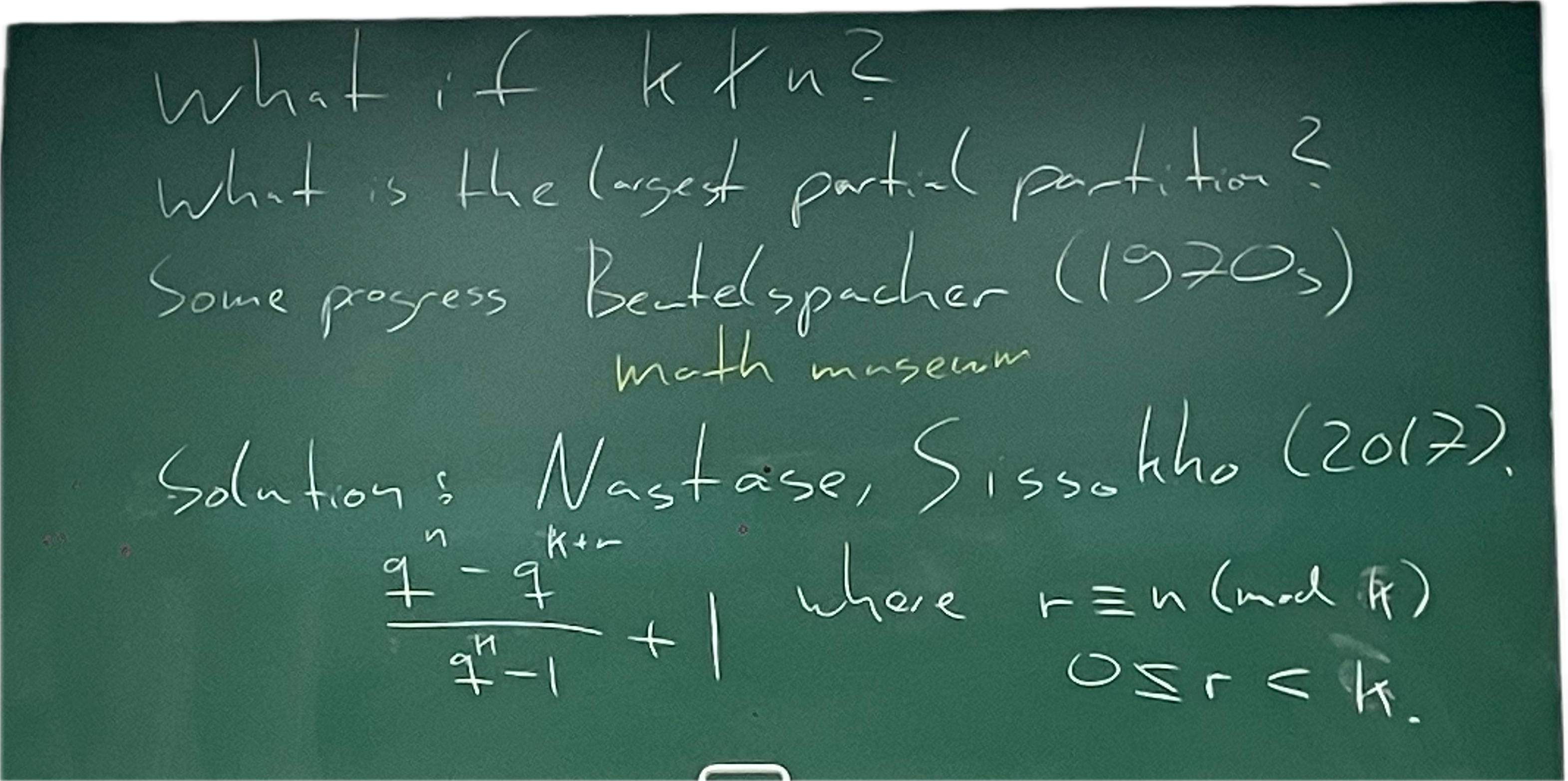
There exists a family of -subspaces of that partitions the -subspaces of iff .
\begin{proof}
Note that iff , so one direction is easy.
Conversely, the -subspaces of correspond to -subspaces of .
\end{proof}
Remark.
Jamison-Brouwer-Schrijver
If is a subset of , the affine space of dimension over the finite field with elements, which meets all hyperplanes, i.e., is a blocking set with respect to hyperplanes, then .
\begin{proof}
Let be a blocking set w.r.t. hyperplanes.
WLOG .
Put , then meets all hyperplanes that do not contain , i.e. hyperplanes of the form
Put .
Then except for .
Write modulo the ideal generated by the polynomials , .
Write , where the highest degree of in is .
For each , and so .
Thus .
Then .
It deduces that .
\end{proof}