Poset and Homotopy
Let be a poset. The order complex is defined as the set of all finite chains in .
Example. For a set with and , we have that
where is called a -chain and is called a -chain.
Homotopy
Abstract Complex
We say is a complex over a set , if the following holds:
- for all
- and yields that .
Simplicial Complex
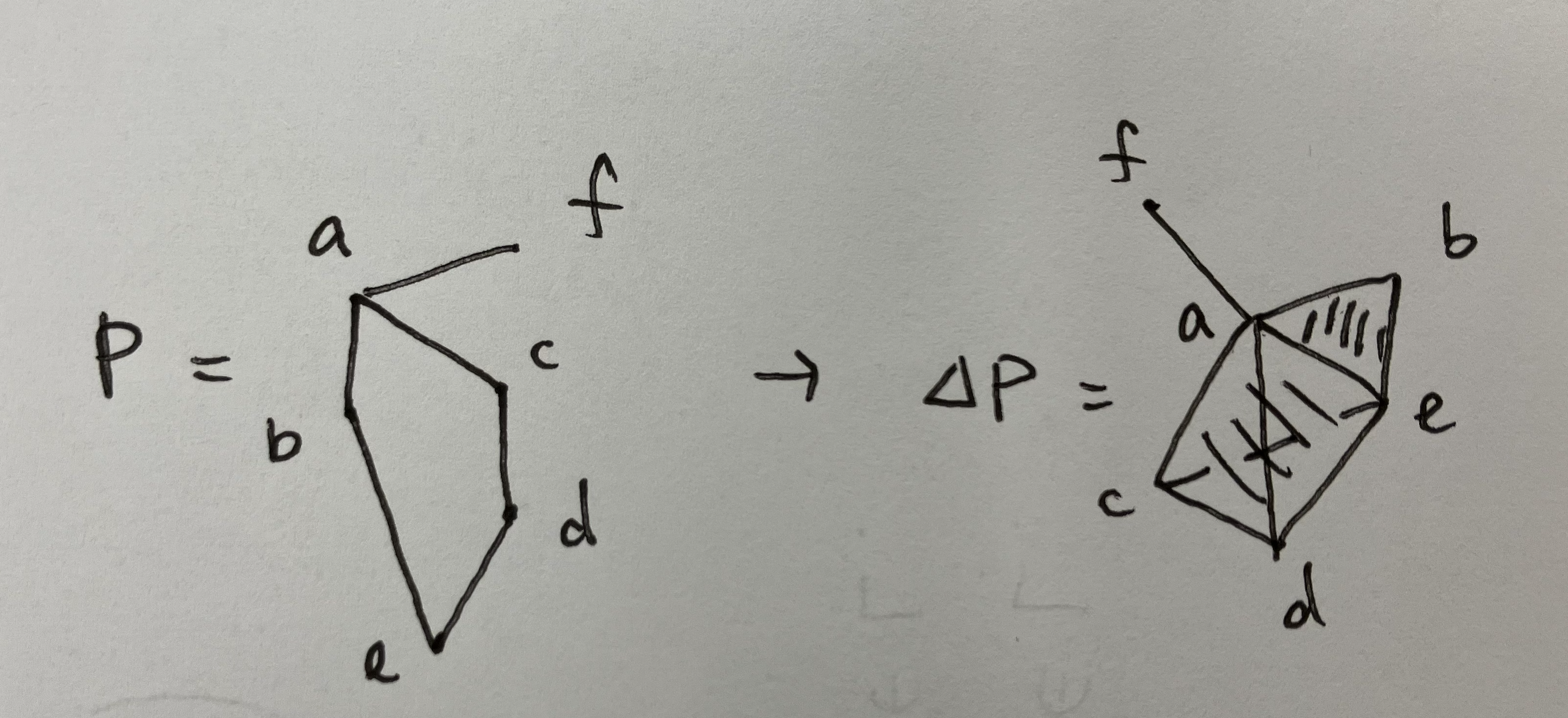
So there is a natural map from -chain to -simplex.
For example, see here.
Homotopy Equivalence
Let . If there exists such that for any , and , then and are homotopy, which is denoted by .
Let be a continuous map. We say that another continuous map is a homotopy inverse for if and . If there exists a homotopy inverse for , then is called a homotopy equivalence and is homotopy equivalent to .
Poset Map
Definition
We say is a poset map if in implies , where and are posets.
Then induces a map by . Furthermore, it induces naturally.
Proposition
Let and be two posets. Suppose that are two poset maps. Then:
- induces a continuous map .
- If for all , then and are homotopic, simply denoted by .
Quillen's Fiber Theorem
For , define .
Let and be two posets. Let be a poset map such that is contractible for all . Then induces a homotopy equivalence of with .
Brown-Quillen Complexes
Define a set . Then we get a poset .
- (Brown) , where and is the Euler characteristics.
- example: for some simple groups, there is . (DS. Smith, Subgroup complexes)
Sylow
For any with , suppose that . Define . Then by ^b9d401, and are homotopy equivalent.
Hence .
Question
When does ?
Quillen(?)‘s conjecture: is a finite group. Then iff .
The direction ← can be proved by ^50889b.
For example, consider and .