1. Let be topological groups and be a homomorphisms which is continuous at the point . Show that is continuous.
\begin{proof}
For any and any open set , the set is a open subset containing . Then is an open set of by continuous at . Take , then we claim that
Now we prove the claim. Since , we have . On the other hand, since , we have . Thus is open. By the arbitrary of and , we know is continuous.
\end{proof}
2. Let be a topological group, and a normal subgroup. Then is closed if and only G/H is Hausdorff.
\begin{proof}
Define be the canonical quotient map, and is a topology space with quotient topology, that is, is open iff is open.
Assume that is Hausdorff, then for any , we claim that is closed. For any , there exist open set such that , and . Set , and define . Then is an open set and . Therefore, is closed. Let be the identity of , then is a closed set of and is closed.
Conversely, assume is closed, then is a closed point. Let be distinct points. Then , and there exists such that . Also for . Take such that by ^36d8qm. Since , we have . It deduces that . Therefore, is Hausdorff.
\end{proof}
3.
- (1) and for every subsets of .
- (2) If is a subgroup then is also a subgroup.
此处 是 closure 的意思。
\begin{proof}
Remark that .
i) For any , we aim to show . For any open set containing , the set is also open by homeomorphism. Since and , we know and then . On the other hand, if , then . For any open set containing , iff , and the latter is guaranteed by and . Now we proved .
For any with and open set contains , since is continuous, there exist open sets such that and (remark that is open and is a set of topology basis of ). Since , and we take . Similarly take . Then is nonempty and so . Now we finish the proof.
ii) Since is a subgroup, the identity . For any , by i) one can check and so is multiplicative closed. Furthermore, note that , which deduces that is a subgroup.
\end{proof}
^9tavuois exact.
Link to original
\begin{proof}
First we prove that is exact. Define
and it induces . If there exists such that , then by the commutative diagram
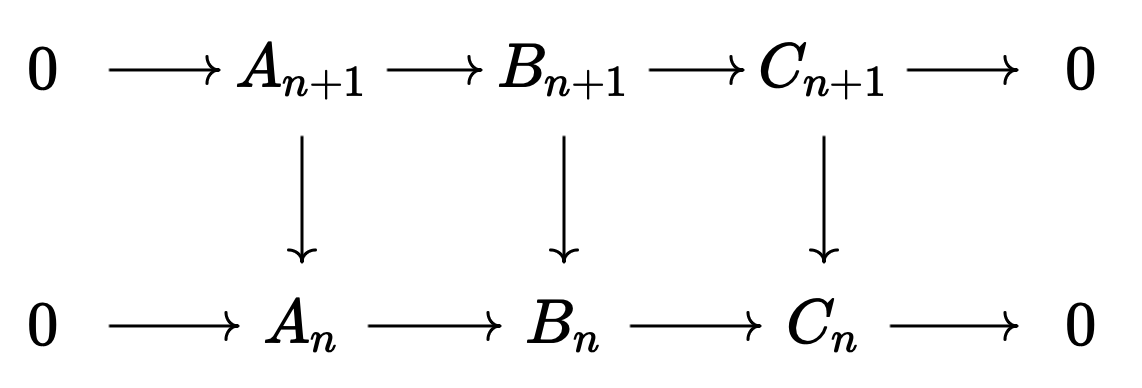
we know . Since is injective for all , and so is injective. Now we check . For any , there is
by exact. So . Take , then yields . Thus there exists such that . Define , then by the commutative diagram it is easy to check and . Therefore, and so is exact.
Now assume that is a surjective system. To show is exact, it is enough to show is surjective. We prove it by induction. For any , there exists such that as is surjective. Suppose for , there exists such that and .
Now we construct such that and . Define . Since is surjective, there exists such that . If , then and so . Thus there is such that . Since is a surjective system and the diagram above commutes, there exists such that . Then is what we desired. Repeat this procedure, and we get such that . Now we finish the proof.
\end{proof}