Highlight: topological group/ring/module; Noetherian→ Noetherian.
Example. Product topology on : its topological basis is generated by with for finitely many and for almost every .
In our course, we only use “open neighborhood”.
Topologies and Completions
Definition
A topological abelian group is a abelian group equipped with topology such that is continuous, and is continuous.
Examples. They are topological groups:
- with usual topology
- any group equipped with discrete topology
Remark. The category of topological abelian groups is NOT an abelian category. Consider
which is a homomorphism of topological groups with trivial kernel and cokernel, but they are not isomorphism. Clausen-Scloze: {condensed abelian groups} {topological abelian groups}.
In the following, only consider topological abelian groups. Notation: for , let
Lemma
Let be a topological abelian group, and let . For any , with .
\begin{proof}
Consider the composite map
which is continuous. Its inverse map is , which is also continuous. Hence are homeomorphism. Hence maps bijectively to .
\end{proof}
Lemma
Let , then there exists such that and .
\begin{proof}
Consider the continuous map
which deduces that is open. Since , we have . Then there exist containing such that . Let . One can check and so .
Similarly we can get such that . Then is what we desired,
\end{proof}
Lemma
Let be a topological group. Let . Then
- is a subgroup;
- , the closure of ;
- is Hausdorff.
- is Hausdorff iff .
\begin{proof}
i) Suppose , we aim to show . For any given , it suffices to show . Note that and . Then and so , which yields . Similarly, we can prove that .
ii) Note that iff there exists such that . But for some . So yields . Therefore, iff iff by i) iff .
iii) By ii), is closed. Recall quotient topology on is defined by , where open iff open. Since is closed, we know is a closed point. Let be distinct points. Then , and there exists such that . Also for . Take such that by ^36d8qm. Since , we have . It deduces that . Therefore, is Hausdorff.
iv) "→" If is Hausdorff, then is closed and so . "←" by iii).
\end{proof}
Remark. Let be a group, and let be a subgroup. Then Hausdorff iff is closed. The proof is similar as above.
Completion of Topological Abelian Group
Definition
Say a sequence is a Cauchy sequence, if for any , there exists such that for any .
Say two Cauchy sequences are equivalent, if .
Let be the set of equivalent classes of Cauchy sequence, which is called it the completion of .
Facts.
- is an abelian group, by defining . It suffices to show is a Cauchy sequence.
- Proof is easy
- is still a topological abelian group
-
Sketch of proof. To define topology on , it suffices to define . For , define
and then define . One can check is a topology basis.
-
- The map is continuous, whose kernel is . Thus injective iff Hausdorff.
Remark. Similar to Completion.
Definition
We say topological group is complete, if is an isomorphism.
Examples.
- , then .
- with discrete topology, then .
- with -adic topology
- by ^34rum4 where . Let . Then .
- .
- Let be the completion of under -adic topology. For with , it means for any and such that .
Use a sequence of subgroups to define a topology
Let be an abelian group (not topology yet), and let be a sequence of subgroups.
Fact. The subsets forms a basis of topology.
\begin{proof}
If , then we aim to find such that . WLOG suppose , then , which yields and so . Then . So we can let .
\end{proof}
Remarks.
- So one can use above to define a topology on . It is relatively easy to check this makes a topology group.
- Fact. For , use and the induces topology is precisely the -adic topology.
Fact. For above topology on , is both open and closed.
\begin{proof}
By definition, is open. But yields is closed.
\end{proof}
Fact. These forms a fundamental system of open neighborhood of . That is, for any , there exists such that .
\begin{proof}
Since is open, . Thus for some and so . Thus . Now we finish the proof.
\end{proof}
In above set-up, we can use “topological inver limit” to define
Definition
An inverse system of groups is a sequence of groups together with group homomorphisms . If is always surjective, call it surjective system.
Define , call it the inverse limit.
If the above are topological groups, then one can equip with induced topology.
Now let , equip with discrete topology, and note form an inverse system. We can define a topological group .
Theorem
There is a homeomorphism of topology groups .
\begin{proof}
Step 1. Define .
Let . For each , there exists such that if . This implies . Thus with define a unique element in . We let for . Now verify . This is easy, because and for . Now we have defined .
It is easy to check is a group homomorphism. If , then for any , there exists for . Thus in and so is injective.
Step 2. Check is surjective.
Let , so for some non-unique . One can easily check is a Cauchy sequence. So it defines a element in , which is independent of choices of .
Step 3. Check and are both continuous.
(omit)
\end{proof}
Example. . It has been proved by
Link to original
- Fact. For , use and the induces topology is precisely the -adic topology.
Definition
Suppose , and are three inverse systems of abelian groups. If for each have a commutative diagram
where each row is short exact, then say they form an exact sequence of inverse systems. This actually induces a sequence
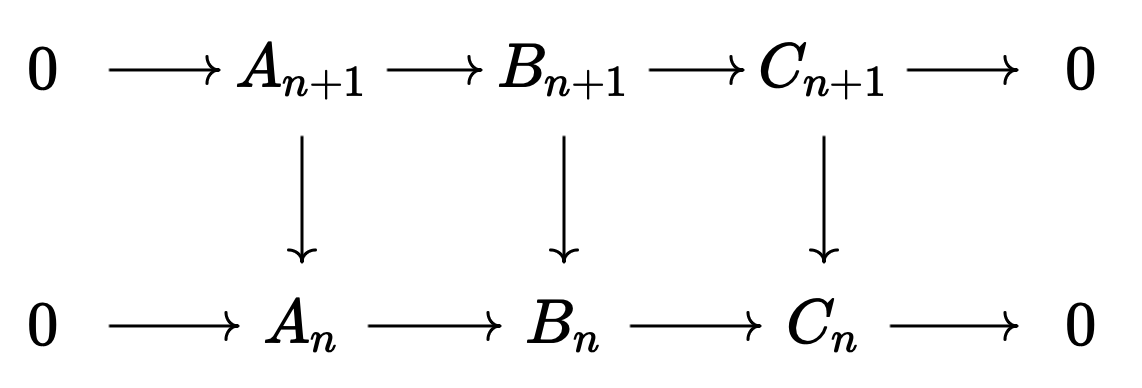
In fact, it is always left exact; but not right exact in general. The following proposition shows that if the is a surjective system, then is short exact.
Proposition
If is an exact sequence of inverse systems then
is always exact. If, moreover, is a surjective system then
is exact.
\begin{proof}
See homework.
\end{proof}
Corollary
Let be an exact sequence of abelian groups. Let be a decreasing sequence of subgroups of , which induces a topology on . So induces a topology on , and induces a topology on . Then is short exact.
\begin{proof}
Apply proposition 10.2 to the following sequence
which is exact for each . Also note is surjective for all .
\end{proof}
Proposition
Let , which gives a topology on . Then .
\begin{proof}
In ^5f86e5, consider , and we have , where
So for all . Take inverse system, then .
\end{proof}
We now define a special type topology on a ring
Let be an ideal. Then the sequence is a sequence of subgroups. This makes an topology abelian group.
Fact. This actually makes a topology ring, that is, is continuous w.r.t. this topology.
\begin{proof}
It suffices to show is open. Suppose , then it is easy to see .
\end{proof}
Fact. is still a topology ring.
Definition
We say is -adic compete if the natural map is an isomorphism.
Example. Using , its completion is also a topology ring. So is -adic complete.
Remark. If is principal, then also write -adic complete.
Example. If with , then .
Definition
Let be an -module. Let be an ideal. So we have a sequence giving a topology on abelian group .
Fact. With this topology, becomes a topology module over the topology ring , that is, is continuous. Furthermore, is also a topology module over .
Fact. (fix -adic topology as above)
- Let be a homomorphism of -modules, then is automatically continuous w.r.t. -adic topology.
- Proof. For any , then it is easy to see .
- Above induces a continuous map .
- Proof. .
Definition
Let be an -module, and let be an ideal. A sequence of submodule is called a filtration of . Call it an -filtration if for all ; call it a stable -filtration if it is an -filtration and for .
Example. is a stable -filtration.
very useful
It are stable -filtrations of , then they have bounded differences, that is, there exists such that for all . So they induced the same topology on , namely, the -adic topology.
\begin{proof}
It suffices to consider the case .
Since is -filtration, there is and so . Note that is stable, then there exists such that for all , and so . In summary, .
\end{proof}
Graded Rings and Modules
Definition
A graded ring is a ring together with , where are subgroups, such that as additive groups, is a direct sum of , that is,
and . Here .
Examples.
- .
- does not have natural grading.
Fact. (non-trivial) is in fact a subring (recall in our class subring contains ). The proof is as follows.
-
Since and is an additive subgroup, it is enough to show .
-
Suppose for some . Note that this composition is unique, and we aim to show . Note that
and , then and .
-
Thus , and so .
Fact. Each is in fact an -module.
Notation. Let . It is clear is an ideal, and .
Definition
Let be a graded ring. A graded -module is an -module , together with a grading , where is a subgroup (not necessary a -submodule), such that for any .
Remark.
- Each is an -submodule.
- Say is homogenous of degree if .
- Each has a unique decomposition , say is the -th homogeneous component of .
Definition
A homomorphism of -module is called a homomorphism of graded -module, if for all .
Proposition
Let be a graded ring. TFAE:
- is Noetherian;
- is Noetherian, and is finitely generated as -algebra.
\begin{proof}
ii)→i). There is a surjective map . By ^75xtmd, is Noetherian.
i)→ii) Recall , so is Noetherian. Also is an ideal of , so is finitely generated. Assume that with .
Note each can be written as some homogeneous components, so WLOG one can assume each is homogeneous. Define , and we aim to show .
It suffices to prove for any , . Note that is trivial, and suppose it holds for all with .
Let , then with . Break , then
Sum up, and we get , as is homogeneous of degree .
So WLOG, one can assume already. By induction hypothesis, , thus . Now we finish the proof.
\end{proof}
and
Definition
Let be an ideal. Define a graded ring , so . Suppose is an -module, with an -filtration , then one can define , then it is a graded -module.
Fact. If is Noetherian, then is finitely generated. Assume that . Then there is a surjective map .
Lemma
For a Noetherian ring , a finitely generated -module , and an -filtration , TFAE:
- is finitely generated -module;
- is -stable.
\begin{proof}
For each , define , which is a subgroup but not a submodule. The -submodule generated by is
Since is a finitely generated -module, is also a finitely generated -module. Note that is increasing and .
So is a finitely generated -module iff is a Noetherian -module iff the increasing sequence is stable iff when , iff for , for any iff is -stable.
\end{proof}
Generalized Artin-Rees Lemma
For a Noetherian ring , a finitely generated -module , and a stable -filtration , if is an submodule, then is also a stable -filtration.
\begin{proof}
First note , so it is an -filtration. Denote . By ^m9pvrs, since is finitely generated and is Noetherian, is finitely generated and so is -stable.
\end{proof}
Artin-Rees Lemma
Let as above, then there exists such that for any .
\begin{proof}
Apply to ^r7klzn.
\end{proof}
Remark. The motivation of this lemma is, for a Noetherian ring, its induced topology and the alpha-adic topology are the same. With this lemma, the exactness is preserved under completion, and ultimately the completion is flat. See ^z8znz5.
Theorem
For a Noetherian ring and its ideal , define -modules , then the filtration and are both stable -filtration, so they induce the same topology on .
\begin{proof}
Apply ^2c426a.
\end{proof}
Proposition
Some notation as above, write , take -adic completion, then is a short exact sequence of -module.
\begin{proof}
Apply ^4t4tgc and ^5f86e5.
\end{proof}
Proposition
For a ring and a finitely generated -module , is surjective. If is Noetherian, then is an isomorphism.
\begin{proof}
Since is finitely generated, there exists a short exact sequence with . Consider
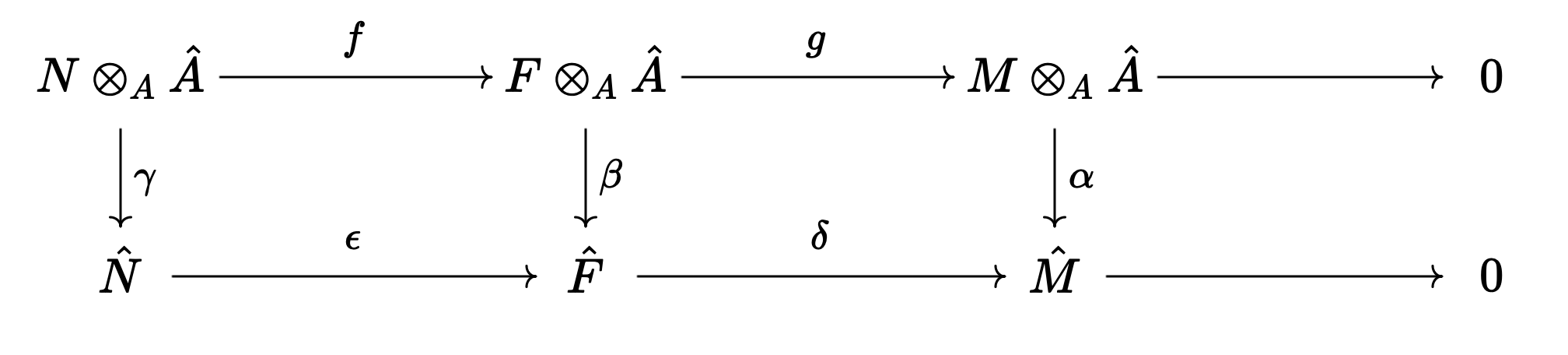
By ^5f86e5, they are right exact sequence. It is easy to check is surjective, because is an isomorphism and is surjective.
Now assume is Noetherian. By ^umxmsx, is injective, and is surjective by arguments above. Use diagram chasing, is injective.
\end{proof}
It is the main theorem of this section.
Proposition
For a Noetherian ring and an ideal , (-adic completion) is a flat -algebra.
\begin{proof}
Recall ^e6ct2u, to see an -module is flat, it suffices to check for each short exact sequence , is still flat.
Now let is a short exact sequence of finitely generated -module, by ^umxmsx, is exact. By ^wc26ph, is exact. Hence is a flat -module.
\end{proof}
Finally, we give some properties of and .
Proposition
For a Noetherian ring and its ideal , define as -adic completion of , that is, . Then:
- .
\begin{proof}
i) We have by ^wc26ph, and consider the following composition
where injective is guaranteed by ^umxmsx. Note that the image of the composition above is , then we finish the proof.
ii) Apply i) to , then we get . It is easy to check . Then by i) .
iii) By the following commute diagram
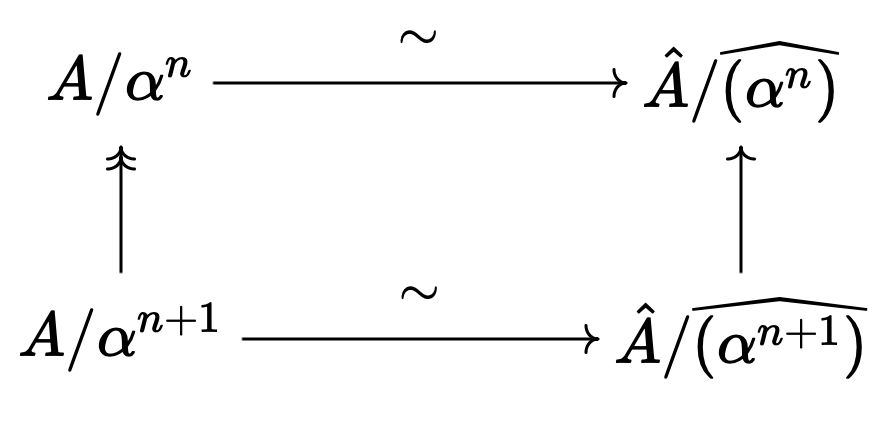
take kernels of these surjective maps, and we get .
iv) By ii) and iii) we have , which means is -adic complete. Let for any , then converges to an element in (since is -adic complete). Thus . By ^h2e8bp, .
\end{proof}
Associated Graded Ring
In this section, we aim to show for a Noetherian ring and its ideal , is Noetherian.
Definition
For a Noetherian ring and its ideal , define (the associated graded ring)
where . It is easy to check is a graded ring.
For an -module with an -filtration , define , then it is a graded -module.
Remark. We define and earlier. They are different with and !
Proposition
For a Noetherian and an ideal , we have:
- is Noetherian
- if is a finitely generated -module and is a stable -field, then is a finitely generated -module.
\begin{proof}
i) Since is Noetherian, is finitely generated. Let in , then one can see is Noetherian.
ii) Use ^wvvi9p iii).
iii) Since is -stable, there exists such that for any . Then is generated over by , because
Thus is finitely generated over by is Noetherian.
\end{proof}
Lemma
Let be abelian groups with filtration. For and , define and , and define and . Let be a group homomorphism such that . So it induces a group homomorphism and . Then:
- injective yields injective;
- surjective yields surjective.
\begin{proof}
Consider the following commutative diagram
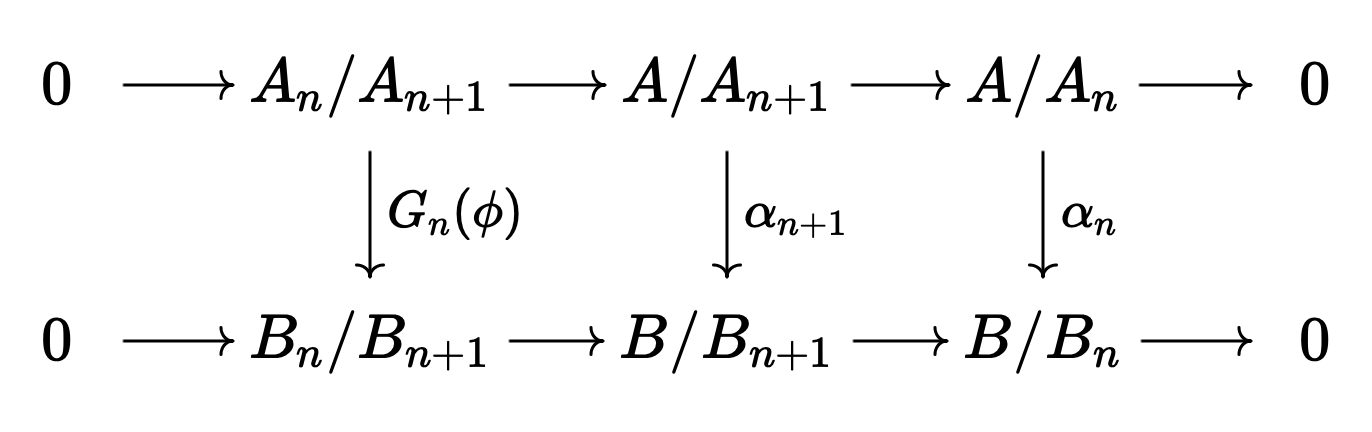
and by ^jgbcg4 we get a exact sequence
i) If is injective, then for all . Consider , the diagram becomes
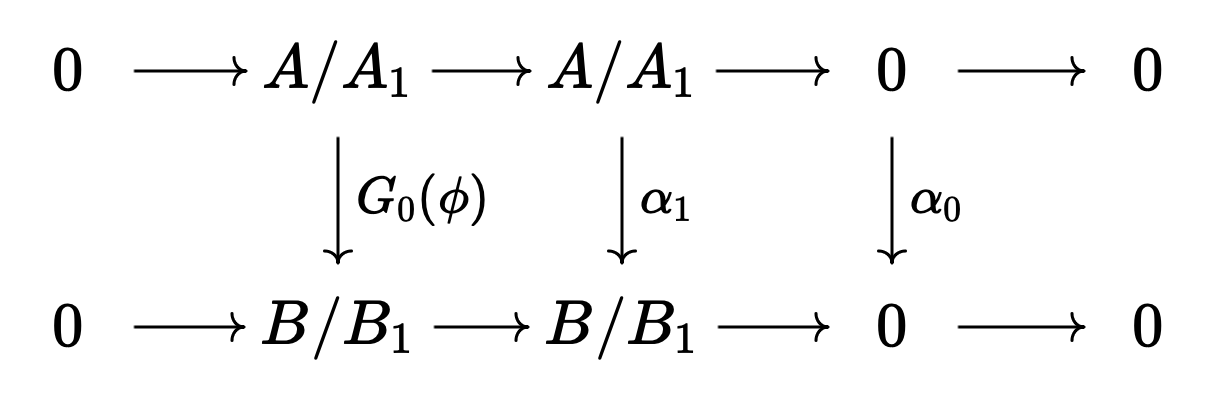
and so . Thus is injective and . We get an exact sequence and so . By induction, one can check that for all , then is injective.
ii) If is surjective, then is surjective and is surjective. Use right half of above long exact sequence, one can see is surjective for all . Note that it is not enough to see is surjective. But consider the exact sequence of inverse systems
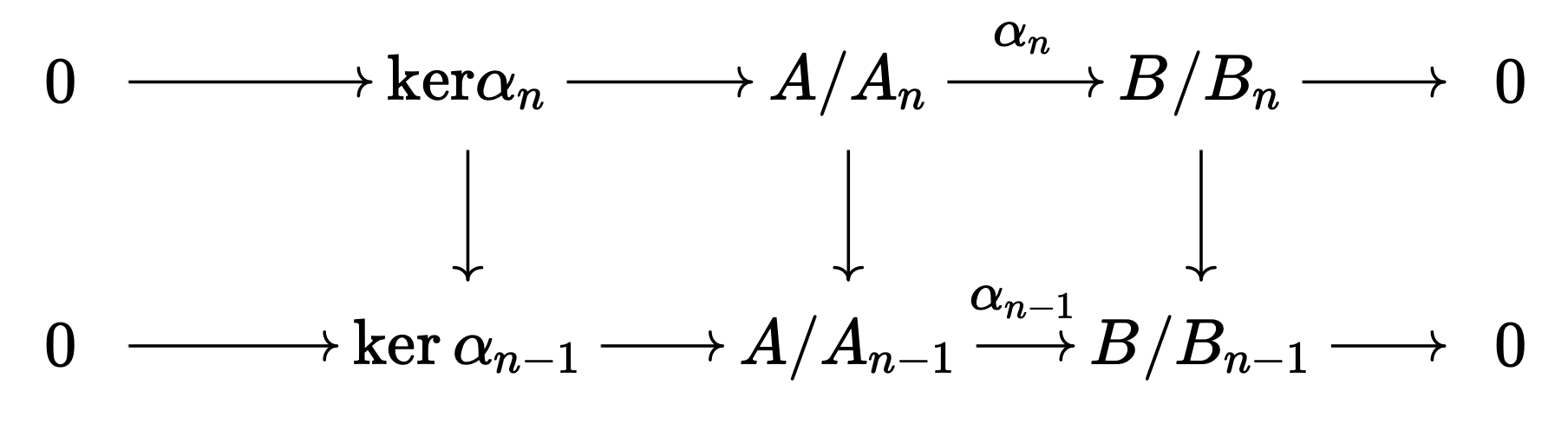
Since the left column is a surjective system by , we know
is short exact by ^bxmt3l. Hence is surjective.
\end{proof}
Proposition
For a ring and its ideal , suppose is a -module and is an -filtration. Define Suppose and , and suppose is a finitely generated -module. Then is a finitely generated -module.
\begin{proof}
Choose a finite set of generators of over . By breaking elements into homogeneous elements, we can assume
with . Choose a lift of .
Let be a free -module of rank , with basis . Define . We aim to show is surjective. Since is complete, is also complete. Also is injective because . So it suffices to show the composite is surjective. Via ^xmmn5a, it suffices to construct some surjective .
First, define a filtration on , so that the submodule with convention . This makes sure the map is compatible with filtration, because . ^xmmn5a tells us to show surjective, it is suffices to show is surjective. But
is surjective.
To explain , there is an example. Say , and . There is , , , . Then . Note that appears in the first summand and appears in the third summand, which is coincides with and .
\end{proof}
Remark. As a corollary, as is surjective.
Corollary
Use the same hypothesis as above. Suppose further that is Noetherian -module, then s Noetherian -module.
\begin{proof}
Let be a submodule. We want to prove is finitely generated over .
Define a filtration , which is still an -filtration and . Note that is injective by definition. Thus is a submodule.
Since is a Noetherian -module, is a finitely generated -module. By ^yad12c, is a finitely generated -module.
\end{proof}
This is the main theorem of this section.
Theorem
For a Noetherian ring and its ideal , is a Noetherian ring.
\begin{proof}
Apply ^yad12c and ^5fncr8 with , filtered by , then it suffices to show "" is a Noetherian ""-module. But "" is a Noetherian ring by ^7r78vs. So the proof is complete.
\end{proof}
Corollary
If is Noetherian, then is Noetherian.
\begin{proof}
By ^75xtmd is Noetherian. Then by ^b6b2a0, is Noetherian.
\end{proof}