Highlights: nilradical, Jacobson radical, Zariski topology
Convention.
- All rings are commutative with .
- iff .
- Ring homomorphism always satisfies
Proposition
Let be an ideal. Then there exists an bijection:
Local
Definition
We say is a local ring, if it has a unique maximal ideal . Furthermore, is called residue field.
Example.
- all fields
- with field. Recall that it has the unique maximal ideal .
- , where and .
Proposition
Let be a ring, and let be an ideal.
- If satisfies , then is local and .
- Suppose is maximal and for all there is , then is local.
\begin{proof}
i) For any ideal and any , . Hence and so is the unique maximal ideal.
ii) Let , then and so for some . Then and so for . By i) we finish the proof.
\end{proof}
Definition
We say a ring is semi-local, if it has a finite number of maximal ideals.
Example.
- If are local, then is semi-local, as it has only two maximal ideals.
- . By ^9eaa9e, there is a bijection between ideals of and ideals of containing . Hence, all maximal ideals of are and .
Nilradical
Proposition
Let . Then is an ideal and has no nontrivial nilpotent element. We say is the nilradical, denoted by .
\begin{proof}
It is easy to verify is an ideal: for any , we have for any .
Let . If is nilpotent, then and so . Then and . It deduces that .
\end{proof}
Proposition
For any ring , there is
\begin{proof}
Let . For any and any prime ideal , we have and so . Hence .
On the other hand, if and for any , define
Notice that as . By Zorn’s lemma, there exists a maximal element .
We claim that is a prime ideal. Otherwise, there exist such that . Since and are not contained in , there are and such that and . It deduces that , which is a contradiction. Hence is a prime ideal and . It contradicts with .
\end{proof}
Jacobson Radical
Definition
Define the Jacobson radical as the intersection of all maximal ideals. Remark that .
Example.
- and
Proposition
Let . Then iff for all .
\begin{proof}
"→" If , then there exists a maximal ideal such that . Since , we have , which is impossible.
"←" If , then there is a maximal ideal such that . Then and so for some and . It deduces that and so , contradiction.
\end{proof}
Some Propositions
Recall that if and are coprime, i.e., , then , where . We have the following theorem.
the Chinese remainder theorem
Let be ideals. Consider .
- If are pairwise coprime, then .
- is surjective if are pairwise coprime.
- is injective if .
\begin{proof}
i) is a generalization of the above “recall” part.
ii) By the Chinese remainder theorem, if are coprime, then and so can be identified as a quotient map.
iii) By ii).
\end{proof}
Proposition
- Let be prime ideals, and let be an ideal with . Then for some .
- Let be ideals, and let be a prime ideal such that . Then for some . Furthermore, if , then for some .
Remark. We cannot change to . Here are two counterexamples.
- . Let , then is not contained in for all .
- . Let , then and for all .
\begin{proof}
i) Consider the contrapositive statement. If for all , then . We prove it by induction. The case of is trivial. Suppose it is true for . By induction hypothesis, we have for each . Take such that for all . If for some there is , then and we have done. Otherwise for all . Define , then and .
ii) If not, we have for all . Then there exists such that . Consider , then and so , which is a contradiction.
\end{proof}
Ideal Quotient
Definition
Let be ideals. Define their ideal quotient as
This is an ideal of .
In particular, if , then is called the annihilator of , denoted by .
Example. Let . Then .
Radical
Definition
Let be an ideal. Define the radical of as
Indeed, consider , then .
Text-Exercise. Let be a prime ideal, then for all .
\begin{proof}
It is easy to show . For any , there exists such that and so . Hence, .
\end{proof}
Proposition
For any ideal , there is
\begin{proof}
Note that
by ^bgejpl. Now we finish the proof.
\end{proof}
Proposition
If are coprime, then are coprime.
\begin{proof}
It is easy to verify that , and it deduces that .
\end{proof}
Extension and Contraction
Definition
Define a ring homomorphism . For an ideal , is not necessarily an ideal. Define the extension ideal as
For ideal , define the contraction ideal as
Important Fact. Let be a ring homomorphism, and let be a prime ideal. Then is prime. (Proof: induces a map , which is injective. Note that is prime is integral domain is integral domain is prime.)
Example. If is prime, then is not necessary prime. Define . Note that is prime, but containing is not prime.
Spectrum and Zariski Topology
Text-Ex. 1.15
Let be a ring. Define . For a subset , let . Then
- If , then .
- , .
- Let with be a system of subsets. Then .
- for any ideals .
\begin{proof}
i) Note that , and then . For any , note that by ^8da6f1 and so . Hence and then . Now we finish the proof.
ii) and iii) are trivial.
iv) Since , there is and . It remains to show . For with , we have or (otherwise, there exist and , which is impossible as ).
\end{proof}
Remark. Notice that is a topological space, using as the set of closed subsets of . Denote by , call the topology the Zariski topology.
Text-Ex. 1.16
Draw picture for .
- .
- The set of closed subsets is , where with .
- The set of open subsets is .
- The closure of is , and so is called “fat point”.
- .
- .
- This is called the -dimensional affine space over .
- Any non-empty open subset is dense.
- .
- .
Remark.
- can be seen as a plane + a fat point, and can be seen as a upper half plane + a fat point.
- The Red Book of Varieties and Schemes, page 75, gives us a picture of .
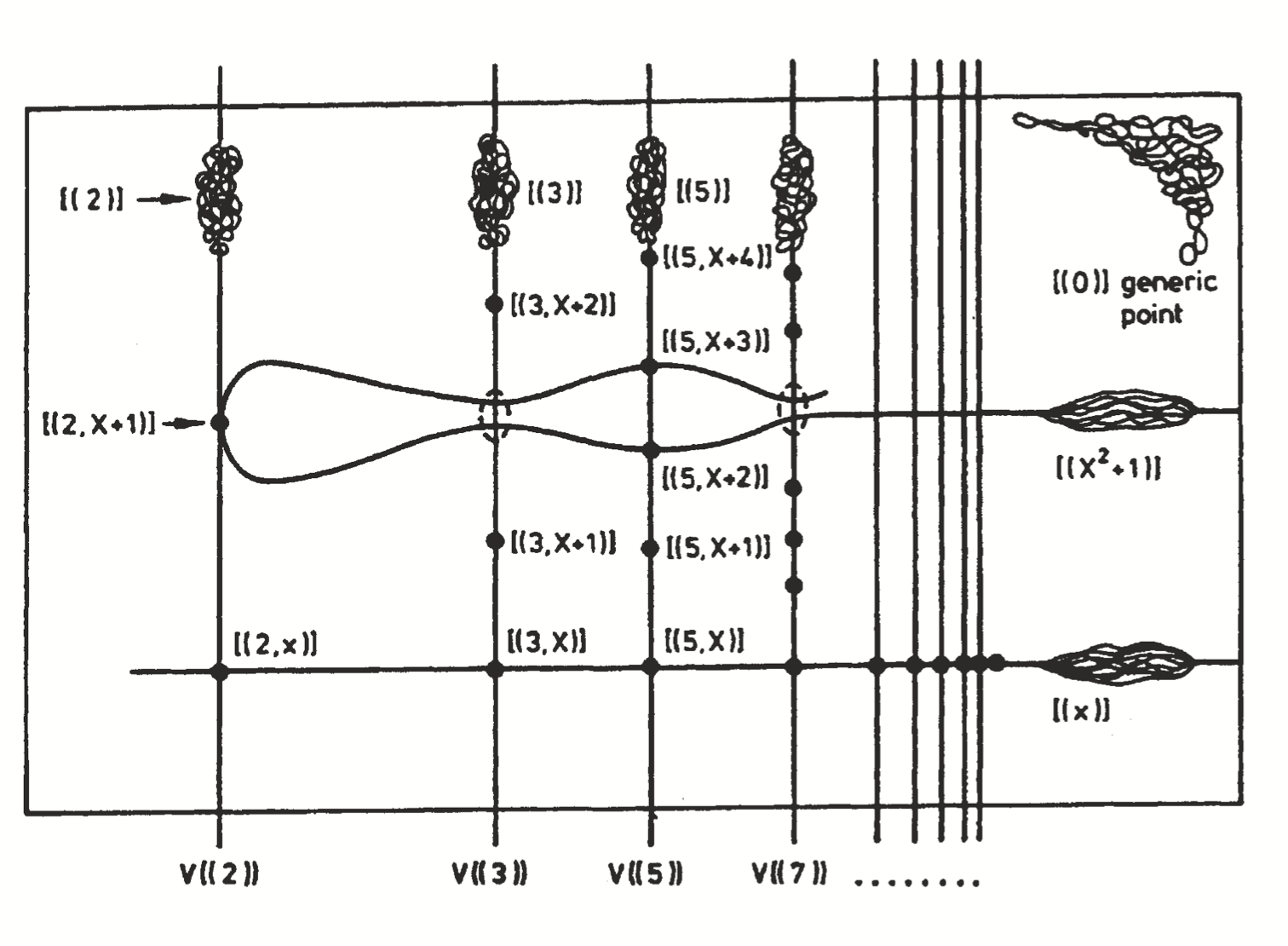
Definition
Let be a set. A basis for a topology on is a collection of subsets of (called the basis element) such that
- for any , there exists such that ;
- if where , then there exists some such that .
Lemma
If is a basis for a topology, then .
Text-Ex. 1.17
Let be a ring and let . For , define . Then forms a basis of Zariski topology. Also:
- ;
- iff is nilpotent;
- iff ;
- iff ;
- is quasi-compact, i.e., any open covering has a finite subcover;
- each is quasi-compact;
- an open subset of is quasi-compact iff it is a finite union of some .
\begin{proof}
i) By ^vf0aa5 . It deduces that .
ii) iff iff iff is nilpotent.
iii) iff iff is not contained in any prime ideals. If is not contained in any prime ideals, then it is not contained in any maximal ideals as maximal ideal is prime. So it can not contained in any non-trivial ideals and . On the other hand, if , and so .
iv) If , then and . If , then by ^8da6f1.
v) Suppose is an open cover of , then and so generate . Therefore, there is a finite subset such that with . Now generates and so is a finite subcover of .
vi) Suppose is an open cover of , then
and so . It deduces that . Since , there exists and a finite set such that . Thus, can be generated by and . For any , and so . Also, for any , yields . Hence and then
Therefore, is an open subcover of and so is quasi-compact.
vii) If an open set is a finite union of some , then it is quasi-compact by vi). Otherwise, if an open set is quasi-compact, then there exists an open cover . Since forms a basis of Zariski topology, we can take such that . As it has a finite subcover, there is finite with and so is a finite union of some .
\end{proof}
Text-Ex. 1.19
is irreducible iff is a prime ideal.
\begin{proof}
Note that is irreducible iff for any iff for any non-nilpotent , is also not nilpotent iff is a prime ideal.
\end{proof}