For an affine variety, define , and then we can associate a “geometric” objective to , which is called . If is a finitely generated integral domain over an algebraically closed field, is nearly the same as . In this section, we assume that is a commutative ring with identity. One can define a point set
and define Zariski topology
It is easy to verify the collection of closed subsets does define a topology, which is proved in ^vf0aa5. Furthermore, define . Later we can check . In addition, we have and is a set of topology basis of , called distinguished open sets.
For any , there is
- is called a closed point if . Note that is a closed point iff is a maximal ideal.
- If , then is called a generic point.
Definition
Let be an irreducible closed subset. Then is a generic point of if , i.e. any open subset of contains .
Proposition
If , then is irreducible.
\begin{proof}
Assume that , WLOG , then and so .
\end{proof}
Proposition
Every irreducible subset equals as set for some prime ideal , and is its unique generic point.
\begin{proof}
Suppose as set. Assume . We will show if is irreducible, then is prime.
Otherwise, there exists such that . We claim with and . Take , then can be written as . Note that
then we have as is radical. Now we proved the claim.
It deduces that . Since , there exists such that and such that . Thus and . In the other word, , which contradicts with irreducible. Therefore, is a prime ideal.
If there exist two distinct generic point , then and so .
\end{proof}
Example. Let . Then and . Note that , and by ^bgejpl.
Proposition
Let . Then iff .
\begin{proof}
Assume that . Then for any prime ideal , there exists such that and so . If , then is contained in some maximal ideal . However, is a prime ideal and , which is impossible. Therefore, and so .
Conversely, assume that . If there exists a prime ideal such that for all , then , which is impossible. Thus and so for some .
\end{proof}
Remark. Since , there exist such that (partition of unity). Hence .
Corollary
is quasi-compact. (same as compactness without Hausdorff in topology)
\begin{proof}
Suppose that , and we aim to find its finite subcover. For each open set , can be written as for some . For any point , we have and so . Thus, there exists , that is, . Also note that
so for each , there exists such that . It deduces that
By ^05e2eb, .
\end{proof}
Remark. Since as topology spaces, one can check is also quasi-compact. Remark that is a set of topology basis of . However, not all are quasi-compact, and here is an counterexample:
- For a ascending chain , define and . There does not exist finite such that .
15:30: Let and . The followings hold:
- iff
For , we aim to define a map . Since iff , there exists such that . So the map can be defined as
It is a functor(这个词是这么用吗), 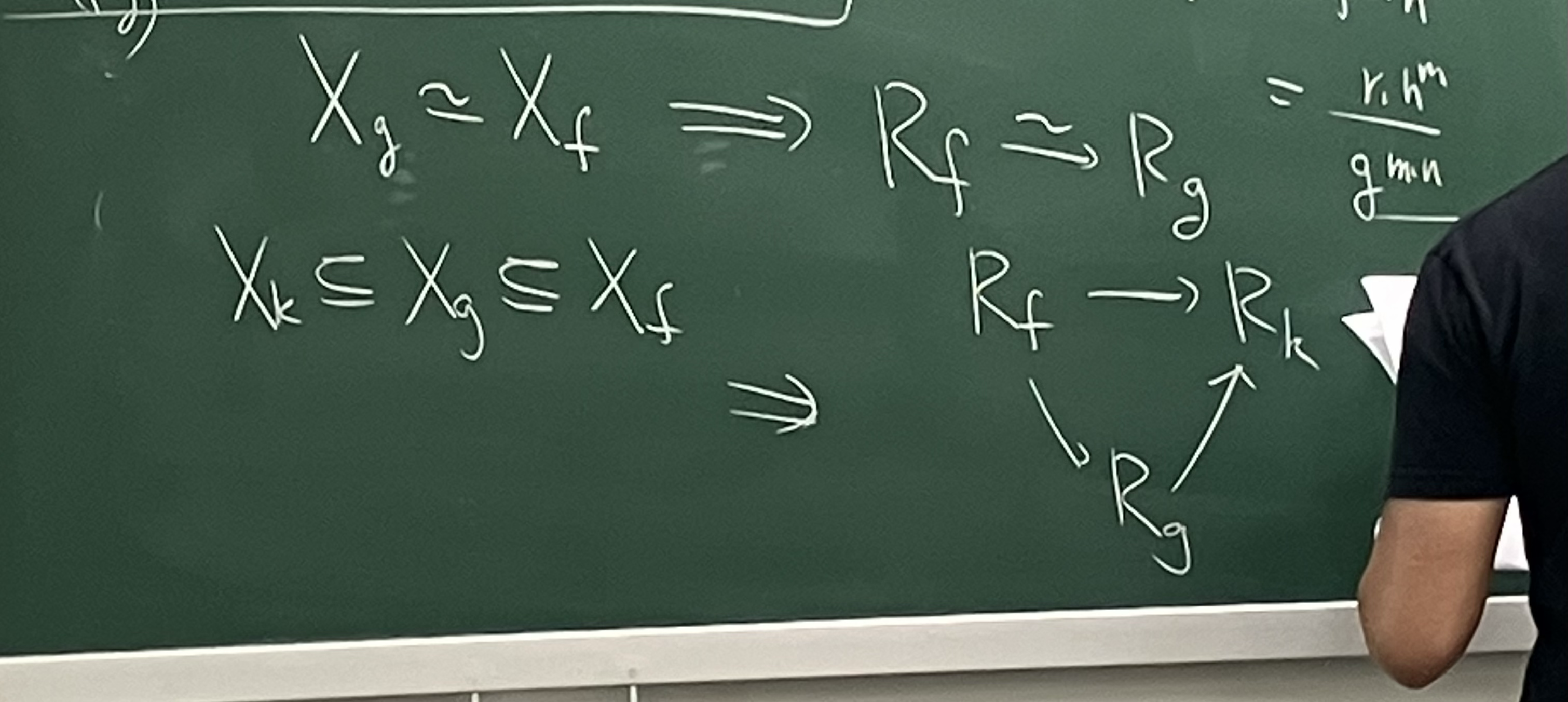
If , then , . . 好像是和stalk的对应,但是这里符号好怪。。
Lemma
Let . If there is such that for all , then .
\begin{proof}
Let . Let . The following are clearly equivalent:
-
i) in
-
ii) such that in
-
iii)
-
iv) .
-
iv)→i) ?
Therefore if , we can choose a prime ideal with , i.e., . Then for some . Using the commutative diagram
it follows that goes to 0 in . Since , so does . Therefore there is some with , i.e., . This contradicts the fact that and the lemma is proven.
\end{proof}
Lemma
, if satisfies , then there exists such that for all .
\begin{proof}
Take . Since is quasi-compact, and it suffices to show for finite covering. If the finite case hold, then by the argument above we finish the proof: Since , by finite case, there exists such that , and so . By ^376c07, .
- Now suppose , where . For with and is independent of .
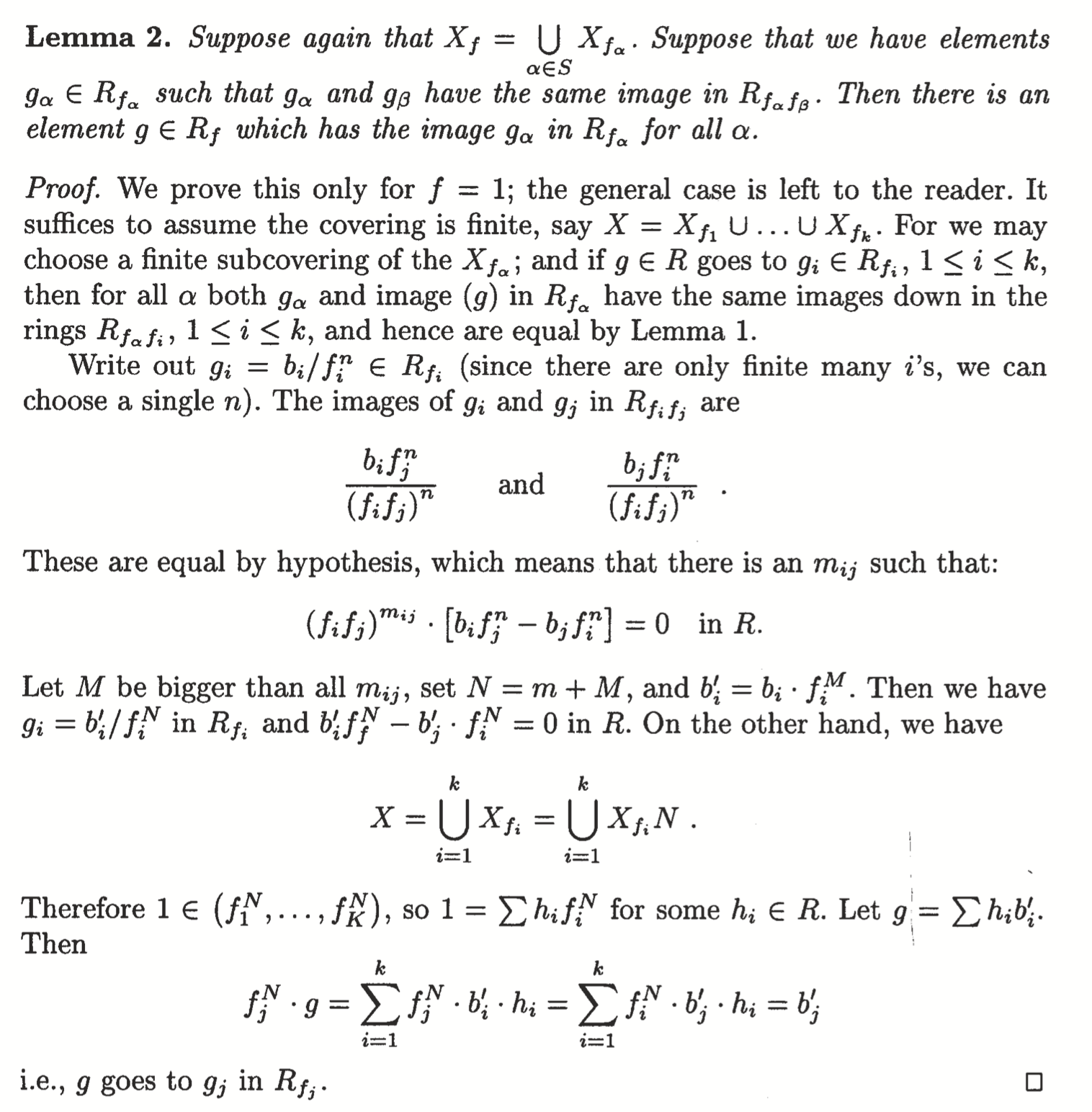
坏消息,一点没听;好消息,和课本一模一样
\end{proof}
(this part prove that is a sheaf.)
Structure Sheaf
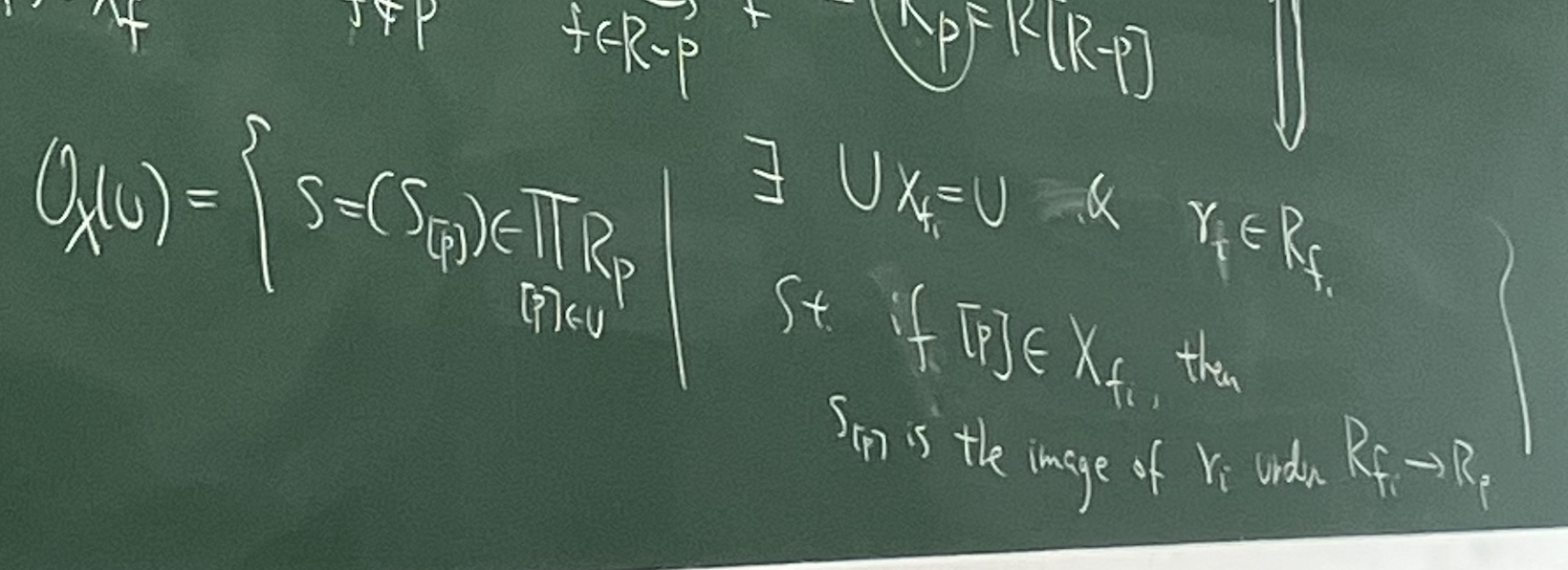
Let , and let be an open set. Define
and remark that
In fact, this definition is equivalent to Mumford, that is,
Proposition
- is a sheaf of rings;
- ;
- , where .
\begin{proof}
i) If with , then and so . Furthermore, if satisfies , then there exists . Recall the definition of the sheaf, and we finish the proof.
- ii) Define . It is easy to check this map is injective: if for any , then . 17:27 后面还有两行,没看懂
Now we check surjective. 17:33-17:35
iii) Notice that
then we finish the proof.
\end{proof}
Examples.
- , and all points of are .
- when , then ;
- if , then and with .
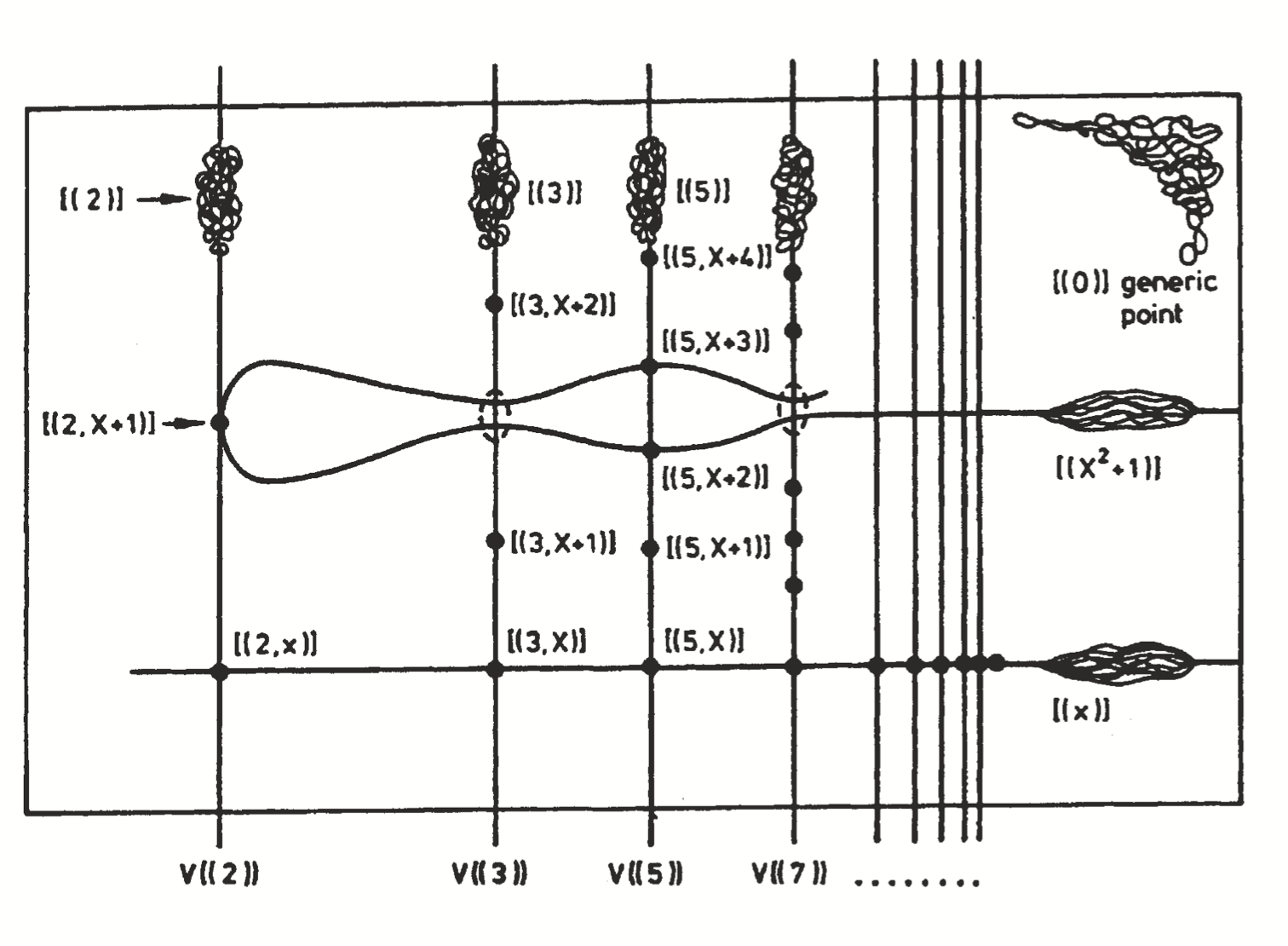
- , then with prime number or , where is a generic point. Note that
- , which has the maximal ideal and
- with , then all prime ideals are
- maximal ideals
- principal ideal with irreducible polynomial
- generic point
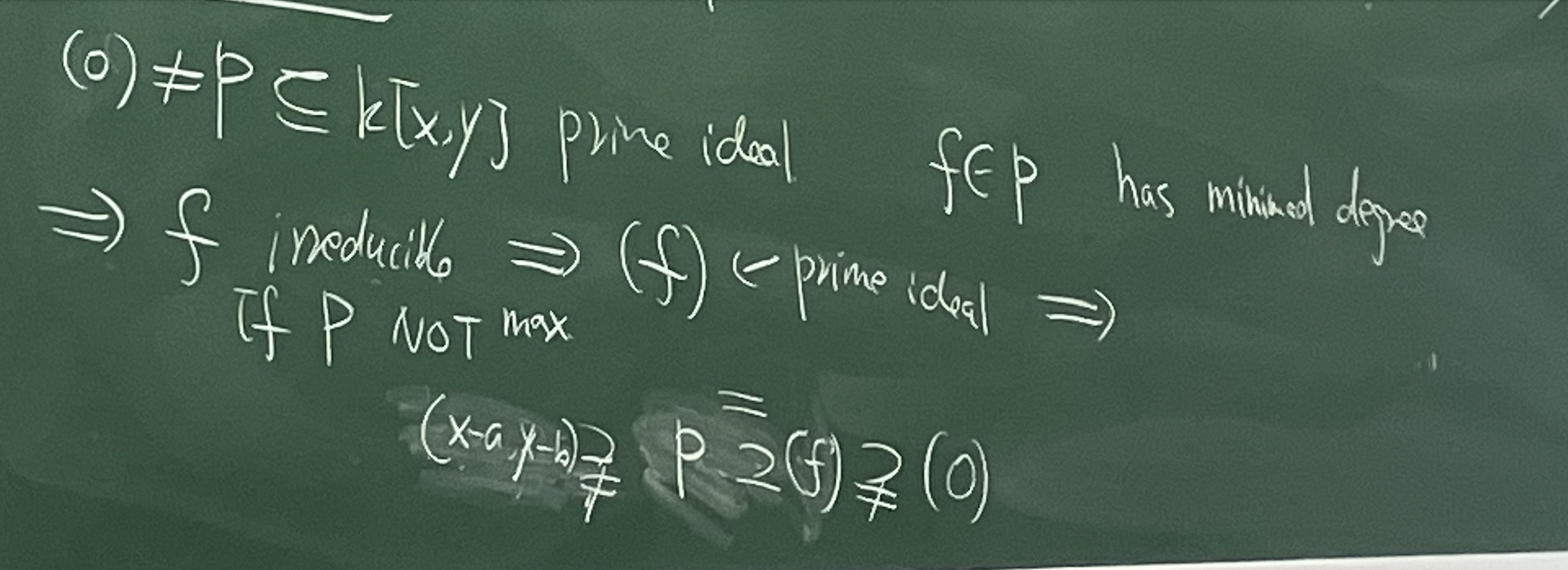
- has prime ideal , where is an integral domain. Also is also a prime ideal.
- arithmetic surface, see ^6bfhl3.
- .
- blabla
- has prime ideal . For any , note that , then and one can set . In fact,
- .
Values of Sections
For , define . For any , stalk is a local ring with the maximal ideal . Then is a residue field. Note that when , we have , and
This definition is coincides with
Remark. For and , there is with and . Then .
Link to original
However, for affine varieties, all values are in the same field , which not always hold here. For example, consider , then and image of at is
Proposition
For and , we have isomorphism of ringed space
\begin{proof}
For any , we know . Thus there is a - corresponding
Also it is easy to check for any , , because when .
\end{proof}
prescheme
A presheme is a topological space , plus a sheaf of rings provided that there exists open covering of such that for some commutative ring .
Remark. For a prescheme and open subset , one can check is also a prescheme by ^pzdwqy.
Definition
For preschemes and , a morphism consists of:
a continuous map
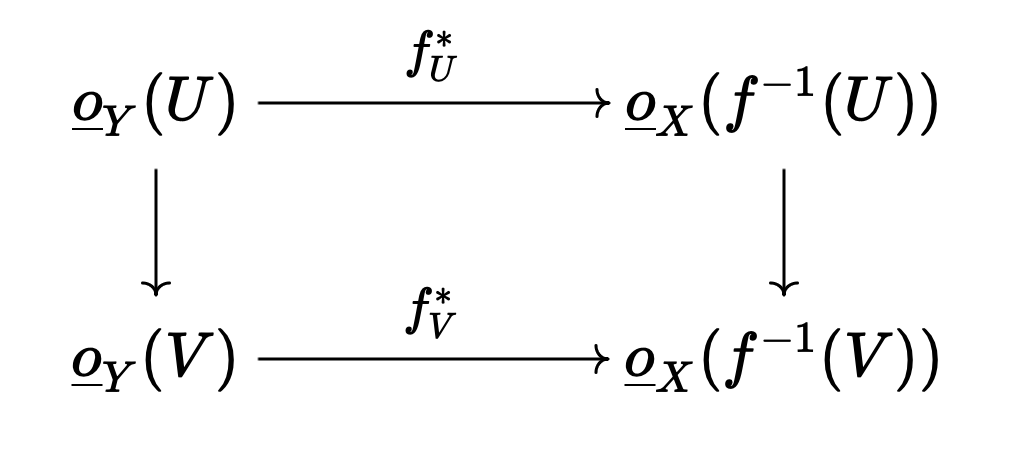
a morphism of rings between sheaves : for any , the following diagram commutes
where and "" are restriction maps.
for any , and , if , then (morphism of locally ringed space).
-
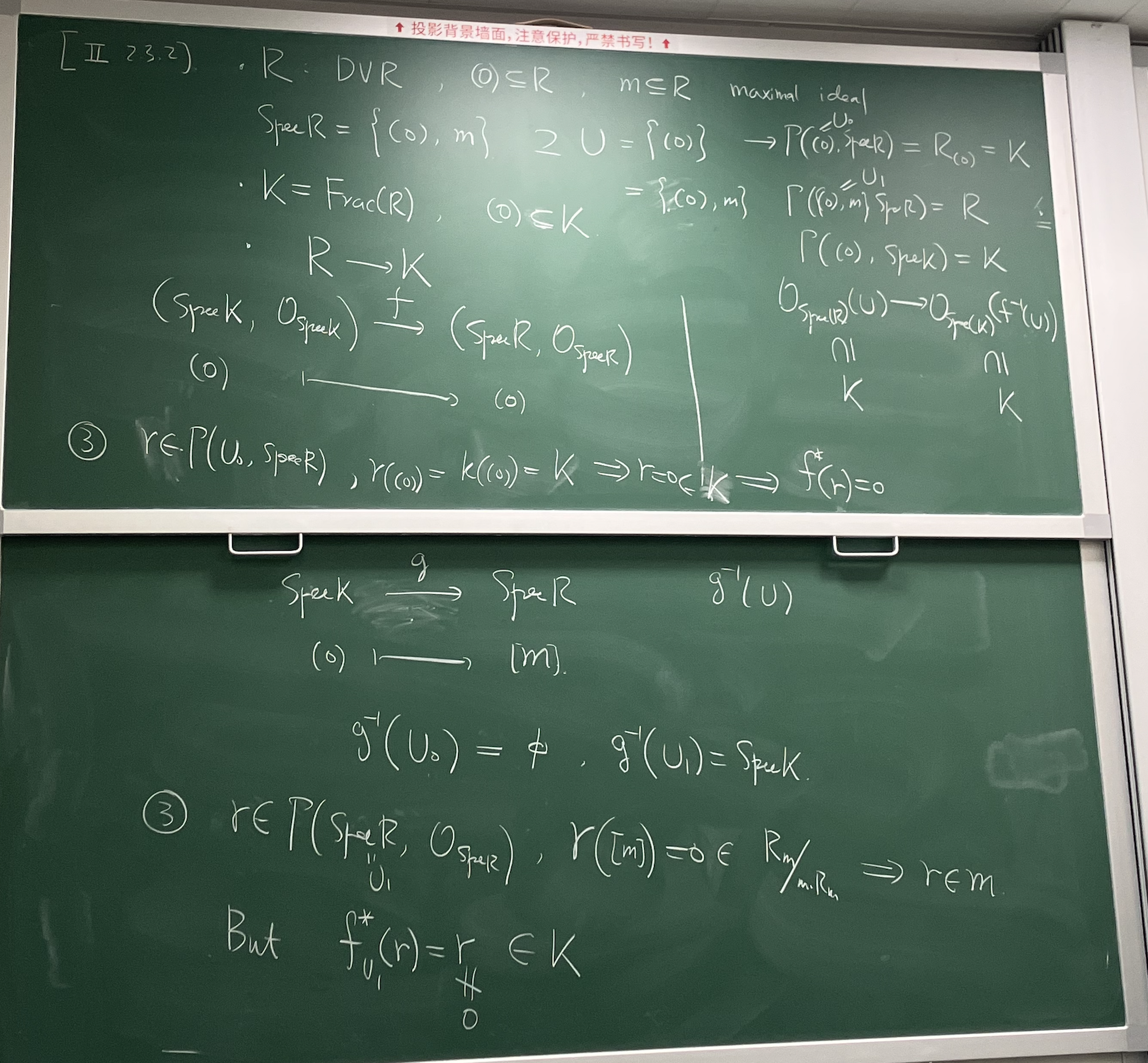
Example. Here is an example to show there exists map satisfies i) and ii) but not iii), see Pasted image 20250522153005.png.
-
然后在解释第三条有什么用: 好像是极大理想射到极大理想/residue field是单射
Theorem
For a prescheme and a ring , there is a - map
where .
\begin{proof}
"→" Define and define , where is defined as follows.
For and , there is . Note that iff . Define , where is a prime ideal.
To check is a morphism:
- is continuous: if closed, is closed.
- with affine , then it suffices to check closed. Define and it induces . One can check that , by comparing . Then .
- So we can assume that is affine.
- in affine case, and 的关系:14:34 下黑板 ^pnaept
- .
- ,
- .
- 14:39 下半黑板。验证continuous
- Consider on distinguish open sets. For , we aim to find .
- Recall that , we can define .
- It remains to show , and it is enough to show for any .
- For any , then and so . Thus and .
- Verify if , then .
Finally, the map is bijective (the proof is omitted).
This argument is important, as we get a corollary from it.
Corollary
The following categories are isomorphic
Corollary
Let be a prescheme, then there exists unique , i.e. is the final object in the category of schemes.
\begin{proof}
15:32 上黑板
\end{proof}
Proposition
Let be a prescheme, and let be an irreducible closed subset. Then there exists unique such that .
\begin{proof}
There exists affine open set of such that . Then is irreducible. Hence, there exists such that . Since , we have .
For uniqueness, there exists another point such that , then as is closed. Then . By affine case (generic point unique), .
\end{proof}
Definition
above is called the generic point of .
Example. . Gluing -pieces of .
Fiber Product
Theorem
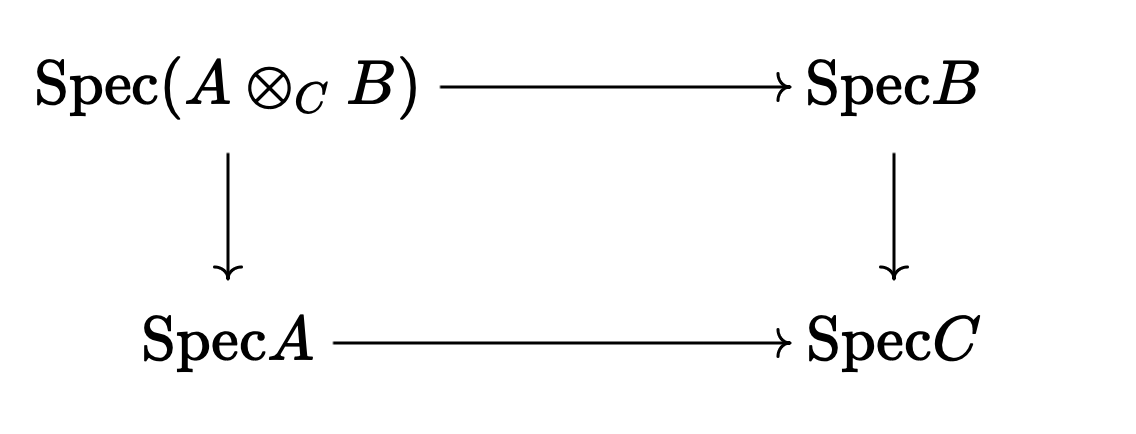
If are -algebras. Let the diagram of affine schemes
be associated to the natural ring. Then .
\begin{proof}
15:50 下黑板
6.3 update: by ^og85o0, the construction is trivial. 16:29
\end{proof}
In general, we glue these affine pieces. Remark that may not an affine variety, and we can write and consider preimage of each pieces. 16:40
universal surjective
If is surjective, then is surjective.
\begin{proof}
Let , then there exists such that . Since , there is such that . Note that there is an affine open set such that . Then . Define and . Consider , which induces a map from to .
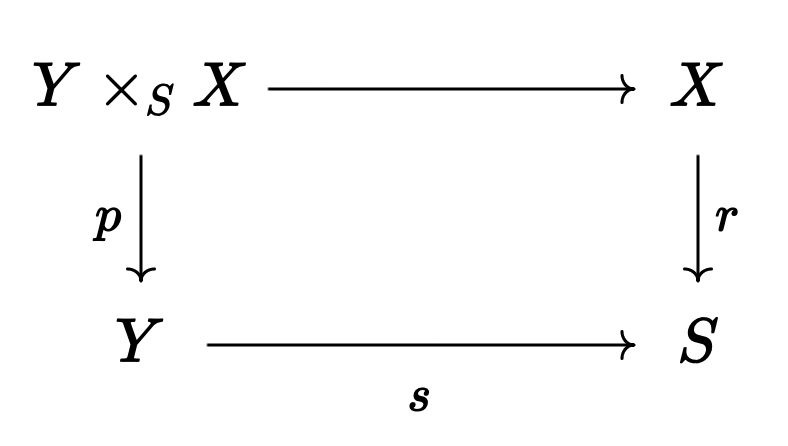
- Then by the universal property, there exists a unique map from to . Then ? is what we desired. 17:02
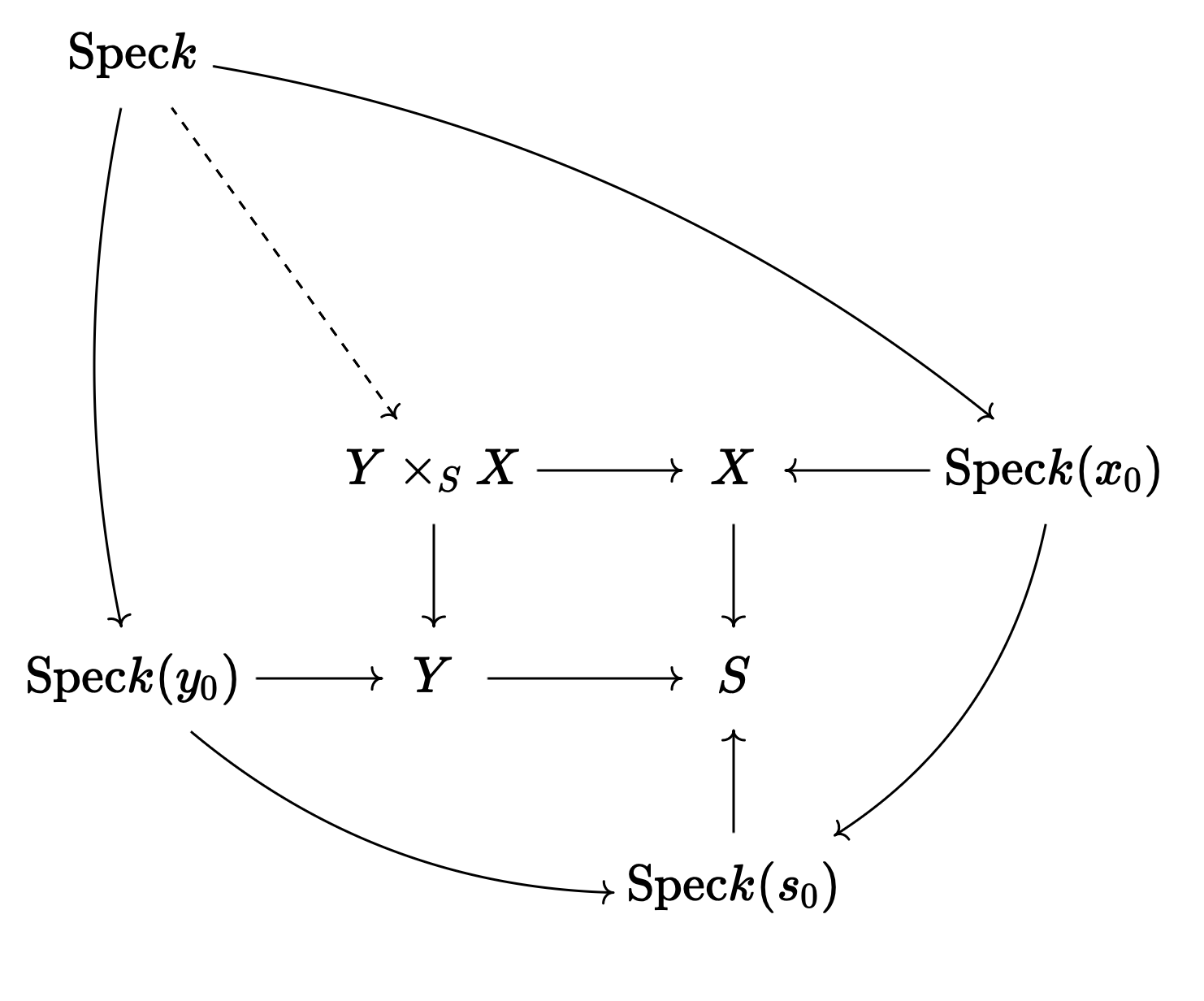
Now we finish the proof.
\end{proof}