Definition
Let be a ring. We say a subset is multiplicatively closed if and is closed under multiplication.
Definition
For multiplication closed , define a relation on , where iff for some non-zero .
We claim that is an equivalent relation. It suffices to check transitivity. Suppose and , then for some . Notice that and we have done.
Definition
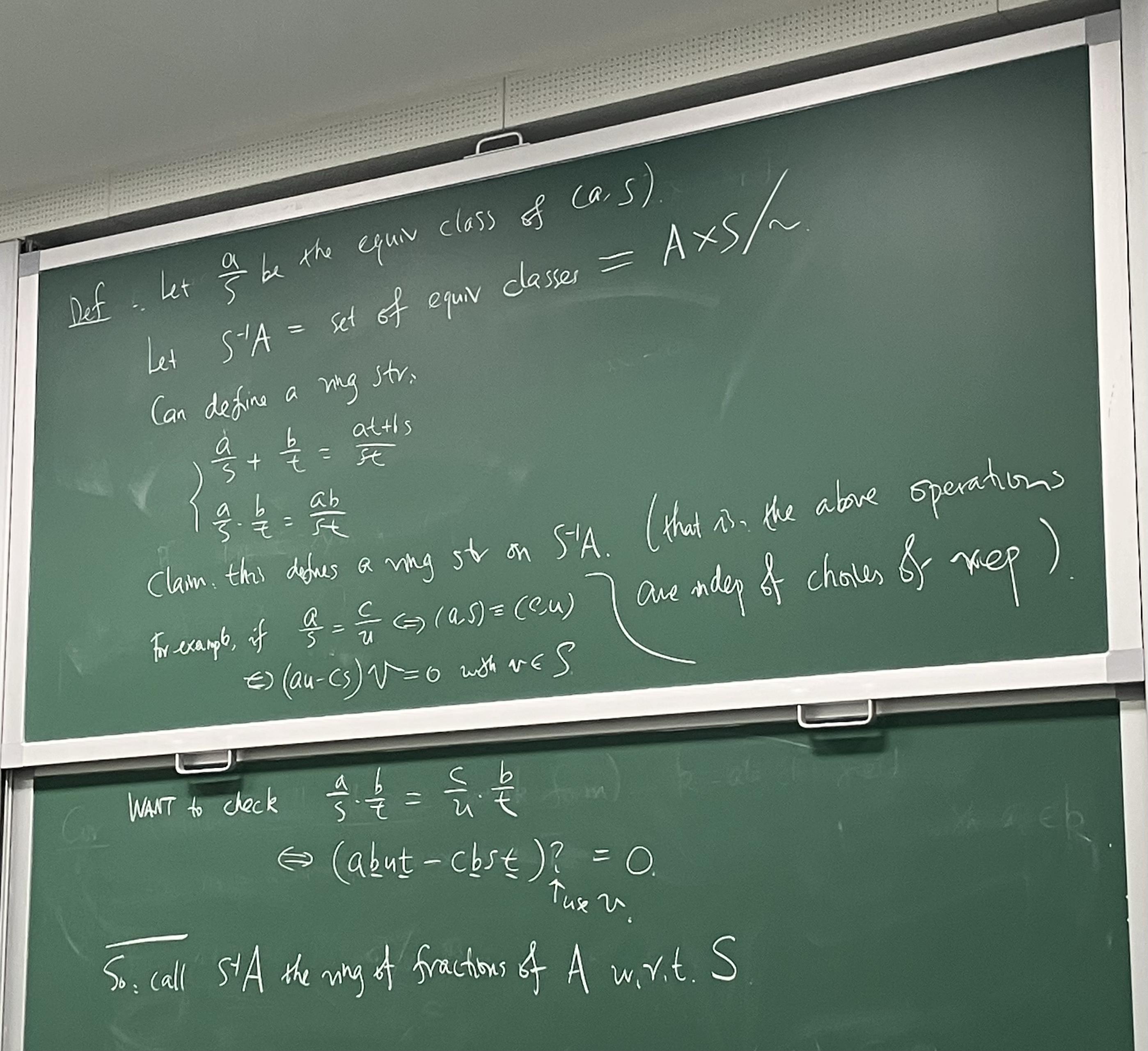
Let be the equivalent class of . Let be the set of equivalent classes, that is, . One can define a ring structure by and . We call the ring of fractions of w.r.t. .
Remark. We need to check the computation is well-defined. See here.
Fact. We have a map . It is NOT necessarily injective. For example, if , then . e.g. and .
important
also important
Let . Let . Then denote by . Note that if , .
- , , . . Here we do not use here.
- , , then get .
Proposition
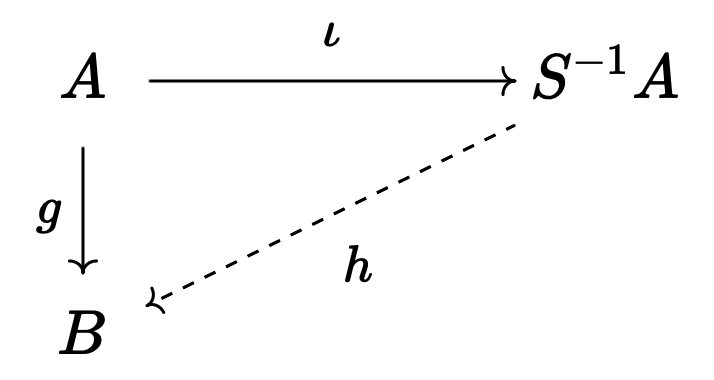
Let be a multiplicative closed set, and let be a ring homomorphism such that for all . Then there exists unique such that
is commute.
\begin{proof}
Define . We only check it is well-defined. If , we aim to show . Since for some , one have . Thus by .
\end{proof}
Definition
Let be an -module. For a multiplicative closed set , define relation on ,
which is an equivalent relation. Define as the set of equivalent classes.
Fact. is an -module via . Also there is a -module homomorphism .
Notation. If , denote ; if , denote .
Easy Fact. is an -module homomorphism induces an -module homomorphism. .
Proposition
The operation is exact on -modules. That is, if is a exact sequence of -module, then is also exact.
\begin{proof}
We aim to show . Since , one have .
On the other hand, suppose , then in . It deduces that for some and so , . Assume that for some . So .
\end{proof}
Proposition
There exists unique -module isomorphism
\begin{proof}
Consider by . It is clearly -bilinear, so there exists a unique map . It is easy to check is -linear and surjective.
To show injective, let . Note that for some . It deduces that . Then there exists such that and so .
\end{proof}
Corollary
is a flat -module.
\begin{proof}
By ^092787 and ^d61f0b.
\end{proof}
Proposition
Let be -modules. Then .
\begin{proof}
By ^d61f0b, we have
and we finish the proof.
\end{proof}
Example. .
Local Properties
Definition
A property of a ring (or of an -module ) is said to be a “local property”, if (or ) has (or ) has for any .
Proposition
Let be a -module. TFAE:
- ;
- for all prime ideal ;
- for all maximal ideal .
\begin{proof}
i)→ii)→iii) is trivial.
iii)→i) If , take nonzero and then is a proper ideal and for some maximal ideal .
Consider . Since , . Then there exists such that and so , contradicting with .
\end{proof}
Proposition
Let be a homomorphism between -modules. TFAE:
- is injective;
- is injective for all prime ideal ;
- is injective for all maximal ideal .
Similar statements hold after replacing “injective” by “surjective” or “bijective”.
\begin{proof}
i)→ii) Recall and by ^8p663h.
ii)→iii) Trivial.
iii)→i) Let . Then is left exact. For any maximal ideal , is flat -module yields that is left exact. It deduces that and so by ^663ccb.
\end{proof}
Proposition
Let be an -module. TFAE:
- is a flat -module;
- is a flat -module for all prime ideal ;
- is a flat -module for all maximal ideal .
\begin{proof}
i)→ii) Given injective homomorphism of -module, we aim to show is injective. Note that and is injective. Now we finish the proof.
ii)→iii) is trivial.
iii)→i) Suppose is an injective homomorphism of -modules. By ^766550, it suffices to check injective after localization at any maximal ideal . By ^udklm4, it is same as , which is injective by iii).
\end{proof}
Extended and Contracted Ideals in
Let . Let be the set of contracted ideals in , that is,
Let be the set of extended ideals in , that is,
Fact. .
Proposition
Part 1:
- If is an ideal, then , that is, is an extended ideal.
- Let be an ideal, then . Also iff iff . Recall that .
- If is the set of contracted ideals in , then iff , is not zero divisor in iff for all .
Part 2:
- gives a - correspondence between
- The operation commutes with , , , radical.
\begin{proof}
i) By definition, . On the other hand, for any , one have and . It deduces that and so . Now we finish the proof.
ii) Note that iff for some and iff for some . It yields that as and . Thus, . Conversely, if , then and and so .
For the “iff” statement,
- iff iff for some iff for some iff .
- Also
- yields .
- yields . Also note that by i) and then .
iii) Recall that iff , it is a HW. See Proposition 1.17.
By ii), , where . Hence iff iff for all iff , is not zero divisor in .
iv) Step 1. For a given prime ideal with , we show is prime. Since is exact, is also exact by ^092787 and ^d61f0b. It deduces that , and it suffices to show is an integral domain.
It is easy to check where . Note that yields that . Since is an integral domain and is a subset without , one have and so is an integral domain.
Step 2. We show the map is injective map. For any , is not a zero divisor of because is an integral domain and . By iii), and then by Proposition 1.17.
Step 3. We show the above map is surjective. That is, given a prime ideal , it is of form . By i), for prime, then . So it suffices to show is prime in . Recall that for a ring homomorphism and prime ideal , one have prime. Indeed, induces a map . Now for . Finally, note , otherwise .
v) This says
- as and so for .
- , whose proof is as follows.
-
Note that and .
-
Consider the left exact sequence where and .
-
Tensor with the flat -module , and there is a exact sequence
Then conclude.
-
- To show :
- For any given , there is for some and for some and . Then , and .
- Conversely, for any given , and , one have and so .
Now we finish the proof.
\end{proof}
Remarks. “Many fields.”
- Let be a prime ideal. Then is a local ring, where is the unique maximal ideal. It deduces that is the residue field of . In fact, . ^4vq1ey
- RHS equals , because is exact.
- as argument in ^961e0a iv), it is isomorphic to , where .
- Examples.
- , and
- , and .
- , and . We have and .
- Even if is integral, in general is not .
- Let be an integral domain, and let be a prime ideal. Then and so is an integral domain.
- In fact, .
- Proof. is integral domain, which yields that .
- Example. .
- In fact, .
Proposition
Let be a finitely generated -module. Then .
\begin{proof}
Let be generators of . For , is obvious, because kills all yields that kills for all .
Now for . For , we have for all . It deduces that for some . Then for all and is not zero. Therefore, .
\end{proof}
Proposition
Let be a ring homomorphism, and let be a prime ideal. Then is a contraction of a prime iff . Remark that even in this case, might not be prime.
\begin{proof}
"→" As , we have by Proposition 1.17.
"←" Now suppose . Let , which is multiplicatively closed in . Consider
We claim that . If , then . But by assumption, which is a contradiction.
This implies is a proper ideal: Otherwise, where , and means and .
Now there exists a maximal ideal of which containing . By ^961e0a, this maximal ideal is of form with and is prime.
Claim that . Indeed, yields and so . Since , one have , and . Therefore, .
\end{proof}
Remark
In ^961e0a (iv), the preimage of a maximal ideal in under the localization map is not necessarily maximal in . For instance, consider the canonical map . The ideal is the unique maximal ideal of , but its preimage in is the prime ideal , which may not be maximal.
Conversely, if is a maximal element in the set , then its extension is a maximal ideal. Indeed, suppose otherwise: there exists a prime ideal such that . Then its contraction in would contradict the maximality of in the set of primes disjoint from .
In summary, in - correspondence in ^961e0a (iv),
this induces a - map
But a maximal element in LHS is not necessary a maximal ideal in .