Let be a primitive idempotent decomposition in . Let be a primitive idempotent decomposition in with .
Definition
We denote by the multiplicity of in , which is called the Cartan variant in . The matrix is called the Cartan matrix of .
Theorem
iff .
\begin{proof}
See ^e4tl53.
\end{proof}
For convenience, if and are two simple -modules, we denote by , the corresponding Cartan invariant, i.e., the multiplicity of in .
Proposition
Let be a finitely generated -algebra over a field , and a simple -module with projective over . Let be a finitely dimensional -module.
- If is a simple -module, then
- The multiplicity of in is .
- If is an idempotent, then .
- Let and be idempotents so that and are projective covers of and . Then
If moreover , then .
\begin{proof}
See ^qi7oer.
\end{proof}
Let be a commutative ring with . For -modules and , we have an -morphism
Proposition
The image of this morphism is comprised of those morphism from to which factor through some finite power of .
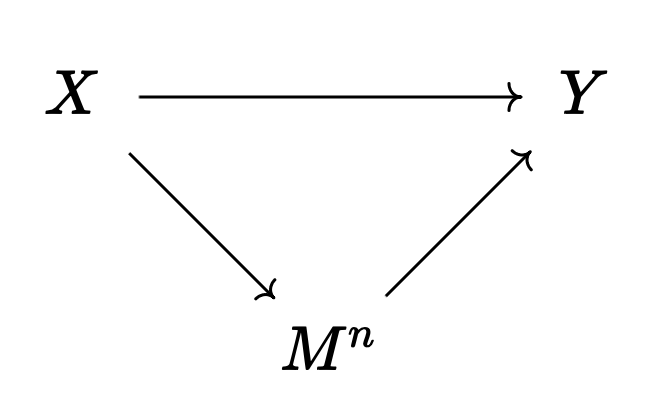
\begin{proof}
See ^v26ddz.
\end{proof}
projective morphisms
Recall that the dual of an -module is defined as . Taking , we obtain a natural -linear map
The image of is denoted by , and its elements are called projective morphisms from to .
Lemma
For any -module , is a -sided ideal of the ring .
\begin{proof}
See ^smhffy.
\end{proof}
Theorem
Let be an -module. TFAE:
- is a finitely generated projective module.
- .
- For any -module , the morphism is an isomorphism.
- For any -module , the morphism is an isomorphism.
- The morphism is an isomorphism.
\begin{proof}
See ^joizl5.
\end{proof}
Integrality
Let be an commutative integral domain with .
Definition
Let be a subring of containing . We say is an integral element over , if there exists a monic polynomial such that .
Proposition
Let be rings and . TFAE:
- is an integral domain over
- is a finitely generated -module.
- There exists a subring of with such that is a finitely generated -module and .
\begin{proof}
See ^274bb5.
\end{proof}
Lemma
are as above. where are subrings of . If are finitely generated -modules, then the ring is finitely generated as an -module.
\begin{proof}
See ^0f6d0e.
\end{proof}
Theorem
are as above. The integral elements of over form a subring of containing .
\begin{proof}
See ^b8xi28.
\end{proof}
Definition
- are as above. The subring of containing of integral of over is called the integral closure of in .
- is called integral closed in if every integral elements of over is containing in .
- We say an integral domain is integral closed if it is integral closed in tis fractional field.
- , if is integral over , we call an algebraic integer. All algebraic integer form a ring.
Theorem
A UFD is integral closed.
\begin{proof}
See ^437xgo.
\end{proof}
Torsion and torsion free elements
Definition
Let be a ring, and let be a -module. is said to be
- a torsion element if
- a torsion free element if .
Example.
- -module has no torsion element but .
- is commutative,
- has no torsion element but iff is an integral domain;
- if is a proper ideal, all element if -module are torsion;
- has no torsion element but , iff is prime.
Lemma
If is an integral domain, the subset of
is a submodule of , which is called the torsion submodule of .
Definition
We say is a torsion module if , and is torsion free if .
Examples.
- -modules: , and
- For an integral domain and a -module , where .
Proposition
Let be an integral domain. Free modules are torsion free.
Proposition
Let be an integral domain. Any finitely generated torsion free -module is isomorphic to a submodule of a free -module of finite rank.
\begin{proof}
See ^czedmd.
\end{proof}
Localization
Link to originalf:S^{-1}A\otimes_A M\simeq S^{-1}M,a/s\otimes m\mapsto am/s.
Set with . The kernel of is .
Corollary
- TFAE:
- the natural -morphism is injective
- is torsion free.
Corollary
If is finitely generated projective -module, then is injective.
\begin{proof}
See ^952afe.
\end{proof}
Definition
The rank of a finitely generated torsion free -module is the dimension of the -space .
Remark. A finitely generated torsion free -module of rank is isomorphic to a finitely generated -submodule of .
- Indeed, if is a -dimensional vector space over , then . Define , then is a -submodule of , and we have .
- In other words, a finitely generated torsion-free -module of rank can be viewed as a fractional ideal of , that is, as a finitely generated -submodule of its field of fractions .
Let be a finitely generated torsion free -module. By ^952afe, injective. So can be viewed as an -submodule of . Given an -basis of , assume is generated by as -module. Then each can be written as
where and . There exists such that . Additionally, generated . This motivates the following definition:
Definition
Let be an -vector space of finitely generated . A fractional -module in is an -submodule of such that
- generates ;
- given any basis of , there exists with such that .
In the case , fractional modules are called fractional ideals of . It is an -submodule of such that there exists nonzero such that . Hence is an ideal of .
- every finitely generated -submodule of is a fractional ideal
- if is Noetherian, then these are all fractional ideals. That is, when is Noetherian, finitely generated -module fractional ideal.
the proof of the second statement
Let be a Noetherian integral domain and . Let be an -submodule of . We want to show that is a fractional ideal if and only if is finitely generated.
() Assume is finitely generated. Let for some . Since , we can write where and . Let . Then and . For each , . Then . By definition, is a fractional ideal.
() Assume is a fractional ideal. By definition, is an -submodule of and there exists such that . Let . Note that is an -submodule of , which means is an ideal of . Since is a Noetherian ring, the ideal must be finitely generated. Let for some . Since , we can write for some . We claim .
Take any . Then . So, for some . Substituting , we get . Since and is a field, we can multiply by to get . This shows . The inclusion is clear since each and is an -module. Thus, , which means is finitely generated.