Why is this section called "Projective Morphism"?
The naming of Projective Morphisms (as elements in the image of ) is deeply connected to the Dual Basis Lemma. This lemma reveals that if is a finitely generated projective module, then , meaning every such homomorphism arises from tensoring linear functionals on with elements in .
Proposition
Let be a commutative ring with . For -modules and , we have an -morphism
The image of this morphism is comprised of those morphism from to which factor through some finite power of .
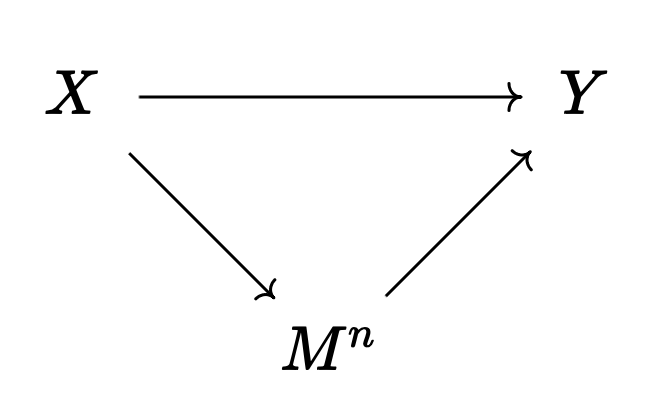
\begin{proof}
An element of the image is , where and . Give a morphism and a morphism . Now we finish the proof.
\end{proof}
projective morphisms
Recall that the dual of an -module is defined as . Taking , we obtain a natural -linear map
The image of is denoted by , and its elements are called projective morphisms from to .
Lemma
For any -module , is a -sided ideal of the ring .
\begin{proof}
It is easy to check for any and , one have .
\end{proof}
dual basis lemma
Let be an -module. TFAE:
- is a finitely generated projective module.
- .
- For any -module , the morphism is an isomorphism.
- For any -module , the morphism is an isomorphism.
- The morphism is an isomorphism.
\begin{proof}
i)→ii) Since is a finitely generated projective -module, there exists such that , that is, is a direct summand of . Define and . Notice that , so . Now we finish the proof.
ii)→iii) Assume , then for any . Consider the morphism
Now we check that is the inverse of . Notice that
where and so . On the other hand, notice that
It remains to verify . Observe that , then
and we have done.
- iii)→iv)
iv)→v) It is trivial, by taking .
v)→i) Assume and such that
It deduces that . Define -module homomorphisms and . Then and so , i.e., is a direct summand of . Therefore, is a finitely generated projective module.
\end{proof}