Definition
Assume that acts on with . Define , then is a -module, which is called permutation module associated with .
Example. Let be a finite group and , then we have a left coset decomposition
and acts on . Therefore, is a -module, which is called coset representation.
Restriction of Module
Definition
Let be a group and and is a representation of , then is a representation of , which is called restriction of to , denoted by , or .
Remark. Simple -module is not necessarily simple -module .
Induced Module
Now let be an -module, then is a -module with respect to action with and . Consider subspace in spanned by
Note that is a -module, i.e., is -invariant.
Definition
Let , and let be an module. Define , then is an -module called induced module from an -module , denoted by , , or .
Remarks.
- For details, look into file on tensor product of two modules over ring .
- In fact, the induced module above is .
Proposition
For a finite group , given a left coset decomposition , the vector space
and .
\begin{proof}
Note that
On the other hand, for any and ,
Define , then . Note that as vector space. Then we have
and so .
\end{proof}
Example. Let and . Define , then is a permutation -module. A basis of is
as . In the other word, the basis of can be identified as where and runs over a basis of .
Example. Let . Consider the trivial module of . A basis of is
and for some . We say the coset representation of .
For a general -module , we want to compute character of . The corresponding matrix of is a permutation block matrix with each block being . Here is defined as . See here.
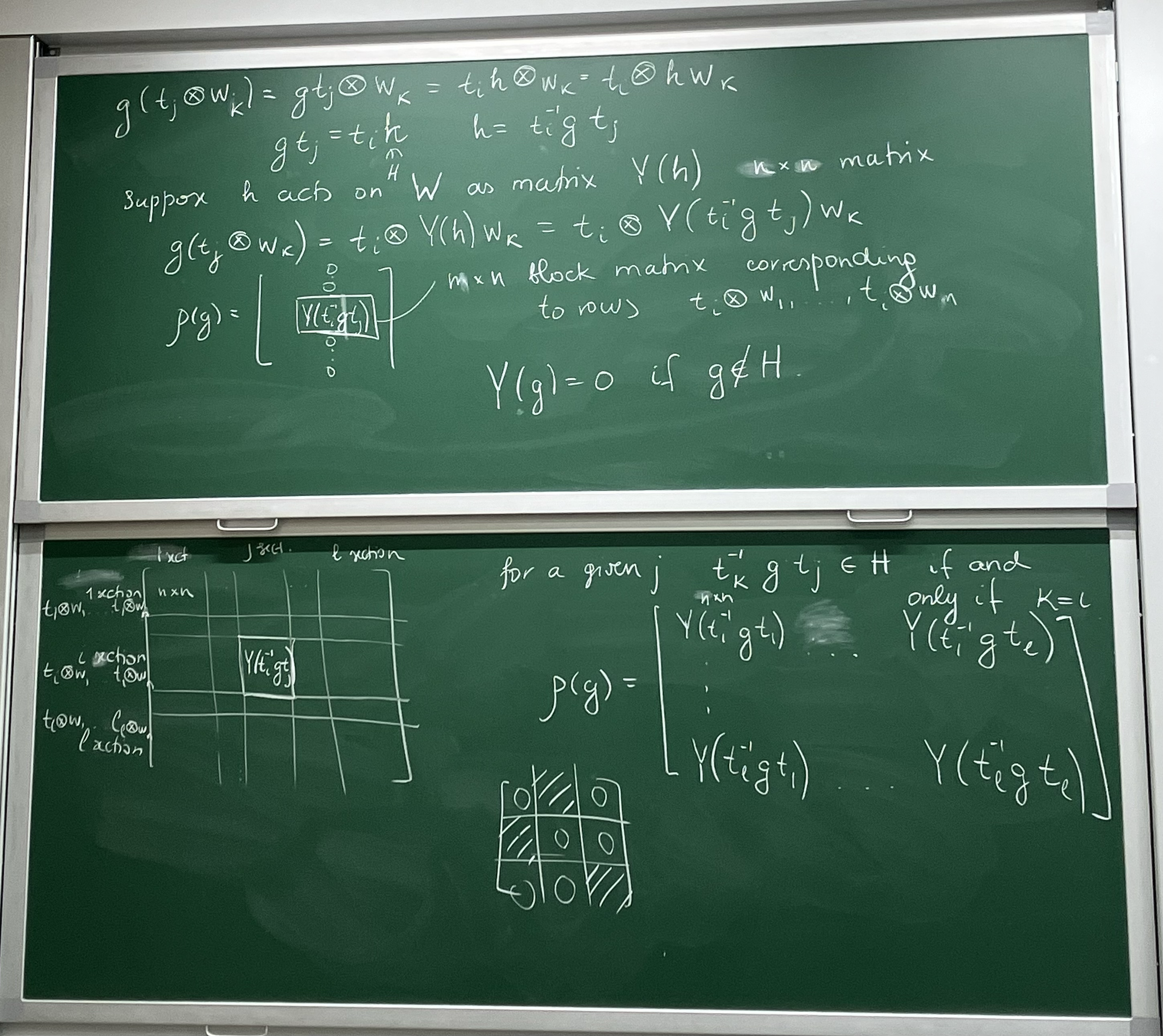
Proposition
Let be a -module with character , then with the convention that if .
\begin{proof}
By the argument above, . Since is constant on conjugacy class, there is
and now we finish the proof.
\end{proof}
Corollary
.