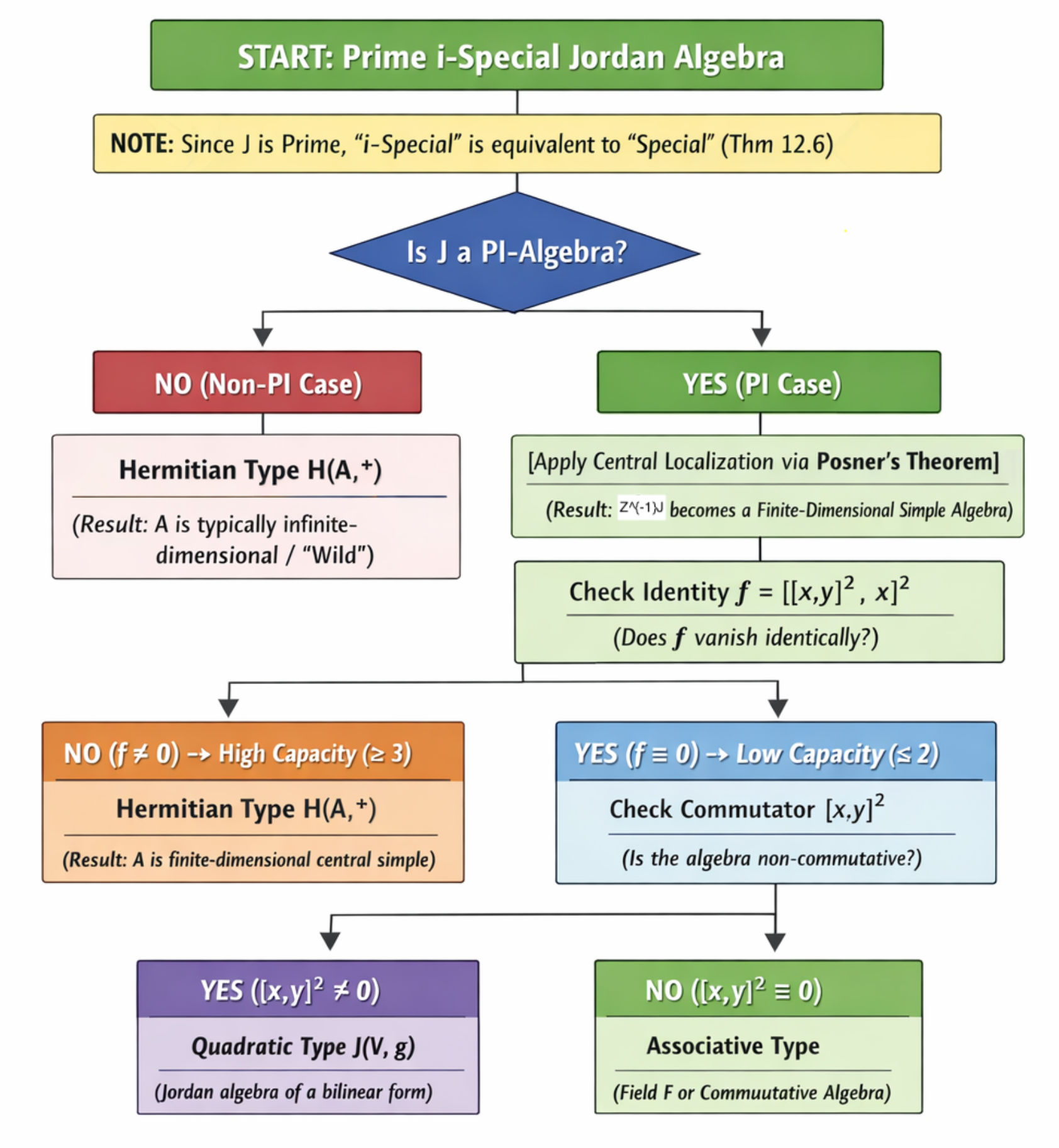
Our goal is to consider the classification of prime Jordan algebras, with a particular interest in the infinite-dimensional case.
According to the structure theory, the classification naturally divides into two branches based on , the variety generated by special Jordan algebras.
- The i-Special Case ( )
- This variety is characterized by the set of all polynomial identities that hold for special Jordan algebras (s-identities), such as Glennie’s identity.
- We show that such algebras fall into
- the Hermitian type , or
- the quadratic type .
- The i-Exceptional Case ( )
- 13 Infinite-dimensional Jordan Algebras II - i-exceptional Case considers algebras that fail to satisfy -identites.
- A key result is that such algebras cannot be infinite-dimensional; they are forms of the 27-dimensional Albert algebra.
This section is organized as follows.
- the Polynomial Identity f and Simple Classification finishes the classification of finite-dimensional simple Jordan algebras.
- Define
- (capacity ≥ 3) If , then
- If , then either
- (capacity = 1) , or
- (capacity = 2) .
- Radical and Speciality gives a criteria of special Jordan algebra in the form of .
- Remark that each Jordan algebra is a quotient of , but here we only consider the quotient of for computational convenience.
- If such Jordan algebra is prime, i.e. , then it is special.
- Furthermore, without proof, a prime Jordan algebra is i-special iff it is special.
- Therefore, in the following sections, we focus on the classification of Prime Special Jordan Algebras.
- Central Localization of Prime Special PI Jordan Algebras is a reduction from prime PI to finite dimensional simple.
- It uses the similar method of Posner, that is why we assume PI. (For non-PI case, and they are wild.)
- We can get finite dimensional simple Jordan algebra from prime PI Jordan algebra via central localization.
- Therefore, by Classification of JNW, a prime special Jordan PI-algebra can be classified as
- satisfies , and so is a finite-dimensional simple Jordan algebra satisfying .
- [[#structure-of-prime-pi-jordan-algebras-satisfying-f0|Structure of Prime PI Jordan Algebras Satisfying ]] divide the prime Jordan algebra with into two parts
- if , then ;
- if , then is associative.
the Polynomial Identity and Simple Classification
Let be a set of variables. Take , then is a Jordan element in . There exists a non-associative polynomial such that . Define .
Recall that we have proved the following theorem.
Link to originalf(x,y,z,t,u,v)=([ [x,y]^2,x]^2,[ [z,t]^2,z]^2,[ [u,v]^2,u]^2)_+.
In this subsection, we consider the later case.
Lemma
Let be a simple finite-dimensional Jordan algebra (over ), and satisfies . Then is either or is a Jordan algebra of bilinear form.
\begin{proof}
Assume that .
For , .
There exists some element such that in , leading to a contradiction.
Hence .
By 7 Capacity of Jordan Algebras ≤ 2, when , ; when , .
\end{proof}
Radical and Speciality
In this subsection, we aim to prove that
Let . If , then is special.
Link to original
Recall that homomorphic image of is special, and .
Lemma
Let . For any , .
\begin{proof}
Take .
Since , it can be written as , where are monomials in .
By ^1k683q, there is . Define , then
Take .
By , we know and so .
Now we finish the proof.
\end{proof}
Corollary
.
Lemma
Let be a special Jordan algebra, and let be an associative algebra. Assume that and . If and , then .
\begin{proof}
WLOG we may assume that and prove that . (Otherwise take and .)
Let .
Then .
Consider .
For any , .
Since , we have and so . In associative algebra we have
It follows that
Since and , there is . Since , is annihilates -sequence and . It yields that . As and , we have for any .
Define .
We prove that .
To prove that, it is enough to prove that and are ideals in .
For any and , .
Since generates , we have .
Thus is an ideal and so is an ideal of .
Since is semisimple, and so .
\end{proof}
Corollary
Let be a special Jordan algebra, with and . Then .
\begin{proof}
Define , then and .
Let with .
By ^786164, and so .
Hence is semi-prime and .
It follows that and so .
The other inclusion: let , and let be any -sequence in which contains . Since and , we know is a -sequence in and so . Then it contains and .
Now we finish the proof.
\end{proof}
Theorem
Let . If , then is special.
\begin{proof}
Define .
Then by ^eh49pd and so .
Note that
Since , we have
Let , then by ^b8ac58 and
On the other hand, since , we have in . Thus . Combining this with the previous inclusion, we get
and
Therefore, is special.
\end{proof}
Remark. Although ^vtiqhh is stated for algebras in the form of , the conclusion holds generally for . For any i-special Jordan algebra (i.e., ), if is prime, then is special. Specifically, Cohn’s examples, which are i-special but not special, are known to be not prime.
Central Localization of Prime Special PI Jordan Algebras
For associative prime PI-algebra, its central localization is central simple.
Posner
Let be an associative prime PI-algebra over with center and let . Then is -algebra, which is central simple and of finite dimension.
In fact, for a prime special PI Jordan algebra, we can use the generalized Posner theorem and get a finite-dimensional simple Jordan algebra via central Localization. Then by Classification of JNW, we have the following conclusions.
Theorem
Let be an associative algebra with involution. Assume that is a prime PI Jordan algebra. Then , is a simple algebra over field , and dimension of over is finite.
Lemma
Let be a prime Jordan algebra generated by three elements. Suppose and satisfies , where
Then . Moreover, is of finite dimension over and or is a Clifford algebra.
\begin{proof}
Since is generated by three elements (variables in ), we can write .
By Cohn’s Theorem, for , the free special Jordan algebra coincides with the symmetric elements of the free associative algebra, i.e., . Thus, .
Since is prime, we have . By ^vtiqhh, we conclude that is special.
Since is special and prime, it satisfies the condition of the analog of Posner’s Theorem. This implies that is a finite-dimensional central simple algebra over the field .
Since satisfies the identity , its localization also satisfies . Recall the classification of finite-dimensional simple Jordan algebras: if a simple algebra satisfies (i.e., degree ), it must be either:
- Degree 1: ; or
- Degree 2: is a Jordan algebra of a bilinear form (Clifford type).
This completes the proof.
\end{proof}
Structure of Prime PI Jordan Algebras Satisfying
Let be the variety generated by special Jordan algebras. The following lemma is a “local global principle”.
Lemma
Let satisfying . Then .
\begin{proof}
Let , then clearly .
To show the other inclusion , it is enough to show that for any and ,
It is equivalent to showing that is an ideal in .
We will assume that (finitely generated). Consider the quotient by the nil radical
where each is a prime Jordan algebra. Since satisfies , each component also satisfies .
By ^boupap, for each , the center , and the localization is a simple finite-dimensional algebra over the field . Specifically, is either the field itself or a Clifford algebra.
Suppose there exist such that . Then there exists some and an epimorphism such that the image (and is not nilpotent) in .
However, consider the images of and in the central localization . Since , is “locally nilpotent” in . This property is preserved by homomorphism and localization. In a finite-dimensional simple Jordan algebra (which is either a field or Clifford type), the only elements satisfying the definition of are the zero elements (since the radical is 0). Therefore, and in .
It follows that in . Since is prime and embeds into (up to central torsion, but prime algebras are torsion-free over center), this implies in (or is nilpotent), which contradicts the assumption that .
Thus , and is an ideal.
\end{proof}
Now we classify the elements in with . Define .
- If is a prime algebra which satisfies and , then . ( is of finite dimension over .)
- If , then is described in the following theorem.
Theorem
Let be a non-degenerate Jordan algebra which satisfies . Then is associative and thus a domain.
Therefore, if is simple and , then one of the followings hold.
- , for some simple associative ;
- is PI algebra;
- if does not satisfy , then ;
- if satisfies , then is associative.