The relationships between the various free algebras discussed in this section can be complex. The following diagram provides a structural roadmap of these subalgebars and their key distinctions.
Error: is a subalgebra.
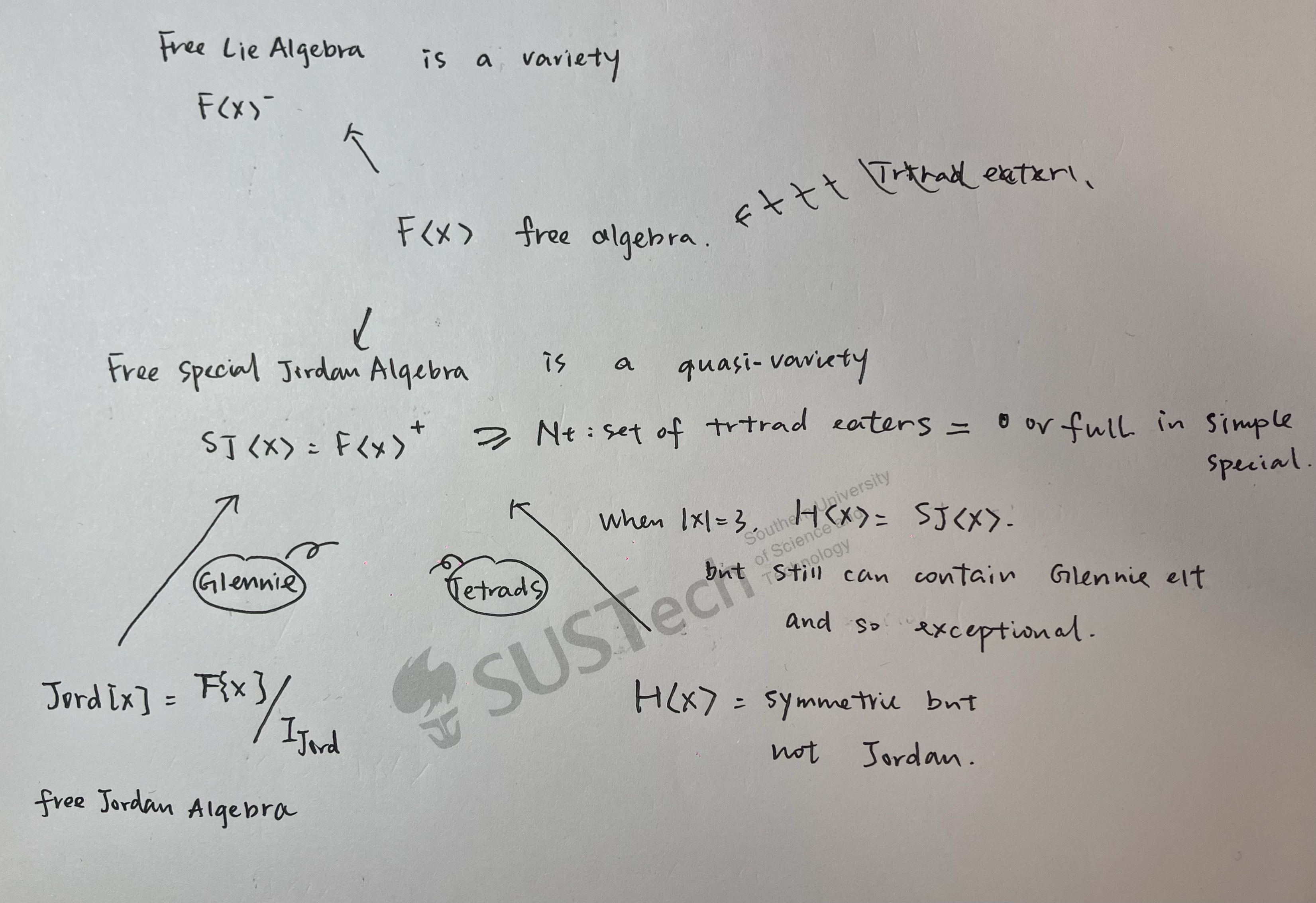
Free Algebra and Special Universal Envelopes
Free Lie and Special Jordan Algebra
Definition
Let be a set of variables. Denote by a free associative algebra generated by .
The subalgebra of generated by is the free Lie algebra generated by , denoted . Its elements are called Lie elements.
- There are at least ways to check whether given element of is Lie element or not.
- Denote by the element . The Dynkin-Specht-Wever criterion guarantees that is homogeneous of degree that is a Lie element iff .
- The other criterion (Friedrichs’ Criterion) considers the coalgebra structure of , which is given by a comultiplication . We say is primitive, if . For any , is a Lie element iff is primitive.
Analogously, the subalgebra of generated by is the free special Jordan algebra, denoted . Its elements are called Jordan elements.
- Contrary to the case of Lie algebras, is NOT free Jordan algebra (since it is not closed under homomorphic images) and we do not know criteria to decide if element is Jordan element.
- Nevertheless, has the following universal property of free algebras.
Proposition
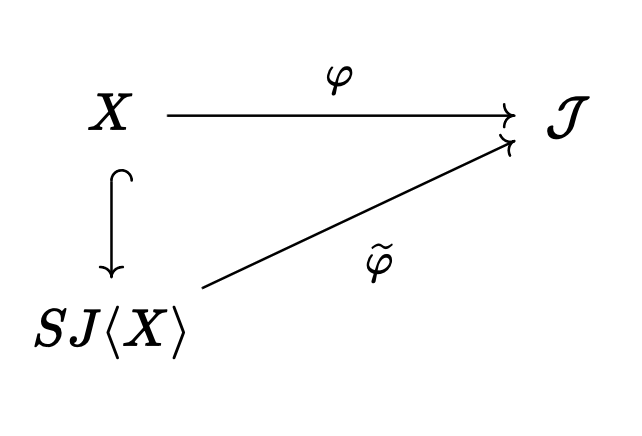
Let be a special Jordan algebra. Then any mapping can be extended to a homomorphism and is unique, i.e. the diagram commutes.
\begin{proof}
Let be a special Jordan algebra, then there exists an associative algebra such that .
Therefore, we have .
Since is a free associative algebra, there exists associative homomorphism which extends .
Then is a homomorphism of Jordan algebras and taking the restriction to as .
We obtain that is a homomorphism of Jordan algebras.
Moreover, since , the map is what we desired.
\end{proof}
Remark. The class of special Jordan algebra is closed under direct sums and subalgebras, but they are not closed under homomorphic images (see ^ajsspd) and so not forms a variety of algebras. This class forms what we call quasi-variety, which consists of algebras satisfying quasi-identity. A quasi-identity is a relation of type , for example define the quasi-variety of algebras without nilpotent elements. Each quasi-variety contains free algebras.
Special Universal Algebra
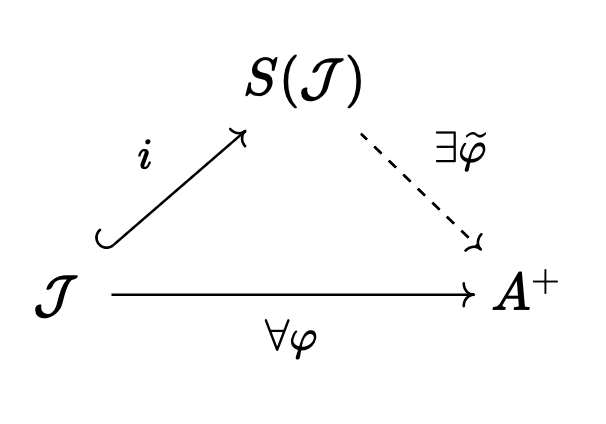
Let be a Jordan algebra. The algebra with a special injection is called special universal algebra of , if for any homomorphism with an associative algebra, there exists a unique homomorphism of associative algebra such that .
Proposition
Let be a Jordan algebra. Consider the tensor algebra generated by a vector space
and an ideal of generated by , . Then .
\begin{proof}
Let be a mapping defined by , for any .
Let be a homomorphism of Jordan algebras, with being an associative algebra.
In particular, is linear.
Since is the free associative algebra over , there exists a unique homomorphism of associative algebras such that .
Observe that since for any , . Thus there exists such that .
\end{proof}
Exercises.
- Let be Jordan algebra. Show that is special Jordan algebra is injective. See here.
- Show that .
- Let be Jordan algebra of dimension . Show that .
Relation between and
Note that consists of Jordan polynomials. Obviously, because contains only symmetric elements, whereas contains anti-symmetric elements like .
Therefore, the meaningful comparison is between and the set of symmetric elements . While is always true, the equality does not hold for .
Definition
Define the free associative algebra with , and define a involution by for .
Denote . Clearly .
Example
Note that and is a Jordan subalgebra of . Furthermore, we have .
\begin{proof}
For any , we denote .
We claim that , but .
Otherwise, assume that .
Consider the Grassmann algebra .
Define .
Then there exists , which is also a homomorphism of Jordan algebras .
Note that
On the other hand, since , there exists a Jordan polynomial such that , which deduces that
which is impossible.
Therefore, and so .
\end{proof}
From the proof of ^gk08p4, we know the element in the form of is the gap between and .
Cohn' theorem
Jordan algebra is generated by with .
\begin{proof}
Define .
It is enough to show that for any , .
We prove it by induction on degree of monomial .
When , .
When , .
Suppose that it is valid for and we will show that it is valid for . Define iff . Note that
and
If is odd, we have finish the proof.
Now suppose that is even. Then we have
Note that , so with . Finally, if , then .
Now we finish the proof.
\end{proof}
Corollary
If , then .
Remark. Shirshov gave direct proof , who gave a algorithm how to write symmetric word in these variables on Jordan elements.
Remark. Although holds when , its homomorphism image can be exceptional.
Let . Then is an exceptional Jordan algebra.
Link to original
Speciality and Exceptionality Criteria
Method 1: Cohn Criterion
Cohn criterion
If is a special Jordan algebra, , denote . Then is special iff .
\begin{proof}
Suppose is special, then there exists associative such that .
Then by definition of special universal algebra, there exists such that , where .
Note that , so is obvious.
Additionally, .
Therefore, .
Conversely, assume that .
Consider , and define .
Note that .
So and the proof is complete.
\end{proof}
Corollary
Let , and let . If is special, then with .
By ^6uo6n2, if is special, then . If , then there exists such that . We call such element Cohn element.
Method 2: Shirshov-Cohn theorem
Let be the free non-associative algebra over vector space . Then , where . Recall that has universal property: for any -algebra and linear map , there exists the unique homomorphism between -algebras
such that .
Remark. When ,
- is the free non-associative algebra on
- is the free associative algebra on
- is the free commutative associative algebra on
Definition
Define . Then is the free Jordan algebra over .
Shirshov theorem
The free Jordan algebra with two generators is special.
Remark. By ^xrk076, . When , there is no information on and .
Cohn theorem
Homomorphic image of is special.
\begin{proof}
Take and .
We will prove that there are no Cohn elements ( and ).
Assume that with and , then
It follows that .
For any , consider in the element , where . Since , the element by ^0xovb9. Then there exists such that .
For any , as is an ideal, and so .
By ^6uo6n2, is special.
\end{proof}
Shirshov-Cohn theorem
Any two generated Jordan algebra is special.
\begin{proof}
Any Jordan algebra with two generators is a homomorphic image of by ^xrk076.
\end{proof}
Method 3: Glennie identity
Remark
However, , whose proof is as follows.
\begin{proof}
There is Glennie identity of multi-degree .
is a scalar multiple of Glennie identity discovered by Shirshov.
Define with . Then and so .
In any associative algebra, . Hence .
Define . For any special Jordan algebra and , we have .
On the other hand, for exceptional Jordan algebra, as the following example shows.
Exercise. For , define
with .
There is .
\end{proof}
Construction of Exceptional Algebras
Example
Let . Then is an exceptional Jordan algebra.
\begin{proof}
Consider , then .
Since , by ^0xovb9 we have .
Thus it is enough to show that is a Cohn’s element.
Suppose , then there exists such that all monomials contain and . Since is homogeneous and is homogeneous, we know or .
Suppose , then . Since , such do not exist. Hence and . The multi-degree of is . As , there is and is a linear combination of tetrads, that is,
We can compute that , , and .
So .
However, it is impossible, because tetrad does not belong to .
Therefore, and so is exceptional.
\end{proof}
This example can be generalized as the following theorem, which will be proved later.
For big enough and nonzero , is an exceptional Jordan algebra.
Link to original
Structure Theory of Special Jordan Algebras
Tetrad Eater
Definition
is called a tetrad eater, if for all . Note that
For , we say iff .
In ^1k683q, we prove that is skew-symmetric under transposition.
Exercise 6. For any , .
Exercise 7. For any , .
Exercise 8. For any , .
Lemma. All these exercises can be generalized for any .
Corollary
Let . Then we have
- (1) ;
- (2) .
Denote by associator of with respect to Jordan product. That is, for any ,
Lemma
For all , there is .
\begin{proof}
Take .
Then
Define . Then
where .
\end{proof}
Proposition
Let such that for all . Then is a tetrad eater.
\begin{proof}
By ^nswau2 we know .
Linearizing in , i.e. , we get
Similarly, by linearizing in , there is
Linearizing in , we obtain
which follows that
Now we finish the proof.
\end{proof}
Corollary
For all , the element is tetrad eater.
\begin{proof}
Let , and let .
For any , there is by ^nswau2, which deduces that for any .
Hence by ^kymkph, is tetrad eater.
\end{proof}
Definition
Let be the set of tetrad eaters.
Theorem
For big enough and nonzero , is an exceptional Jordan algebra.
\begin{proof}
Take such that .
Then , where and .
We claim that . Otherwise is a Jordan element. Since do not appear in , has form for some . We know that is not Jordan, contradiction.
By ^6uo6n2, is exceptional.
\end{proof}
Remark. For simple special Jordan algebras, the ideal generated by tetrad eaters is either the entire algebra (standard type) or zero (PI type)—an “all-or-nothing” property. The quotient construction forces an intermediate state that violates this rigidity, resulting in an exceptional algebra.
the Main theorem
Any special Jordan algebra is either for for some -simple associative , or PI Jordan algebra.
Define as associator with respect to in associative algebra, that is, . Define , where is a derivation of .
The set satisfies the following closure properties.
Proposition
- If , then for any .
- For any and any , there is and .
- For any and , we have .
By this proposition, one can construct an ideal contained in .
Corollary
For all , there is
A simple special Jordan algebra falls into one of two types:
- : for a -simple associative algebra with involution ;
- : satisfies the polynomial identity ;
where .
Definition
We call Jordan algebra a PI Jordan algebra if satisfies polynomial identity such that .
Theorem
Let be a special simple Jordan algebra. Then , where is a -simple associative algebra with involution, or satisfies polynomial identity , where
\begin{proof}
Let .
We show that is an ideal in .
is a subspace in . For any and , take and such that . Consider such that for , and for . Then and .
Since is simple, either or . If , then the element of satisfy by ^9fb994 and so is a PI Jordan algebra. If , then is special. It follows that and by ^6uo6n2 . By universal special enveloping, we have
Define . Note that , and . Since , we have that . By ^1k683q, .
In general, is not -simple.
Define , where means stable by .
Then as .
By Zorn’s lemma, it has maximal element .
Set , then is still an algebra with involution since .
Since , and so .
Let be the canonical projection, then .
Hence , and is -simple by the maximality of .
\end{proof}