Product and its Existence
Definition
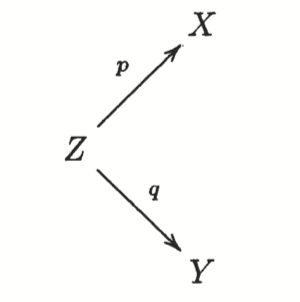
Let be a category, objects in . An object plus two morphisms
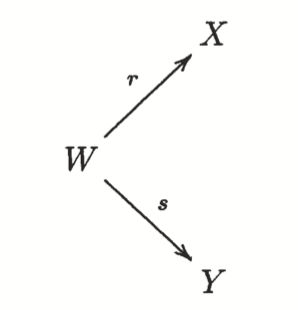
is a (fiber) product if it has the following universal mapping property: for all objects and morphisms
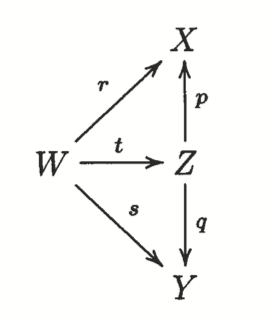
there is a unique morphism such that , i.e., such that
commutes.
Lemma
If and exists, then , where is a forgetful functor.
\begin{proof}
For any , define and and . By universal property, there exists unique and .
Conversely, for , we have and where are projection map.
\end{proof}
in the Category of Affine Varieties
Proposition
Let and be affine varieties, with coordinate rings and . Then
- there is a product prevariety .
- is affine with coordinate ring .
- a basis of the topology is given by the open sets
- is the localization of at the maximal ideal .
Remark. We only need the fiber product is a prevariety. If with affine varieties , then is a fiber product iff are fiber products.
\begin{proof}
It is a sketch of proof generated by Gemini.
-
Construction of (Set of Points and Algebraic Structure):
-
If is defined by ideal and by ideal , then the set of points can be naturally viewed as the algebraic set in defined by the ideal .
-
Its coordinate ring is . There is a standard isomorphism:
-
Key Algebraic Fact: Since is an algebraically closed field and are varieties, and are integral domains. In this case, is also an integral domain.
-
Corollary: Because is an integral domain, the radical of the ideal generated by in is a prime ideal. This means the algebraic set is irreducible. Therefore, is itself an affine variety, whose coordinate ring is precisely .
-
-
Verifying the Universal Property:
- We need to show that the constructed affine variety satisfies the categorical definition of a product.
- The projection maps and are natural (algebraically corresponding to and ) and are morphisms.
- Given any prevariety and two morphisms , , we can first uniquely define a map of sets such that , namely .
- We need to verify that is a morphism. This can be done by checking that the pullback maps regular functions on to regular functions on . Since is generated by elements from and , and since and already pull back elements of and to (because are morphisms), using the universal property of tensor products, one can show that is a ring homomorphism, and thus is a morphism.
-
Basis of Topology:
- The basis for the topology on an affine variety is given by the principal open sets , where .
- In , an element has the form . The point corresponds to the maximal ideal . The condition is usually interpreted as , which means . Thus, these sets form a basis for the topology.
-
Local Ring:
- The local ring of an affine variety at a point (corresponding to maximal ideal ) is the localization .
- Therefore, .
- The equivalent description given in the Red Book is that is the localization of the ring at the maximal ideal .
- (Here and . denotes the ideal generated by elements where , and is similar. This ideal corresponds to the functions in that vanish at . Note: The corresponding formula in the original notes was incorrect).
Now we finish the proof.
\end{proof}
in the Category of Prevarieties
Theorem
Let and be prevarieties over . Then they have a product.
\begin{proof}
Assume is affine. Then with affine and exists as an affine variety by ^f0237a. Since is an open set in both and . Then we can glue and along . Now we get a topological space, and then we construct a sheaf on it by
Assume is affine. Then with affine and exists as an affine variety by ^f0237a. Since is an open set in both and . Then we can glue and along using the identity map. Repeating this for all pairs yields a topological space . We construct a sheaf on by defining its sections on open sets :
Now we verify is a prevariety. Notice that is a finite cover of , where are irreducible affine varieties. Also note that and are connected, then is also connected, because a space covered by finitely many connected open sets with overlapping intersections is connected. Therefore, is a prevariety. Define .
It remains to check the universal property. For any prevariety and , define . Then it remains to check is a morphism. Take a finite open cover of such that for some . Then is a morphism by ^f0237a.
By the definition of morphism, it suffices to show for any open set and , . For any , there exists containing such that is a morphism. Define , then is also a morphism. It deduces that
That is, is regular at for any . Thus and so is a morphism. The uniqueness is easy to check.
In general, prevariety can be written as with affine. As exists, we can glue and along . Similarly, we can get a topological space , which satisfies the universal property.
Remark. For affine and , take open , then is open in .
in the Category of Projective Varieties
Theorem
The product of two projective varieties is a projective variety.
\begin{proof}
Assume and , then where . Define the Segre embedding
and is injective.
It suffices to show is a closed embedding, that is, the image of is a subvariety of . Note that
where , and if and , . Then , that is, the ideal generated by .
Check that
is a morphism between affine variety. So is an isomorphism.
\end{proof}
Hausdorff Axiom
Hausdorff axiom
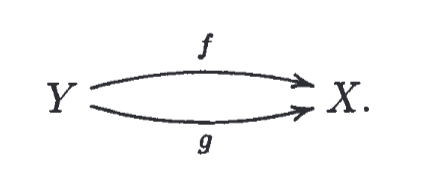
Let be a prevariety. is a variety if for all prevarieties and for all morphisms
is a closed subset of .
Too similar definitions to differ
- Affine variety: Defined by polynomial equations in affine space.
- Prevariety: A space locally modeled on affine varieties (can be glued from them).
- Variety: A prevariety satisfying the Hausdorff axiom — morphisms into it are distinguishable (equalizer sets are closed).
Example. Let , . Also let be a morphism . is called the diagonal morphism, and
Therefore the Hausdorff axiom implies is closed. In fact, we can prove that for a topological space , is Hausdorff iff is closed.
Proposition
Let be a prevariety. Then is a variety if and only if is closed in .
\begin{proof}
Suppose are given. Then they induce a morphism . Since
being closed implies the Hausdorff axiom, so is a variety.
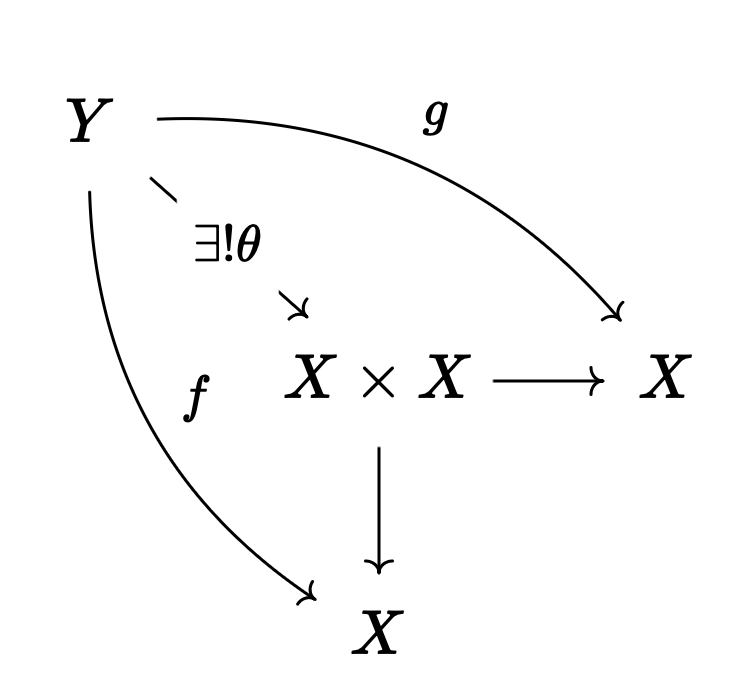
Conversely, if is a variety, then take with and is closed.
\end{proof}
Example. a line with two points at zero does not satisfy Hausdorff axiom, see here.
Separateness = "limit is unique"
Why is this called the “Hausdorff Axiom”? This term draws an analogy with the Hausdorff property in topology:
- Topology: Hausdorff separation means distinct points can be separated by disjoint open sets.
- This is equivalent to the diagonal being closed in (product topology).
- Algebraic Geometry: The separation axiom here distinguishes morphisms. For any , the set where they agree, , must be closed in (Zariski topology).
- Connection to Limits/Closure: Taking the closure of is similar to taking a limit. As all open sets are dense in (if is irreducible), a morphism is uniquely determined by its values on an open set.
- This axiom is also equivalent to the diagonal being closed in (product Zariski topology).
Proposition
is variety, and is a closed sub-prevariety. Then is a variety.
\begin{proof}
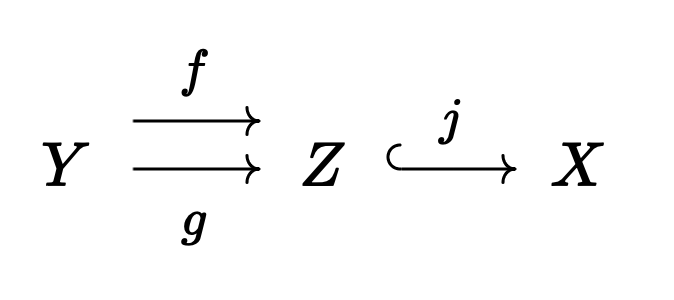
Since is variety, is closed and so is closed. Hence is a variety.
\end{proof}
Proposition
are varieties, then is variety.
\begin{proof}
Let be an arbitrary prevariety, and let be two arbitrary morphisms. By definition, it suffices to show
is a closed subset of .
Let and be the projection morphisms. We can decompose the morphisms and into their components:
Since compositions of morphisms are morphisms, are all morphisms. Note that iff both and hold. Let and , then one know . Since and are varieties, and are closed and so for .
\end{proof}
Proposition
Affine variety is a variety.
\begin{proof}
Let be an affine variety, and let be its coordinate ring. To show is an variety, it suffices to show for any prevariety and any morphisms , the equalizer is closed in .
For any , the functions and are global regular functions on since are morphisms. Then their difference is also a global regular function on . Note that iff for all . So can be written that
By definition of a prevariety, is a closed subset of . Now we finish the proof.
Alternating proof. Let be an affine variety, embedded as a closed subset in some affine space . Then the product is a closed subset of . Note that
is defined by the equations , where are coordinates on . This is clearly a closed set.
It follows that is still closed in and is also a closed subset of . By ^t398yf, is a variety.
\end{proof}
Proposition
is locally closed. Remark that we say is locally closed if for any , there exists open containing such that is closed in .
\begin{proof}
Take with . Then is closed in . For any , let be an affine open neighborhood of in . Remark that . Then
where is an open set containing . Define and , then are morphisms from to . Since is a variety, is closed in , where . Now we finish the proof.
\end{proof}
Proposition
Let be a prevariety. If for any , there exists an open affine subvariety containing . Then is a variety.
\begin{proof}
Define . Take . Assume and , and we aim to show . By assumption, there exists an affine open set such that . Then is an open set in . Since is affine, is closed in by ^w3d7va. It deduces that .
Note that . Thus and so is closed.
\end{proof}
Corollary
is a variety.
\begin{proof}
For any , take such that . Then contains . By ^c0400a, is a variety.
\end{proof}
Proposition
Let be a variety, and let be affine open subvarieties. Then is affine.
Counterexample. is not a variety.
\begin{proof}
Since is a variety, the set is closed by ^t398yf. Since are affine open subvarieties, we know is affine by ^f0237a. Define
and let be the projections to the first and second factors, respectively. Since and are morphism, by universal property is also a morphism. Set , and define . It is easy to check and . Note that is closed in and is an affine variety, then is also an affine variety.
Define and , then by ^f0237a. Since is closed in , we can set . Then induces the map , and induces the map . Note that and are inverse, and we have . Therefore, is affine.
\end{proof}