Definitions
There are five equivalent definitions of generalized polygon, which is mentioned here. For example, the type (IV) is as follows.
is a finite generalized -gon if the following two axioms are satisfied:
- contains no ordinary -gon as a sub-geometry, for .
- Any two elements are contained in some ordinary -gon as a sub-geometry in .
Definition
An automorphism of is a permutation preserving , and incidence relation . The full automorphism group is the group of all automorphisms of .
Restriction of
Feit-Higman, 1964
Finite thick generalized -gons exist only for .
When , is a projective plane.
When , is a generalized quadrangle.
When , is a generalized hexagon.
When , is a generalized octagon.
Order
Let be a finite generalized -gon. Then has order if is bi-regular of degree . Remark that and are also defined here.
V Maldeghem, Generalized Polygons
Every thick generalized -gon has an order with ; if , then , and if then .
Examples
Easy Examples
The following slide comes from here.
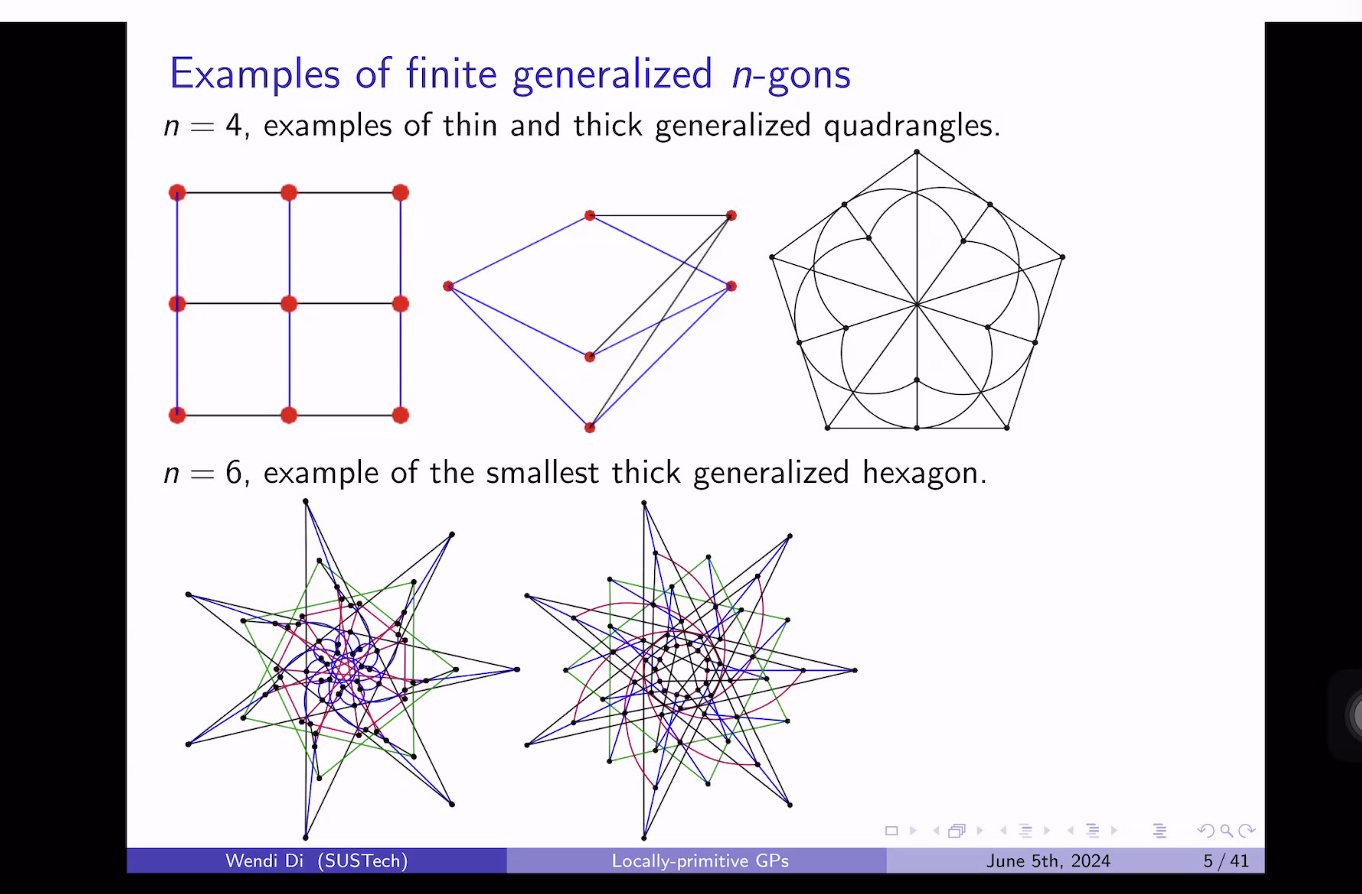
Well-known Examples
Furthermore, more well-known examples are displayed as follows:
- Thick GQs: Examples of Thick GQs
- Thick GHs and GOs: Examples of Thick GHs and GOs
Certain Symmetry
Integral Conditions
Definition
is flag-transitive (antiflag-transitive), if it has an automorphism group such that acts transitively on all flags (antiflags) of .
is point-primitive (line-primitive), if it has an automorphism group acting primitively on ().
Remark. All known GHs and GOs are flag-transitive, point-primitive, and line-primitive; all known classical GQs are flag-transitive, point-primitive, and line primitive. All of them are mentioned here.
There are two open problems:
- Classify all flag-transitive finite generalized polygons? With conjecture:
- , Kantor 1991, classical or finite exceptions.
- , are the known examples.
- Classify all point-primitive (line-primitive) finite generalized polygons?
Local Conditions
Definition
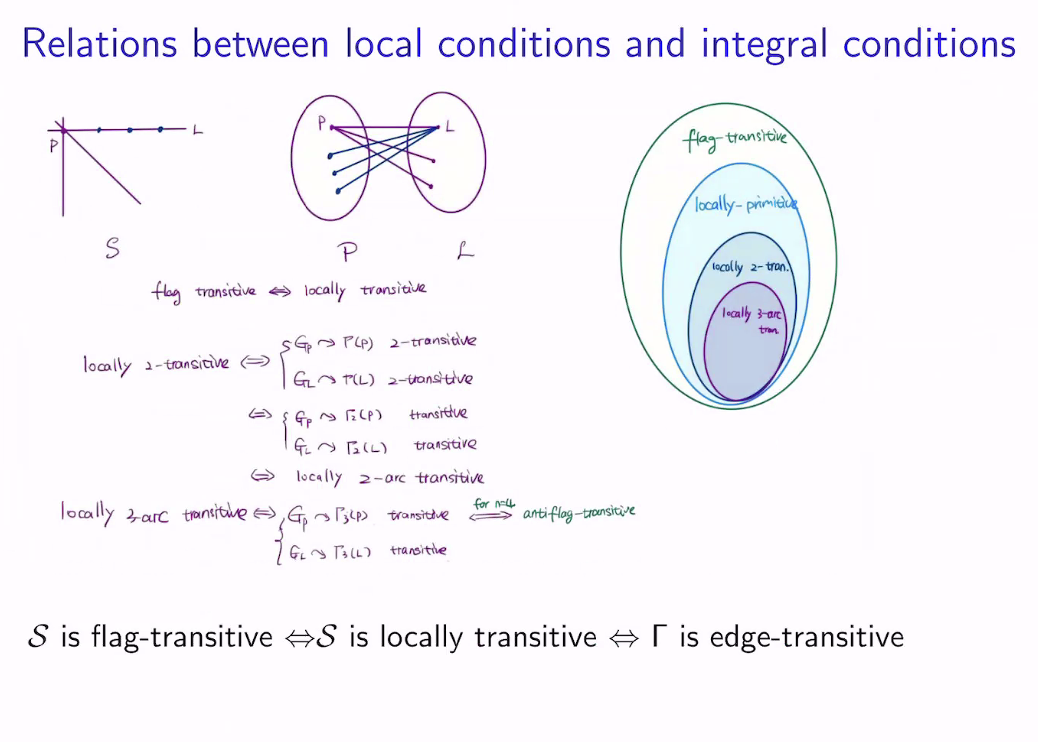
Let be a generalized -gon and . is called -locally , if for each vertex in , the stabilizer has the property in , where is the neighbor of in .
Remark. dwd gives some relations between local and integral conditions, see here.
Parameter Conditions
See here.
Some Useful Tools
See here:
- Benson type argument
- Fixed element structure
- Normal quotient graphs