lower central series
We say is a nilpotent group if it has a lower central series terminating in the trivial subgroup after finitely many steps. That is, a series of normal subgroups
where . The length of the lower central series is called the nilpotency class of .
central series
A group is called nilpotent if it has a chain of subgroups, which is called a central series,
such that and .
upper central series
A group has an upper central series terminating in the whole group after finitely many steps. That is, a series of normal subgroups
where and is the subgroup such that .
nilpotency class
For a nilpotent group, the smallest such that has a central series of length is called the nilpotency class of ; and is said to be nilpotent of class .
Equivalently, the nilpotency class of equals the length of the lower central series or upper central series.
Observations.
- A nilpotent group is a solvable group.
- For any prime , a -group is a nilpotent group.
- Direct product of two nilpotent groups is nilpotent.
- and are not nilpotent.
- Note that . (Maybe that’s why they are called upper/lower central series.)
Theorem
The followings are equivalent:
- is nilpotent.
- if , then .
- each maximal subgroup of is normal and of prime index.
- is a direct product of its Sylow subgroups.
\begin{proof}
Assume (i) holds. Then has a central series
Let . Then there exists such that and . It yields that . So for any and , there is and so for some . We have
So , i.e. and . Thus , as in (ii).
Assume (ii) holds. Let be a maximal subgroup of . Then and so . The factor group is simple as is maximal. So is a prime, as in (iii).
Assume (iii) holds. Let . If is not normal in , then and . Let be a maximal subgroup of such that . Then . By Frattini’s argument, , a contradiction. Hence, and so is a direct product of Sylow subgroups.
Assume (iv) holds. Since -group is nilpotent and direct product of nilpotent groups is nilpotent, we obtain (i).
\end{proof}
Remark. Note that for any Sylow -subgroup. So (ii)→(iv) is easy.
Proposition
Let be nilpotent groups. Then is also a normal nilpotent group.
\begin{proof}
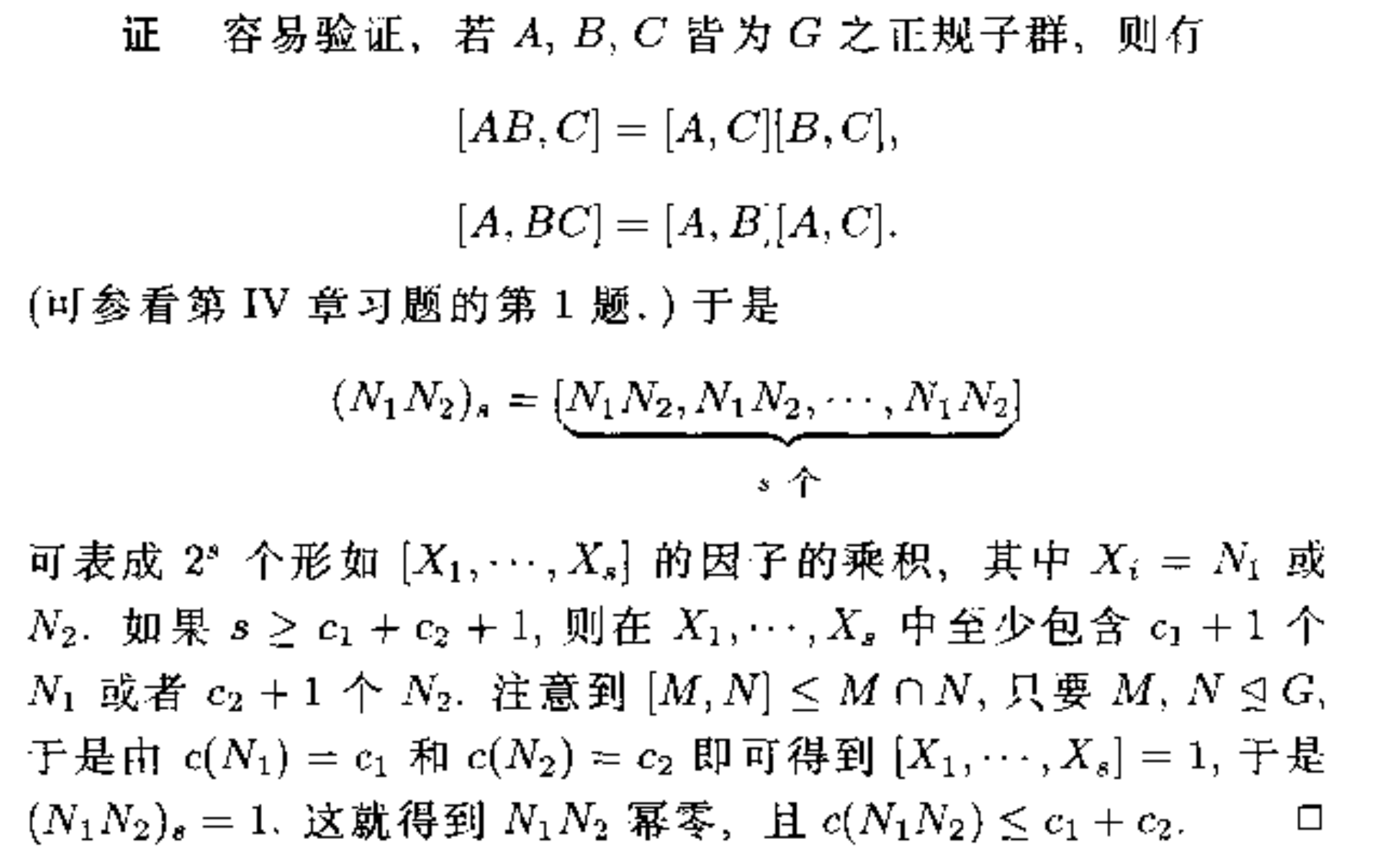
\end{proof}