NOTE
这是2024年春的“群论及其应用”笔记。
第三周缺课,第十周和第十一周的内容没有整理。
Week 1: Constructing groups (done)
Semi-direct product
Example.
We call the affine group when it has trivial center, denoted as .
from finite field
It is mentioned in Singer Cycle.
Let and let and . Define a group where .
And the automorphism group of is where the order of is .
acts on as Frobenius action.
example. Let and . Let and . Then we can verify , and .
Let where . So .
also can be written as and it has a subgroup .
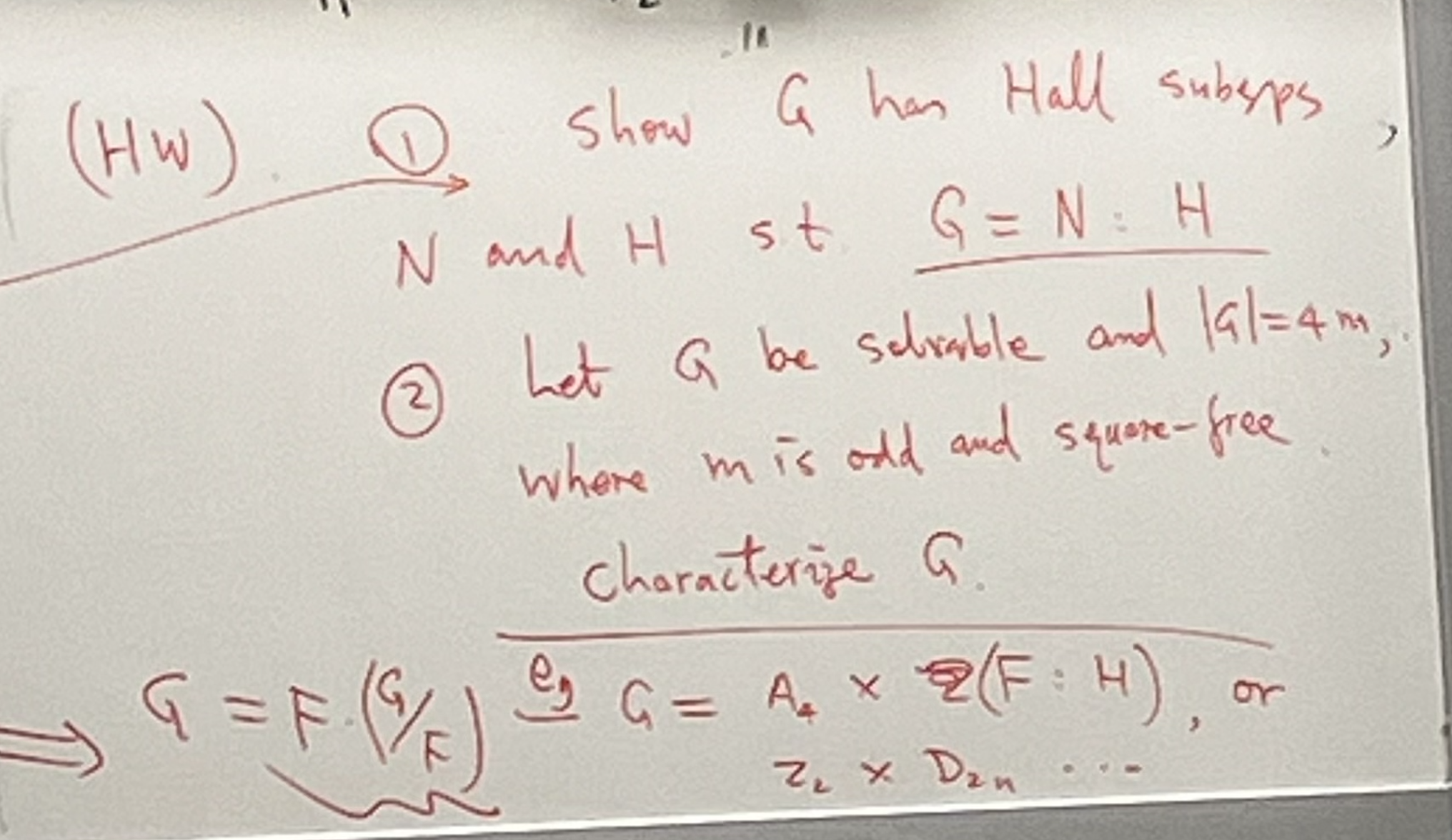
exe. Prove that all elements of order in are conjugate.
exe. , . Show that is unique and where .
(hint: consider the Sylow 3 group , which is normal and cannot be cyclic by trivial center. Then by NC lemma, .)
Week 2 The two groups whose elements with same order are conjugate (done)
Question. (1970s) If is such that elements of the same order are conjugate, then or .
Solved by P. Fitzpetrich 1985, W.Feit-G. Seitz 1988, Jiping Zhang 1988.
Week 4: Burnside transfer (done)
Let and . Define and be the permutation induced from .
Suppose . Then .
Definition
Define
as a transfer from to .
Lemma
- is a homomorphism from to ;
- does not depend on the choices of ;
- Writing in cycle form,
where is defined as following. partitions i to orbits:
\begin{proof}
(i) and (ii) are easy. For (iii), take as representatives.
\end{proof}
Definition
A group is called -nilpotent if , where and is a Sylow -subgroup, and . (equivalent: If has a normal subgroup such that , where is a prime divisor of . )
Burnside
Let be a finite group, and a Sylow -group. If , then is -nilpotent.
\begin{proof}
Since is abelian, . Let . Then . As and and abelian, and . Hence .
By Sylow theorem, there exists such that .
Also is not trivial. So with kernel . By isomorphism theorem, there is . So such that and so is -nilpotent.
\end{proof}
Theorem
Let be finite of which Sylow subgroups are all cyclic. Let be the smallest prime divisor of and let be a Sylow -subgroup of . Then:
- is -nilpotent.
- is solvable.
\begin{proof}
Since is cyclic, . It follows that . So has a normal subgroup with . Then is -nilpotent. Repeat this procedure and we get where is a Sylow -subgroup. So is solvable.
\end{proof}
Corollary
If a Sylow -group of is cyclic, then is -nilpotent and by Feit-Thompson Theorem solvable . Further is solvable.
Proposition
Let be a finite nonabelian simple group. Let be a prime divisor of .
- If is the smallest prime divisor, then is divisible by or .
- If with , then for a Sylow -subgroup ,
- ;
- is divided by .
\begin{proof}
(1) Suppose is not divisible by , then . Otherwise, a Sylow -subgroup and is -nilpotent, contradiction by simple. Thus is cyclic or . The first case is impossible. Hence and . Further and . Since is the smallest one, and . It yields that .
(2) (i) is easy. For (ii), .
\end{proof}
Exercise. . Prove that is cyclic.
\begin{proof}
is -nilpotent. .
\end{proof}
Week 5 (done)
Lemma
The number of right cosets of contained in is equal to .
Theorem
Let be finite, and let be a non-Sylow subgroup of , then .
\begin{proof}
Decompose . Note that
and
Since is not a Sylow -group, then LHS of is divisible by . Thus there exists at least one such that . It yields and so . Therefore, by .
\end{proof}
Theorem
Let be a -group.
- If , the .
- If , then and .
- is solvable.
- .
- If is a normal subgroup of and , then .
\begin{proof}
(v) By NC lemma, . Thus , that is, all elements in commutes with . So .
\end{proof}
Corollary
A group of order with prime is abelian.
Theorem
Let . Then either is abelian, or:
- for , or .
- for , or where the exponent of equals to .
\begin{proof}
Assume is non-abelian. First, suppose has an element of order . Then there exists and . If , then as in (i) for and as in (ii) for .
Suppose . Then for some integer . If , then and . It deduces that . If is odd, then for some with . Claim . Let . Since the order of is , we get back to the last case.
Assume does not have elements of order . Then each of elements of is of order . If , then is abelian. Since is abelian, . Further and , where .
\end{proof}
Remark
Define as and as .
Exercise. Prove:
open question. (…closed by zyz) automorphism group acts on G has three orbits.
Week 6 triangle group (done)
Definition
Define the triangle group as
Consider .
Assume that and is nontrivial.
Case 1. .
If , then .
If and , then .
If and , then and , which corresponding , respectively.
- [ ]
Case 2.
All possible solution: . They correspond 正三角形,正六边形,正方形. They are the only polygons filling the whole plane.
Those groups are infinity and solvable.
Case 3.
These groups are infinity and non-solvable.
Week 8 Quasiprimitive (done)
Transclude of Finite-quasiprimitive-graphs#^pn888w
Holomorph simple (HS)
This part is mentioned here.
Proposition
Let where is simple. Then .
\begin{proof}
Note that can be identified by
By NC lemma, there is .
\end{proof}
Holomorph compound (HC)
This part is mentioned here.
is of HC type if where with and is nonabelian simple.
Proposition
If is of HC type, then
where .
Classification of quasiprimitive groups
See here: Quasiprimitive Groups
This section is mentioned in Quasiprimitive Group of Type HS, HC and HA are Primitive.
Lemma
A quasiprimitive permutation group of type HS, HC or HA is primitive.
\begin{proof}
i) Let be of type HS. Let with . Then where . It remains to show is a maximal subgroup. Otherwise, there is a such that . Then an element has the form . Thus . For any element , we have and . Hence and so is a subgroup of , where
Since , the action of on by conjugation fixes . So and . Thus . So is the maximal subgroup and so is primitive.
iii) Let be of type HA. Then , where is an abelian unique minimal normal subgroup.
Suppose is imprimitive on . By Equivalent Condition of Primitivity, there is a subgroup such that and . Then and hence . Contradiction.
(iii) is mentioned here.
\end{proof}
For example, let be a nonabelian simple group. Then is a quasiprimitive group on and is not primitive, because any point stabilizer is trivial.
Week 9 Coset action (done)
Let be a group and be a subgroup of . Then there is a group action acting on . Note that , we have . If is core-free in , then is faithful.
Definition
Let acts on and transitively and faithfully. Then and are said to be equivalent if there is a - map from to , and an automorphism such that the following diagram commutes.
Theorem
and are equivalent iff and are conjugate in .
Week 10: Classification of 2-transitive group
Exercise 13. Characterize quasiprimitive permutation group such that . If is of holomorph simple, then
Burnside
A -transitive permutation group is affine or almost simple.
Proposition
Let be a -transitive group. Then:
- is primitive.
- is faithful on and transitive on .
- If , then is -transitive.
Lemma
Let be a -transitive group. Let such that with and non-abelian simple.
Then does not have a proper normal subgroup which is regular on . (i.e., is not HS, HC, SD, CD).
\begin{proof}
Suppose is regular on . Then and is half-transitive on . Let be the size of an orbits of on . Then . Also yields and , because . Thus , which is impossible.
\end{proof}
Lemma
is not regular on . Furthermore, is not TW.
\begin{proof}
Suppose is regular on . Then . By regular, and so . Then can be identified by acting by conjugation. Notice that elements in the same orbits of have the same order. Clearly, has at least prime divisor . Let be such that , and . Then , and are three orbits and so . Contradiction.
\end{proof}
Example. If and , then and , where .
Let be -transitive and let such that does not have a normal subgroup which is regular on , with and nonabelian simple.
- Then such that acting on by . We say acts on in product action.
Then , otherwise is regular. Write as where . Let be the projection of into . Then , where and .
Then and . is transitive on and normalize . Then is transitive on .
Then and is normalized by . Thus . Since is primitive, is maximal and so and .
Consider acting on . Identifying with ,
with acting on defined by .
i.e. if , then .
Example.
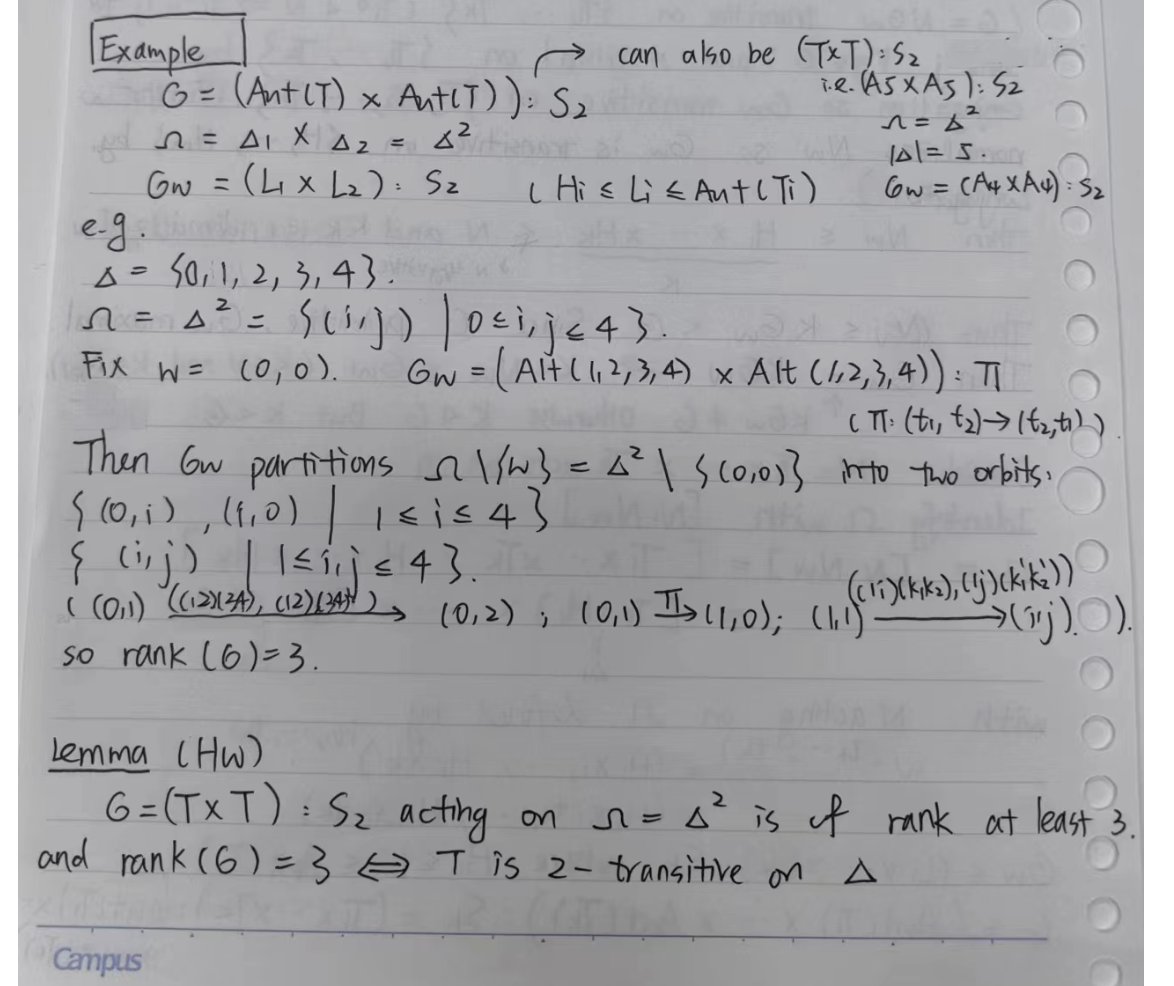
Problem.
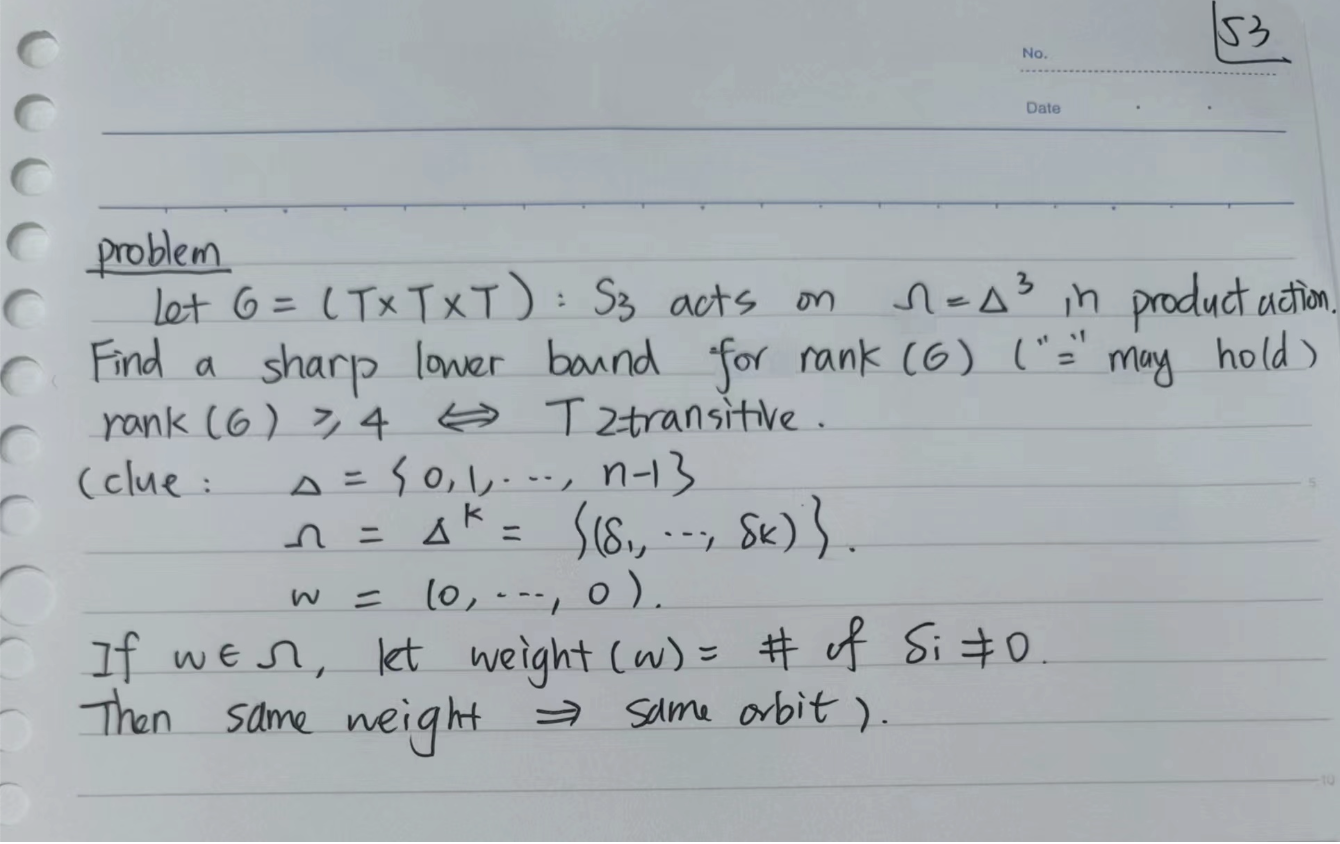
Week 11: Classification of Quasiprimitive to Classification of Quasiprimitive Rank
Theorem
If and is quasiprimitive on , then is HA, AS or and acts on in product action, where induces a -transitive action on .
\begin{proof}
By the following lemmas.
\end{proof}
Lemma
Let be regular on . Then . In particular, if is nonsolvable, then .
\begin{proof}
Identify with and let . Then and acts on by conjugation. Now the action of on partitions into orbits, whose number the number of fusion classes of . Suppose that is non-solvable. Then by Burnside’s Theorem, there exist , , such that , and . Since , , are in different fusion classes, we have .
\end{proof}
Corollary
With the lemma above, is not of type HS, HC, TW.
Lemma
Let be a quasiprimitive group of type SD. Then .
\begin{proof}
Let N=T^k\lhd_\min G. Write where are isomorphic. Then , and is regular on . Note that and with a representation . Observe that iff .
Note that , normalizes and induces an action on transitively by N\lhd_\min G (need proof). The stabilizer and acts on by conjugation transitively and faithful ( and yields ). Each element of has the form with and .
Pick two elements and are two nontrivial elements of . Then lie in the same orbits of iff there exists such that .
- If , then and so they are conjugate in .
- If , the where the latter is conjugate to . Then and so , i.e., and so are conjugate by .
- If , then , which is impossible.
Therefore, and lie in the same -orbits iff
- , or
- and , and we say and are inverse conjugate in .
Thus .
\end{proof}
Example. and . Then .
Let , where . For , define and such that acts on naturally. We say acting on is a blow-up of on .
Lemma
Using the notation above, we have
- ;
- iff and is -transitive on .
\begin{proof}
(i) Fix . For a point , define . Then if , then for any . Since preserves the weight of each point and the weight function ranges , group has at least orbits and .
(ii) Assume , then and . The set of all points with weight forms an orbits of . Thus is transitive on and so is -transitive on . Conversely, assume that and is -transitive on . Since is transitive on , then the set of all points with weight is an orbit and so for weight .
\end{proof}
Corollary
CD is not rank .
\begin{proof}
Since CD is a blow up of SD, and SD is not -transitive. So CD is not rank by the lemma above.
\end{proof}
week 12: Examples of -transitive Groups (done)
Almost Simple Type
Theorem
Let with , and let , then acting on is transitive.
- If , then the action is -transitive.
- If , then the action is imprimitive with a block system .
- If , then the kernel of the action on is .
- is -transitive on .
- on is not -transitive iff .
(v) is mentioned here.
Remark. Suppose . Then acting on is transitive and imprimitive, of rank :
- .
- .
Affine Type
Theorem
Affine group is -transitive. If is -transitive, then .
Sharply -transitive
Definition
is said to be sharply -transitive on if for any and , there is the unique such that .
Proposition
is sharply -transitive on .
week 13: Hall subgroups I (done)
Definition
Let be a finite group of order , where are the prime divisors of . Let . For a subset , a subgroup is called a Hall -subgroup of if and .
Examples.
- Let . Suppose with . Then is of size . Since is simple, acting on is faithful. So we have , which is impossible. Therefore, -Hall subgroup does not exist.
- Let . has two subgroups and , which are Hall -subgroups of . Note that they are not conjugate.
Theorem
Let be a finite group of order where are prime. Then is solvable if and only if has Hall -subgroups for each subset .
\begin{proof}
If , then is solvable as -group has nontrivial center. If , by Burnside’s Theorem is solvable. Now assume that , and assume inductively that Hall theorem holds for groups of which the order has at most prime divisors.
i) First, assume that has Hall subgroups for all . Let be a Hall -subgroup of , for . By induction hypothesis, is solvable. Let be a prime divisor of such that . The existence is guaranteed by its minimal normal subgroup is elementary abelian. Then divides or , WLOG we assume that divides . Let be a Sylow -subgroup of . Then is a Sylow -subgroup of . Furthermore, for some by Sylow Theorems. We have , because
Let , the normal closure of in . Then and as , where with and , i.e. is the proper normal subgroup of . For a Hall -subgroup of of , we have is a Hall -subgroup of by computing , and is a Hall subgroup of . By induction, and are solvable, which yields that is solvable.
ii) Conversely, let be a solvable group. Let . Then for some prime and some positive integer . Note that has order properly dividing . Thus by induction hypothesis, has Hall -subgroups for all . Take a subset . Let be a Hall -subgroup of .
If , then the full preimage of under is , which is a Hall -subgroup of .
If , then . Let where such that . Then the full preimage of has the form . Let be the Sylow -subgroup of , then . Consider .
Suppose . For any , and so . Also . Thus , and so . Thus . Since C_M(Q)\leqslant M\lhd_\min G, we obtain that and hence . As , we have . Let . Then and has a Hall -subgroup . So the full preimage of under is a Hall -subgroup of , so for .
Now suppose . Claim that . Let . Then a preimage of under is such that . Thus , namely, is a Sylow -subgroup of . So there exists such that by Sylow Theorems. Thus . Suppose with . Then . Also and it yields . Define
It is easy to verify is a homomorphism and well-defined: Let . Suppose . Then and hence .
To show is an isomorphism, suppose and . Then and for . Hope: .
- to be continued. (from week 13)
week 14: Hall subgroups II (done)
Assume is solvable. Let such that . Let . Then with prime, and is solvable. Let be a Hall -subgroup of .
If , then the full preimage of under is a Hall -subgroup of .
If , then . Define as the full preimage of under . We aim to find a subgroup of order .
Remark
If , then by induction, has a Hall -subgroup which is isomorphic to , and is a Hall -subgroup of .
Assume . Let . Then . Suppose . Then by claim as follows. Then yields .
We claim that .(*) If , then suppose . Since . Thus . As P\leqslant M\lhd_\min G, then and so . Now and so .
Let be a Hall -subgroup of . Then the full preimage of under is a Hall -subgroup pf .
Definition
Define as the largest normal -subgroup of . Note that is the intersection of all Sylow -groups of . Then:
- and is such that .
- If , then is a characteristic subgroup of
- If , then Fitting subgroup is defined by .
Let such that . The existence is implied as is solvable (hint: consider minimal normal subgroup). Then , where is a Sylow -subgroup of . And as .
Further, claim that . Let . Then for any , we have and so . Now we finish the proof.
Also claim that (as ). Let . Then there is a unique such that . Define
Suppose . Then , so , i.e., is injective. Thus . And either , or . For the former, is a Hall -subgroup of . Suppose now that . Then . Otherwise, and then
which is a contradiction. Therefore, and by (*).
\end{proof}
Proposition
Hall subgroups are conjugate if is solvable.
\begin{proof}
Let be a solvable group. Let such that is a prime . Let be Hall -subgroups of . If , then and are conjugation by induction.
Assume . Then and , are Hall -subgroups of . By induction, there is a such that . Now , are Hall -subgroups of such that . Thus .
As , then such that . So . Similarly, such that . Thus .
If , then , not possible as is a Hall -subgroup of and . Thus and , so .
\end{proof}
week 15 (done)
Nilpotent Subgroup
Definition
A group is called nilpotent if it has a chain of subgroups, which is called a central series,
such that and .
Example. and are not nilpotent.
Theorem
The followings are equivalent:
- is nilpotent.
- if , then .
- each maximal subgroup of is normal and of prime index.
- is a direct product of its Sylow subgroups.
\begin{proof}
Assume (i) holds. Then has a central series
Let . Then there exists such that and . Then and centralizes each other. As , for any and , there is and so for some . We have
So , i.e. and . Thus , as in (ii).
Assume (ii) holds. Let be a maximal subgroup of . Then and so . The factor group does not have a proper subgroup as is maximal. So is a prime, as in (iii).
Assume (iii) holds. Let . If is not normal in , then and . Let be a maximal subgroup of such that . Then . By Frattini’s argument, , a contradiction.
Assume (iv) holds. Let . Then , and satisfies (iv). Let , and let be the full preimage of under . Then by , and . Let , and let be the full preimage of under . Then and . Repeat the procedure, we get the central series, as in (i).
\end{proof}
Frattini Subgroup
It is mentioned here.
Definition
Let be a finite group. The Frattini subgroup of , denoted by , is the intersection of all maximal subgroups of .
Observation.
- If , then .
Definition
An element is called a non-generator if , then for any .
Example.
- Let . Then for any , is a non-generator.
- has non-generator s of order or .
- The set of non-generators of is .
- Each non-identity element of a non-abelian simple group is not a non-generator element. In fact, each non-abelian simple group can be generated by “1.5” elements. That is, for a non-abelian simple group and any , there exists a such that .
Lemma
is the set of non-generators of .
Link to original
Proof is omitted.
Gaschutz
Let such that . Then is nilpotent iff is nilpotent.
\begin{proof}
Assume that is nilpotent. Let be a Sylow -subgroup of . Then is a Sylow -subgroup of , and
Hence, and . By Frattini’s argument, we have , so . By ^65aef6 (iv), is nilpotent.
\end{proof}
Corollary
- is nilpotent.
- is nilpotent iff is nilpotent.
- (Wielandt) is nilpotent iff .
- If is a -group, then is elementary abelian.
\begin{proof}
(i) Taking . Then by ^wigmsn is nilpotent.
(ii) Let and . Then is nilpotent iff is nilpotent, by ^wigmsn.
(iii) Suppose is nilpotent. Let be the maximal subgroup of . Then and is abelian. Thus . By the arbitrary of , we have . Conversely, assume that . Then is abelian and so is nilpotent. Then by ^a15hbm (ii) is nilpotent.
(iv) Since is a -group, then is nilpotent. Thus and so is abelian. If there is a with is not a prime, then is a non-generator with , which is impossible. Thus is elementary abelian.
\end{proof}
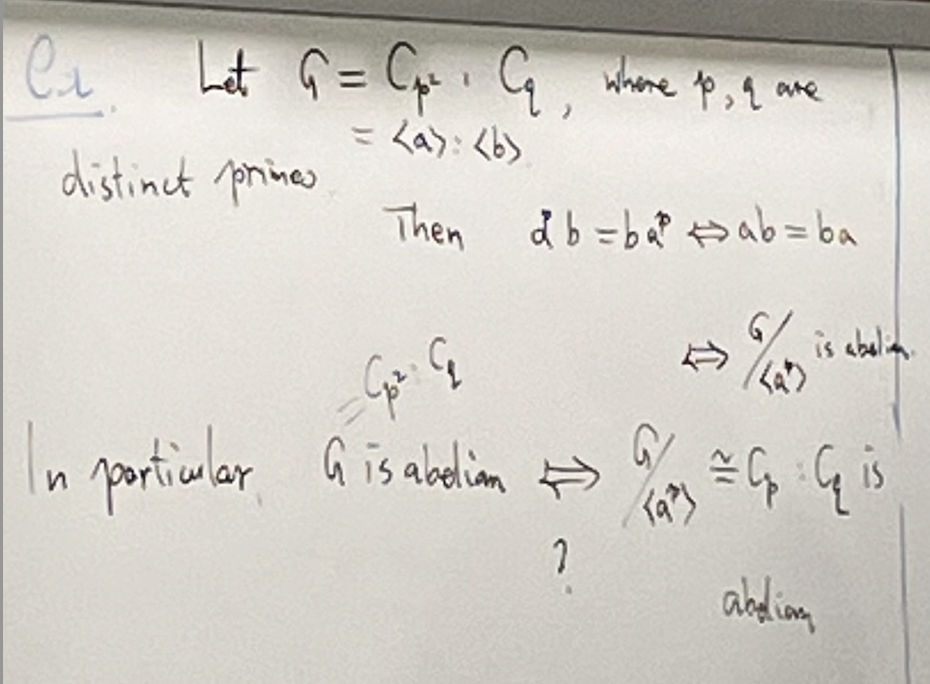
Exercise. There is a easy exercise. Pasted image 20240529212723.png
Fitting Subgroup
It is mentioned here.
Definition
The product of all normal nilpotent subgroups of is called the Fitting subgroup of , denoted by .
Note that is a normal nilpotent subgroup. So .
Theorem
Let be a solvable group, and let . Then:
- .
- , i.e., is self-centralizing. Moreover, we have .
\begin{proof}
(i) Let be a nilpotent normal subgroup of . Then where are Sylow subgroups. Now and so . So and so .
(ii) Let . Then . Since , , and are characteristic subgroups of . Let and . Suppose , then there exists such that , and . Hence the full preimage . Let be a Sylow subgroup of . Then . By definition, centralizes . So . Then and . So that
\end{proof}
Example. Let be a group such that each Sylow subgroup is cyclic. Then is solvable. Further, is metacyclic, i.e., is cyclic and is cyclic.
\begin{proof}
Let . Then is cyclic, and is abelian. Since is abelian, and is abelian and cyclic.
\end{proof}