TLDR
Just like linear transformation classified by Jordan canonical form, we use “(generalized) eigenspace”, which is called (generalized) weight space, to analyze representations of Lie algebra. However, for a set of matrices, it is not easy to find a common eigenspace. Luckily, with additional conditions, named solvable and nilpotent, we have some good results.
Two important conclusions will be showed:
- every solvable Lie algebra has a weight space;
- for any representation of nilpotent Lie algebra, can be decomposed as direct sum of generalized weight spaces.
Solvable Lie algebra
Eigenspace contained in an ideal is -invariant
Naive try. Suppose , is a subalgebra. Suppose has a weight and is the according weight space. Hope that to be -invariant. That is, for any , and .
For any and , by above assumptions we have
so should be zero. If is an ideal, then should be zero.
Lemma
Suppose is a finite dimensional complex Lie algebra and is an ideal. Let be a weight of and be the corresponding weight space, where is a finite dimensional complex representation. Then is -invariant.
TL; DR: 找到一个下的不变子空间,考虑限制在子空间上的矩阵:它的迹为.
\begin{proof}To show is -invariant, by the above argument it remains to show . For any , and , we can verify
is -invariant.
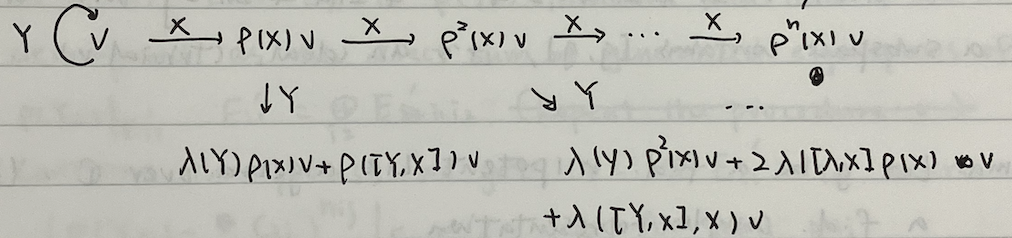
Note that for any , acts on this space by the matrix
Since is an ideal, . Then the trace of is . Also is trace zero. Thus .
\end{proof}
Main result
Proposition
For a finite dimensional complex solvable Lie algebra and its finite dimensional complex representation , this representation has a weight.
\begin{proof}By induction, we only need to prove that if has a weight, then has a weight. Suppose has a weight and the corresponding weight space . For any , by lemma is -invariant. Choose eigenvalue and let be the corresponding eigenspace. Now is a weight space of . Then repeat the procedure, by is finite we know has a weight.
\end{proof}
Nilpotent Lie algebra
Proposition
Let be a finite dimensional nilpotent Lie algebra over and be a finite dimensional complex representation. Then:
- for , the generalized eigenspaces of are -invariant;
- is the direct sum of generalized weight spaces.
\begin{proof}i) Let be an eigenvalue of and the according generalized weight space. It suffices to show for any and any , , that is,
for some . Note that
and is also nilpotent. So for a big enough , .
ii) Choose a basis of where . Write where each is a generalized eigenspace of . Each is -invariant and hence can be decomposed as the direct sum of generalized eigenspaces of , written as . Continue the process we get where
Define
Claim that is the generalized weight space associated to . is nilpotent yields is solvable and then there is a basis such that is an upper triangular matrix for all . Then
So , whence is a weight. And on for some . Therefore is the generalized -weight space.
\end{proof}