Solvable Lie Algebra
Existence of Weight Space
We show that every finite dimensional complex representation of a solvable Lie algebra has a weight space:
Link to originalProposition
For a finite dimensional complex solvable Lie algebra and its finite dimensional complex representation , this representation has a weight.
Then we have the following corollary:
Corollary
Every irreducible representation of finite dimensional solvable Lie algebra is -dimensional.
Question
Conversely, for a Lie algebra , if every finite dimensional complex representation of has a weight, would it must be solvable?
Answer
The answer is yes. Consider the adjoint representation. Since is an representation, using the same argument in Lie’s theorem, there exists a set of basis such that are upper triangular matrices. Then are nilpotent. By Engel’s theorem, is nilpotent and so is solvable by ^2be7fe.
Lie's theorem
Let be a finite dimensional solvable Lie algebra over and a finite dimensional representation. Then one can choose a basis of and w.r.t. the identification .
\begin{proof}
Since is solvable, there is a weight and is diagonalizable. Let . Then consider , still has a weight . Let be the preimage of and . Then repeat the procedure, that is consider and its weight until we get a set of basis of . It is easy to verify under this basis .
\end{proof}
Finest Ideal Sequence
Proposition
A finite dimensional Lie algebra is solvable iff it admits a sequence of ideals
with .
\begin{proof}
i) If is solvable, then . Note that any subspace contains is an ideal, so there is a sequence of ideals
where . Similarly, use to construct subsequence of between and . Repeat this process and get the sequence we want.
ii) Conversely, suppose admits a sequence . Take a set of basis such that . Then under this basis is an upper triangular matrix for any , and so are nilpotent. By Engel’s theorem, is nilpotent and so is solvable by ^2be7fe.
\end{proof}
Unique Maximal Nilpotent Ideal of Solvable Lie Algebra
Corollary
Let be a finite dimensional complex Lie algebra. Then
- is solvable is nilpotent;
- when is solvable, has a unique maximal nilpotent ideal
\begin{proof}
i) nilpotent solvable is trivial. Now assume is solvable. Then can be represented by upper triangular matrices. So elements of can be represented by strictly upper triangular matrices. By Engel’s theorem, is nilpotent.
ii) Since is solvable, we have the following diagram.
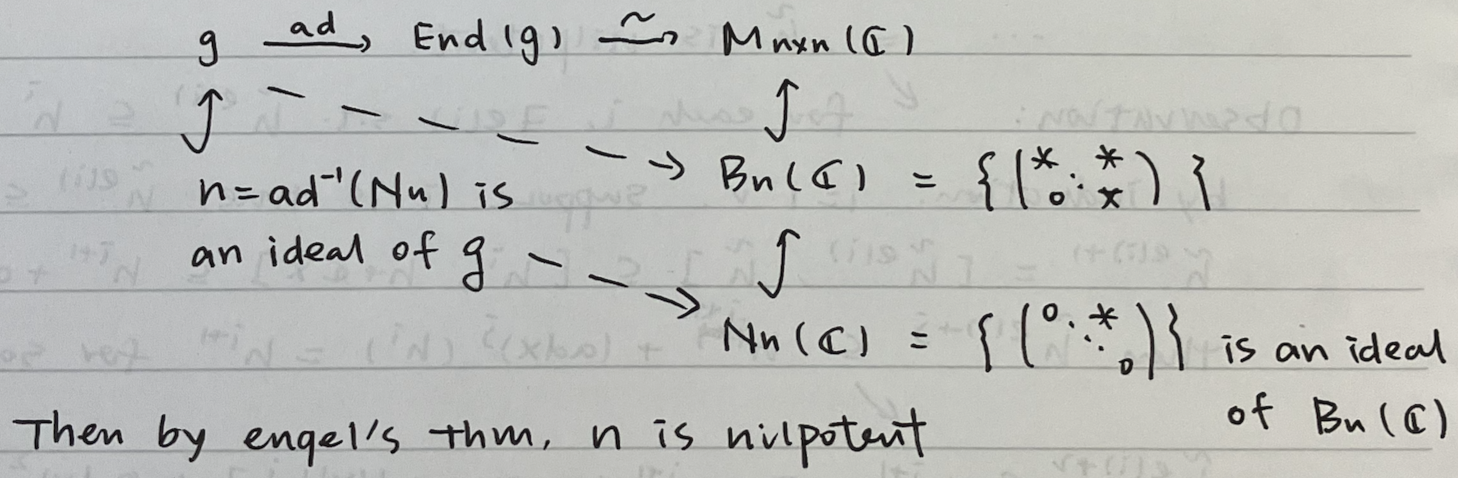
Thus is a nilpotent ideal. Let be a nilpotent ideal. Since is nilpotent, for each , is nilpotent. Then yields and is the unique maximal nilpotent ideal. \end{proof}
Open Question
Could we “classify” all complex representation of a finite dimensional solvable Lie algebra?
Nilpotent Lie algebra
Decomposed as Direct Sum of Generalized Weight Space
Every representation of a nilpotent Lie algebra can be decomposed as a direct sum of generalized weight space. See here.
Question
If its each finite dimensional complex representation can be decomposed as a direct product sum of generalized weight spaces, would it must be nilpotent?
Answer
The answer is yes, see here.
Engel’s Theorem
Let be a finite dimensional complex Lie algebra. Then is nilpotent is nilpotent for each .
Link to original
This theorem is proved here, and we get the following corollary.
Corollary
Let be a finite dimensional complex Lie algebra. Then is nilpotent iff it has a basis w.r.t. which the adjoint representation sends into the space spanned by strictly upper triangular matrices.
\begin{proof}
i) Suppose any is upper triangular matrix. By Cayley-Hamilton is nilpotent. Then is nilpotent by Engel’s theorem.
ii) Suppose is nilpotent. Then is solvable and there is a basis s.t. is upper triangular for all . By Engel’s theorem, is nilpotent. By Cayley-Hamilton is strictly upper triangular matrix.
\end{proof}