Week 2
Q1. For , show
Proof. By induction. And is used.
Week 3
Q1. Suppose is a finite dimensional linear space and . The generalized eigenspaces of are -invariant iff for some .
Proof. i) Suppose is a generalized eigenspace of and for some . Then it suffices to show for any there is a such that . By Week1-Q1, we have
as . For any , suppose . Then if .
ii) Conversely, suppose is a generalized eigenspace of and it is -invariant. By induction, we can prove
Also note that , so . For any , there is a s.t. for all . By , we have . If runs over all generalized eigenspaces of and take
Then for all and so .
Q2. Let be a finite dimensional complex Lie algebra and .
- If the generalized eigenspaces of are -invariant, then for some .
- for some iff for any finite dimensional complex representation of , the generalized eigenspaces of is -invariant.
Proof. i) Since , is in the -generalized eigenspace of . Then is still in the -generalized eigenspace of and so
ii) Assume that for some . Since is a homomorphism, . Use the same argument as Week3 Q1 i) to finish the proof. Now suppose that for any finite dimensional complex representation of , the generalized eigenspaces of is -invariant. Take as the adjoint representation then we get back to i).
Q3. Suppose is an ideal, then is also an ideal.
Proof. By induction. For any ,
\end{proof}
Q4. For a complex finite dimensional Lie algebra, if its each finite dimensional complex representation can be decomposed as a direct product sum of generalized weight spaces, it is nilpotent.
Proof. By Q2, we only need to show each generalized weight space of adjoint representation is -invariant. If it is true, then for any , generalized eigenspaces of are -invariant. Then for some . By the arbitrary of , is nilpotent. Now it remains to show generalized weight spaces are -invariant.
Since the adjoint representation can be decomposed as a direct product sum of generalized weight space, each generalized weight space is a -submodule and so is -invariant. Now we finish the proof.
Week 4
Q1. For a Lie algebra and , if is the Jordan-Chevalley decomposition of , then the Jordan-Chevalley decomposition of is
\begin{proof}For any , . So . Since is a homomorphism, . It remains to verify is diagonal and is nilpotent.
Note that and . Suppose , then is a set of basis of . For any , . So is diagonal. Similarly, . Reorder the basis like and then is nilpotent. By the uniqueness of Jordan-Chevalley decomposition we complete the proof.
\end{proof}
Q2. For a complex diagonal matrix , there is a polynomial with constant term such that .
Proof. Take a Lagrange polynomial, which maps to .
Week 7
Q1. Show that has a Cartan subalgebra
Proof. Since is abelian, it is nilpotent. And it is easy to verify .
Week 8
Q1. Let be a root system according to Definition 1’, then there exists an inner product which is unique up to scalars so that is a root system according to Definition 1.
Proof. Firstly, Prof. Qiu gives us a lemma. I write it down here.
Lemma. Suppose finite dimensional and spans . Then for any . a symmetry with vector is unique if it exists. In the other word, a hyperplane fixed by a symmetry is unique.
Proof. Suppose are two symmetries with vector , then and induce identity maps on . Note that and is identity on . (Now the corresponding matrix of is upper triangular, we hope it is diagonal. That’s why we consider the order of as a permutation. )
Since is a permutation of , there is an integer s.t. . Thus is a polynomial killing and hence the characteristic polynomial of has no multiple roots. Also all eigenvalues of are . So and hence .
By lemma, is unique. So we can denote the hyperplane fixed by to . Since is a linear isomorphism, with a set of basis where spans , can be written as
So where is a linear functional such that and . For any inner product of , there is a such that . Then and .
Now suppose and are two inner products which make a root system according to Definition 1, then . For all , we may assume
Then for any , there is
and so for some . Therefore, for this , which is what we want.
Q2. Let be a root system according to Definition 1’ for each , write the symmetry with vector as , where . Then is a root system according to Definition 1’.
Proof. In 4.3 Root system, we have proved that is a root system with “dual inner product”, i.e. it is a root system according to Definition 1. Since Definition 1 and Definition 1’ are equivalent, is also a root system according to Definition 1’ and it is done. However, I want to prove it with inner product omitted.
Note that is defined in the symmetry with . Now we define , where . Since spans , is well-defined. Also define . By Q1, for any inner product , for some real number . So there is
Therefore, is a root system.
Week 12
Q1. Let be a Lie group. If is a subgroup and a regular sub-manifold, then is an embedding Lie group.
\begin{proof}Firstly, it is easy to verify is a Lie subgroup. Then it is enough to show is an embedding. Since is a regular sub-manifold, is automatically an embedding and we finish the proof.
\end{proof}
Q2. Show that and is given by , where denotes the Lie algebra of a Lie group .
\begin{proof}Since is an open set of , the tangent space at is . Thus . Another proof from gz: for a small enough , is invertible for any . Therefore .
For any , define
Since , maps to . Note
By ^3c468f, and so .
\end{proof}
Week 15
Q1. Figure out the Lie algebra of .
\begin{proof}Note that
where . Suppose . Then for any and any , there is
Then
Conversely, for any with ,
Therefore, .
\end{proof}
Q2. Figure out the Lie algebra of .
\begin{proof}Note that
where . Suppose . For any , we have
Then
Conversely, if , then
Therefore, .
\end{proof}
Q3. Figure out the Lie algebra of .
\begin{proof}Suppose . Then for any , . Note that
Define
then the derivative of satisfies . Since also allows , we have . Thus yields and .
Conversely, if satisfies , then is a constant map and . Therefore,
\end{proof}
Q4. Figure out the Lie algebra of .
\begin{proof}Note that
where . Suppose . For any , we have
Then
Conversely, if and , then
Therefore, .
\end{proof}
Week 16
Q1. A connected Lie group is generated by an arbitrary neighborhood of the identity element.
\begin{proof}see here. In fact, this conclusion is true for topological group.\end{proof}
midterm
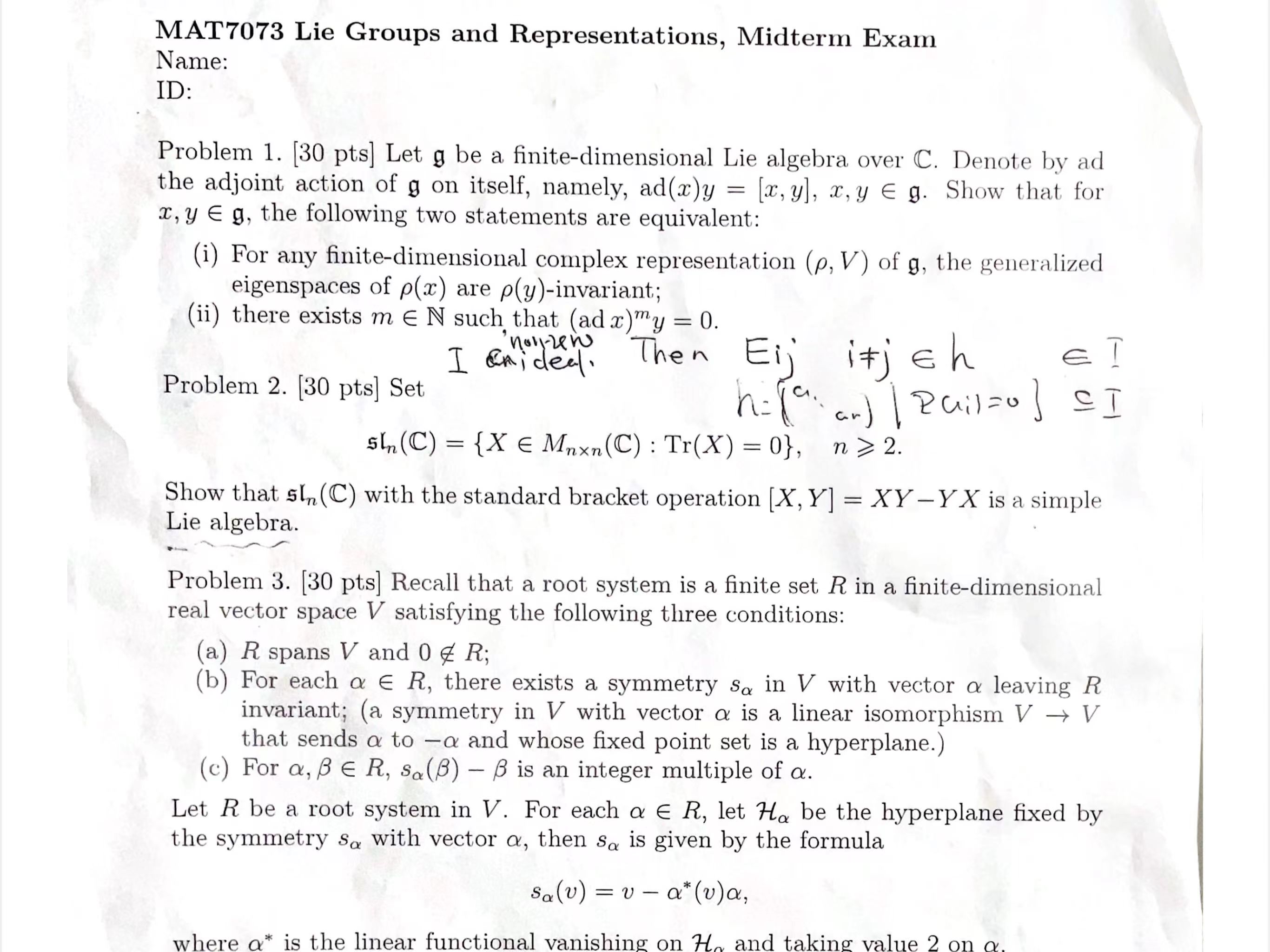
Q1. an exercise in week 3.
Q2. see LieAlgebrasOfFiniteAndAffineType_carter, 4.4.
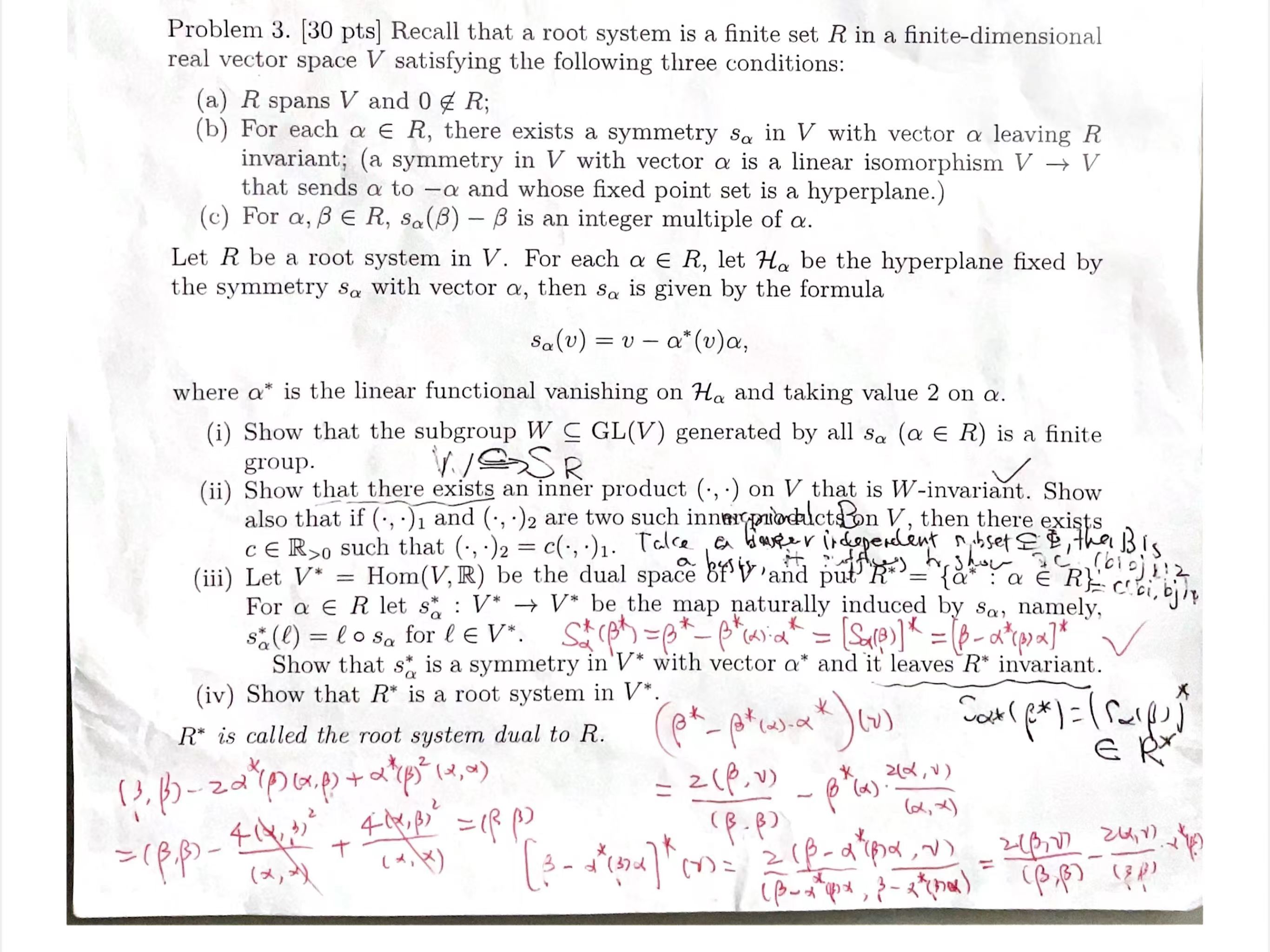
Q3. Recall that a root system is a finite set in a finite-dimensional real vector space satisfying the following three conditions.
- spans and ;
- For each , there exists a symmetry in with vector leaving invariant; (a symmetry in with vector is a linear isomorphism that sends to and whose fixed point set is a hyperplane.)
- For , is an integer multiple of .
Let be a root system in . For each , let be the hyperplane fixed by the symmetry which vector , then is given by the formula
where is the linear functional vanishing on and taking value on .
- Show that the subgroup generated by all is a finite group.
- Show that there exists an inner product on that is -invariant. Show also that if and are two such inner products on , then there exists such that .
- Let be the dual space of and put . For let be the map naturally induced by , namely, for . Show that is a symmetry in with vector and it leaves invariant.
- Show that is a root system in .
\begin{proof}i) Define . Since for any , each is a permutation of . Since spans , . And yields is a finite group.
ii) Define an inner product by . It is easy to verify it is an inner product and it is -invariant. Then show that it is unique up to scalar.
Firstly, show that a symmetry with vector is unique. Suppose are symmetries with vector . Then . And acting on is trivial. Hence has a representation
Since , there is such that . By Cayley-Hamilton’s theorem, . Note that has no multiple roots, . Therefore the symmetry is unique.
Since the symmetry with vector is unique, is unique. Suppose and are two inner products on . Then there exist such that . Since , . Thus . For each , there is such that . Since , . Note that , for all . Then spans yields , where .
iii) Since and for any , is a symmetry. Since , leaves invariant. The key point is, .
iv) It remains to show , which can be yielded by .
\end{proof}
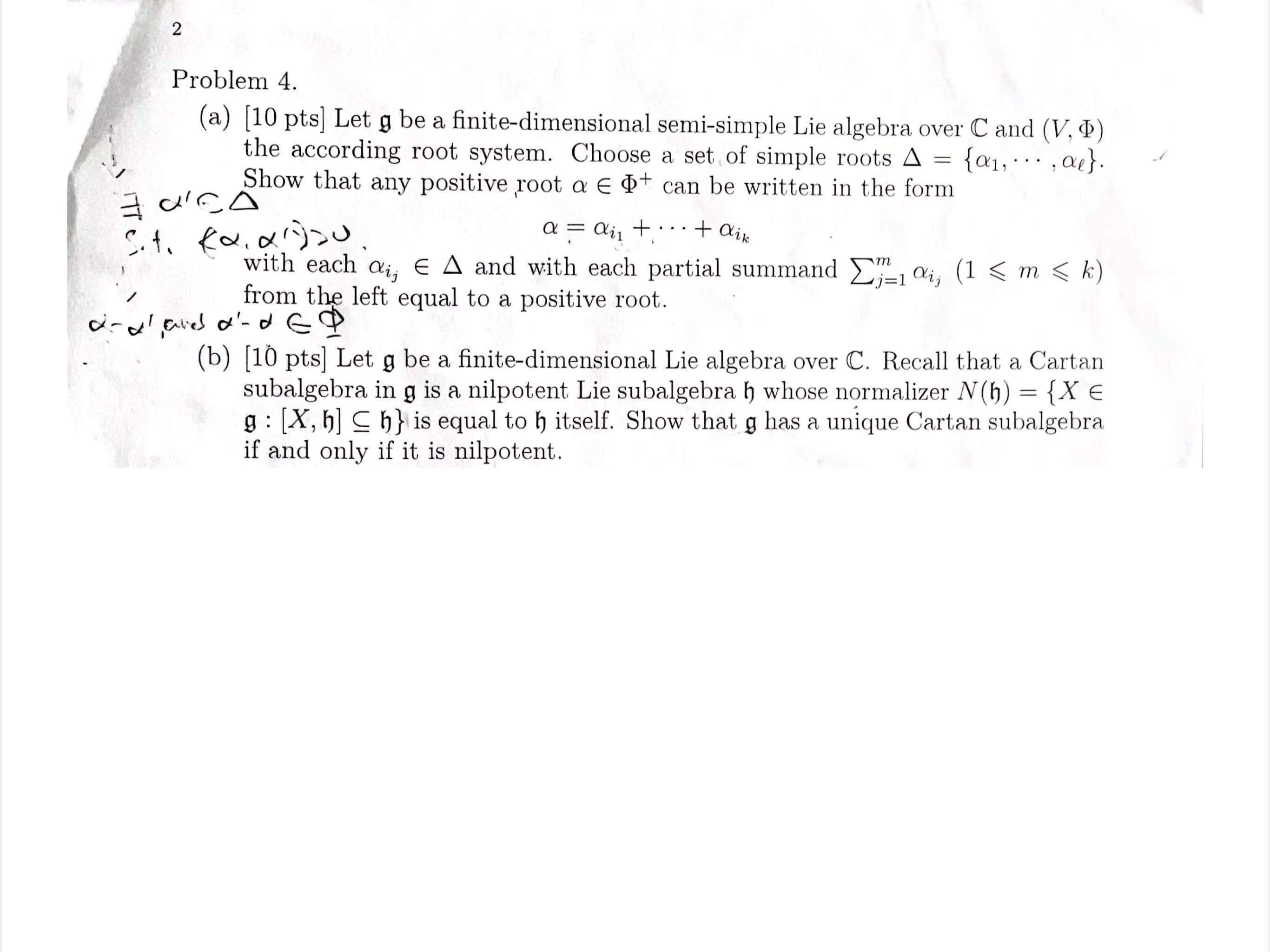
Q4. Let be a finite dimensional semi-simple Lie algebra over and the according root system. Choose a set of simple roots . Show that any positive root can be written in the form
with each and with each partial summand from the left equal to a positive root.
\begin{proof}The following lemma is used: For any , there is a such that . Then and by induction we finish the proof.
Proof of lemma: otherwise, for all . Then is linear independent, contradiction.
\end{proof}