TLDR
For complex finite dimensional semi-simple Lie algebra, the set of weights forms a “root system”. We define “dual pairing” w.r.t dual space. As and , both and are root systems. Angle and ratio of length between roots are in finite cases, which makes possible to classify complex semi-simple Lie algebras.
Motivation
Observation 0. Using conclusions of last section, we find that should in the following conditions: inner products are rational, invariance under reflections.
-
Suppose is a finite dimensional Euclidean space, and . Define
and is the reflection w.r.t. , that is, .
-
Recall for any we have the following chain:
Then and are symmetric w.r.t. the center of the chain.
-
We can choose a maximal linearly independent subset of , and then
by . So
And , .
-
At this moment, for ,
that is, is invariant under .
root system
A root system is a finite dimensional Euclidean space together a finite subset s.t.
- ;
- spans ;
- for each , ;
- for , .
If a root system satisfies a further condition:
- for , , then it is called a reduced root system.
Example. is a reduced root system.
Dual pairing
dual pairing
Let be a finite dimensional complex semi-simple Lie algebra and be a Cartan subalgebra of . Let be a Cartan decomposition. Then the Killing form induces an identification
and a pairing on which is defined as
Note is an inner product on .
An example:
Define and . We can prove that is a simple Lie algebra with , see here or textbook. So is semi-simple.
Now let . Since is a Cartan subalgebra of , then
View of
Suppose . Then , where and . Thus the collection of roots is and .
Since for with and , there is
Since
the identification is . And then the induced pairing on is
View of
Since and , one can consider a pairing on induced from . We can choose suitable inner product of and a map from to s.t. the induced pairing on is compatible with the restriction of the induced pairing on .
Define an inner product of as , and define a map . Then it is easy to verify they are compatible.
Thus we may view the associated root system is contained in the -dim Euclidean space , which sits inside the natural Euclidean space, i.e., .
Remark. This example tells us for any orthonormal basis , can be seen as a root system. So we can get some root systems for different , which is called with .
Propositions
Proposition
Let be a reduced root system. Then is also a reduced root system, where is the dual space of equipped with the associated inner product via the identification
and for .
\begin{proof}
Recall for , there is
So .
Define , then . With the induced pairing, there is
Thus . Since is a reflection, . Thus and so . Further, and . For any , if there is an integer s.t. , then as . It contradicts with reduced root system.
\end{proof}
Remark. In midterm, we have a similar exercise. See ^d044ea.
Proposition
Let be a reduced root system and . There are two integers
Then , . Thus the angle between satisfies
local picture
Let be a reduced root system and , . Then:
- if the angle is or , then ;
- if the angle is or , then the ratio of the length is ;
- if the angle is or , then the ratio of the length is .
Proposition
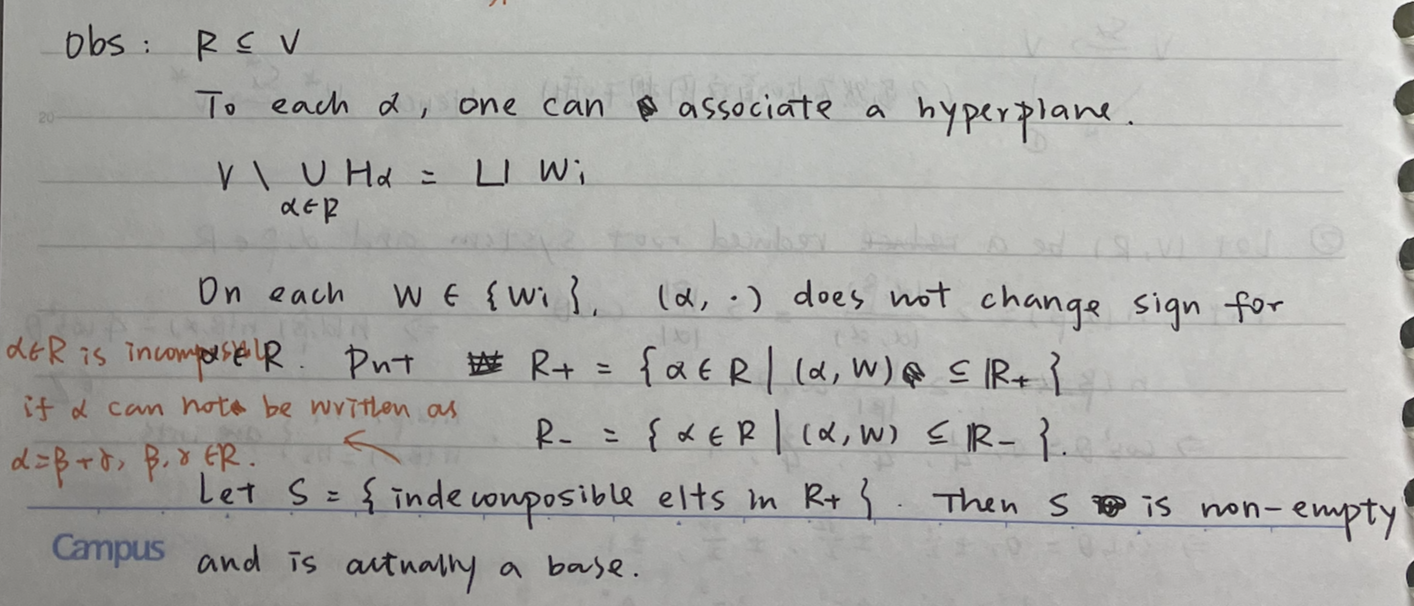
Let be a reduced root system. Then there exists a subset consisting of elements, s.t. every element of is a linear combination of elements of with coefficients either all in or all in . Such a subset is called a base or fundamental system or simple root system of and
is called the Weyl group acts transitively on the set of fundamental systems.
\begin{proof}
The main idea is
\end{proof}