About Lie subgroups
Theorem
Let be a (smooth) Lie group and a Lie subgroup of . Then
Heuristics. If is an embedded Lie subgroup, then is a regular sub-manifold. In this situation, if
then for sufficiently small, where is a neighborhood of . So and . On the other hand, if is not an embedding Lie subgroup, then may not a regular sub-manifold. Recall the example, that is the place where the argument fails.
Example. It is possible that there exists such that for some . Let
be a Lie group where , . Then
are a Lie subgroups and Lie . Since , there do exist such that . Also, note that the “bad points” are countable, which gives us an idea to finish the proof.
\begin{proof}First, one direction is easy. If , then by diagram. Second, it remains to show that if then does not hold for all . Actually, one can show for a fixed , is countable.
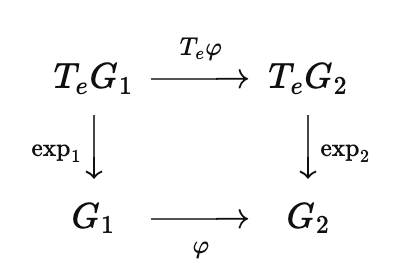
To figure out , we need to do it “locally”. In other words, choosing an open neighborhood of and , ask about
It is possible that the above set is . With such an answer, we can quickly pass to the global using translation.
Local assertion.
Consider
Because and , is injective. As a conclusion, is locally an embedding and specifically injective by inverse function theorem. So there exists small and small neighborhood of in such that is injective, that is, iff iff for some . Whence
Choose a smaller open neighborhood such that .
With the local assertion at hand, we proceed to the global question as follows. Since is a neighborhood of in and is second countable, one can write where is an countable set. If , then
Thus if then . Therefore is countable for any .
\end{proof}
Embedding Lie subgroup
Embedded Lie subgroup is closed
Lemma
Let be a smooth Lie group and be an embedded Lie subgroup. Then is closed in .
\begin{proof}It remains to show , where is the closure of in . First, there exists an open neighborhood of in such that is closed in by the definition of embedding Lie subgroup. In the other word, is locally closed in .
Claim: . One direction is easy. For , there exists such that . When is big enough, . Since is closed in , .
Second, we argue for . Choose a smaller such that and . If , there exists with . So there exists such that for any . For any , there is . Also yields . Fix and let , . Since is closed in , we have . Thus .
\end{proof}
A closed subgroup is an embedded Lie subgroup
Cartan's closed subgroup theorem
Let be a smooth Lie group. If is a closed subgroup, then has an embedded submanifold structure such that is an embedded Lie subgroup.
Heuristics. The key is to give a suitable local chart of whose restriction to give local charts of . For this purpose, one needs to work out how to do it as .
Candidate of local charts
Lemma
Suppose is a smooth Lie group and is a closed subgroup of . Then is a vector space.
\begin{proof}Obviously, is closed under scalar multiplication. We now argue that yields . Actually,
by Dynkin’s formula and is a group homomorphism for a fixed . Let , then
Now we finish the proof. \end{proof}
The key proposition
Proposition
Suppose is a closed subgroup of a Lie group . There exists a small open neighborhood of such that and is a diffeomorphism.
To finish the proof, we will first establish the statement for an approximation of exponential.
Approximation of exponential
Observation. Choose a complementary subspace of in . Define
Then and hence is a local diffeomorphism.
Claim: There exists a sufficiently small open neighborhood of such that and is a diffeomorphism. To prove the claim, we need the following lemma.
Lemma. is a closed subgroup of a Lie group . Suppose satisfying
- ;
- ;
- exists in . Then .
Proof. Note that
So we finish the proof.
Proof of the claim. "" is easy. We prove "" by contradiction. First, choose a small open neighborhood of in such that is a diffeomorphism. If the assertion is false, then for any small open neighborhood , there is .
Let run over a local neighborhood basis of in , then there exists . Suppose with and . Thus there exists a subsequence such that , and exists. By Lemma, we know . Also . Thus , which is impossible as . Contradiction.
Proof of the proposition
The choice of in the lemma can be arbitrary small. Choose a small open neighborhood of in such that is a diffeomorphism. Choose so that . Put , then meets the requirement by .
Proof of Cartan’s theorem
It follows from the key proposition.
Example of
Define
Since is a Lie group and is an closed subgroup, is an embedded Lie subgroup. The question is, what is the Lie algebra of ?
Solution. The Lie algebra of is . The exponential map is given by because is a group homomorphism from to whose derivation at is . Thus the Lie algebra of consists of such that , that is, . Since , there is
On the other hand, if , then
and so . Therefore, iff and
Exercise. What about and ? See here.
A remark
Lie subgroups: about injective Lie group homomorphisms
Closed Lie subgroups: related to surjective Lie group homomorphism