TLDR
Motivation. How to handle a Lie group homomorphism using the associate Lie algebra homomorphism?
Some consequences of Cartan’s closed subgroup theorem
Proposition
Suppose , are smooth Lie groups and is a Lie group homomorphism. Then is a closed Lie subgroup with $$ \mathrm{Lie}\space(\ker\varphi)=\ker d\varphi.
^b18c72 `\begin{proof}`Note $\ker\varphi$ is closed because $\varphi$ is continuous. Due to Cartan's closed subgroup theorem, $\ker \varphi$ is an embedded Lie subgroup. For $X\in\mathrm{Lie}\space(\ker\varphi)$, there is $e^{tX}\in\ker\varphi$ and $1_H=\varphi(e^{tX})$. By the [[Pasted image 20240103150136.png|commute diagram]], there is $\varphi(e^{tX})=e^{td\varphi(X)}$ yields $d\varphi(X)=0$. Thus $X\in\ker d\varphi$. Conversely, if $X\in\ker d\varphi$, then $\varphi(e^{tX})=e^{td\varphi(X)}=1_H$. Hence $e^{tX}\in\ker\varphi$. `\end{proof}` [!proposition] continuous group homomorphism is smooth Suppose $G,H$ are smooth Lie groups. If $\varphi:G\to H$ is a group homomorphism and continuous, then $\varphi$ is smooth. `\begin{proof}`Consider the following diagram. Define a graph $\Gamma_\varphi=\{(g,\varphi(g)):g\in G\}$. ![[Pasted image 20240105114733.png]] Note that by Cartan's closed subgroup theorem, $\Gamma_\varphi$ is a closed Lie subgroup of $G$. Whence $\tilde p_1=p_1|_{\Gamma_\varphi}$ is a bijective smooth Lie group homomorphism. Also we have the following proposition. [!proposition] If $\varphi:H_1\to H_2$ is bijective smooth Lie group homomorphism, then $\varphi^{-1}$ is also smooth. `\begin{proof}`Since $\ker\varphi=1$, $d\varphi$ is injective by [[#^b18c72|^b18c72]]. Also we need to show $d\varphi$ is surjective. If it is true, then $\varphi$ is local diffeomorphism near $1_G$ and a local diffeomorphism at every $g\in G$, thus $\varphi^{-1}$ is smooth. We will use Haar measure or Sard's theorem to prove it. By Haar measure: If $d\varphi|_{e}$ is not surjective, then a small open neighborhood $U$ of $1_G$ has an image of measure $0$ in $H$. On the other hand, choose a compact neighborhood $V$ of $1_G$ contained in $U$, then $G$ is covered by countably many translates of $V$. It follows that $\varphi(G)$ has measure $0$ in $H$. It contradicts $\varphi(G)=H$. By [Sard's theorem](https://en.wikipedia.org/wiki/Sard%27s_theorem): If $d\varphi|_{e}$ is not surjective, then $d\varphi|_g$ is not surjective at every $g\in G$. So the critical point set at $\varphi$ is $G$, which contradicts with Sard's theorem. `\end{proof}` ^7e0dad [!remark] about the above proposition I think there is no need to take a compact neighborhood contained in the open neighborhood in the argument using Haar measure, as Lie group is second countable, and Lebesgue measure, Haar measure can be identified, and [this property](https://zhuanlan.zhihu.com/p/367328708). With the proposition above, we know $\tilde p_1^{-1}$ is smooth. Then $p_2\circ \tilde p_1^{-1}=\varphi$ is smooth. `\end{proof}` # Questions - Suppose $g$ a finite dimensional Lie algebra over $\mathbb{R}$. Does there exists a connected Lie subgroup $G$ such that $\mathrm{Lie}\space G=g$? - $G$ a connected Lie group with Lie algebra $g$. If $h$ is a Lie subalgebra of $g$, does there exist a Lie subgroup $H$ of $G$ such that $\mathrm{Lie}\space H=h$? - What's the relation between Lie groups with the same Lie algebras? - Let $G,H$ be connected Lie groups with Lie algebras $g,h$, if $\rho:g\to h$ is a Lie algebra homomorphism, does there exists a Lie group homomorphism $\varphi:G\to H$ such that $d\varphi=\rho$? ## Answer of question 3 [!lemma] existence of universal covering Lie group Let $G$ be a connected Lie group with Lie algebra $g$. Let $\tilde G$ be the universal covering of $G$, then $\tilde G$ has a Lie group structure and the projection map $\tilde G\to G$ is a smooth Lie group homomorphism. ^103f0c `\begin{proof}`By [[15 Covering homomorphisms#^dcaeb6|the theorem]] of existence of the universal covering space, $G$ has a universal covering $\tilde G$. And by the [[13 Covering map#general-lifting-problem|lifting criterion]], define multiplication and inverse operations on $\tilde G$. By the uniqueness of lifting, these operations do make $\tilde G$ a group. And the preimage of projection map gives charts of $\tilde G$. Thus $\tilde G$ is a Lie group. Also $\pi:\tilde G\to G$ is smooth because on every chart the map equals identity. The notes on the class is attached [[Pasted image 20240105133905.png|here]]. `\end{proof}` [!proposition] Let $G,H$ be connected Lie groups and $\varphi:G\to H$ is a Lie group homomorphism with $d\varphi:g\to h$ bijective. Then: - $\varphi$ is a covering map. - If $H$ is further simply connected, then $\varphi$ is an isomorphism. `\begin{proof}`Note that $\varphi$ is a local homeomorphism near $e_G$, and a connected Lie group is generated by an arbitrary neighborhood of the identity element by [[0.0 Exercise#week-16|exercise]]. Thus $\varphi$ is surjective and so $\varphi$ is a covering map. Furthermore, when $H$ is simply connected, $\varphi^{-1}$ must be a homeomorphism and hence smooth by [[#^7e0dad|^7e0dad]]. `\end{proof}` ## Answer of question 2 [!theorem] The subgroups-subalgebras theorem Let $G$ be a connected Lie group and $g$ be the Lie algebra of $G$. If $h$ is a Lie subalgebra of $g$, then there exists a unique connected Lie subgroup $H$ of $G$ such that $\mathrm{Lie}\space H=h$. ^3b51d3 `\begin{proof}`It is just a sketch of proof. There exists a maximal connected integral manifold $H$ of $G$ such that for any $h\in H$, $T_hH=dL_hh$. Then equip $H$ with a group structure. `\end{proof}` [!remark] I cannot complete the sketch of proof and I think it is not important :) maybe later I will finish it. [!definition] maximal integral manifold A submanifold $(M,\psi)$ of $N$ is an integral submanifold of a distribution $\mathcal D$ on $N$ ifd\psi(M_m)=\mathcal D(\psi(m))
for each $m\in M$. A maximal integral manifold $(M,\psi)$ of a distribution $\mathcal D$ on a manifold $N$ is a connected integral manifold of $\mathcal D$ whose image in $N$ is not a proper subset of any other connected integral manifold of $\mathcal D$. ## Answer of question 4 [!proposition] The homomorphisms theorem Let $G,H$ be connected Lie group. Let $\rho:g\to h$ be a Lie algebra homomorphism. If $G$ is simply connected, then there exists unique Lie group homomorphism $\varphi:G\to H$ such that $d\varphi=\rho$. ^d9ae7e `\begin{proof}`Firstly, the uniqueness is clear, because $\varphi$'s behaviour near $e_G$ is determined by $\rho$ and $G$ is generated by an open neighborhood of $e_G$ by [[0.0 Exercise#week-16|exercise]]. Now we consider the existence. Consider the Lie algebra
k={(X,\rho(X)):X\in g}\subseteq g\oplus h.
Let $K$ be the unique connected subgroup of $G\times H$ whose Lie algebra is $k$. Put $\tilde p_1=p_1\circ i$. Then $d\tilde p_1=dp_1\circ di$ is a map sending $(X,\rho(X))$ to $X$. So it is a bijection map. Hence $\tilde p_1$ is a covering map. Because $G$ is simply connected, $\tilde p_1$ is a Lie group homomorphism by [[#^103f0c|^103f0c]]. Put $\varphi=p_2\circ \tilde p_1^{-1}$, then $\varphi$ meets the purpose. ![[Pasted image 20240105155424.png]] `\end{proof}` [!corollary] If $G,H$ are simply connected Lie groups with isomorphic Lie algebras, then $G$ and $H$ are isomorphism. ## Answer of question 1 [!theorem] Lie's third theorem Every finite-dimensional real Lie algebra is the Lie algebra of some simply connected Lie group. ^a98121 `\begin{proof}`See [here](https://en.wikipedia.org/wiki/Lie_group–Lie_algebra_correspondence#Proof_of_Lie's_third_theorem). The key point is to use Ado's theorem and there are some [references](https://math.stackexchange.com/questions/3757784/shortest-proof-of-ados-theorem-for-real-lie-algebras). I am too lazy to read it. `\end{proof}` ## Connection to the representation theory **Rmk.** Combining the theory of finite dimensional representations of semi-simple Lie algebra and Lie algebra-Lie group correspondence, we have: - the theory of finite dimensional representations of simply connected complex semi-simple groups, such as $\mathrm{SL}_n(\mathbb{C})$. - the theory of finite dimensional representations of connected complex semi-simple groups. **Rmk.** If $G$ is a connected Lie group and $\varphi:G\to\mathrm{GL}_n(\mathbb{C})$ is a smooth Lie group homomorphism, then $d\varphi:g\to gl_n(\mathbb{C})$ is a Lie algebra homomorphism with $g\cong \mathbb{R}^m$, which induces a Lie algebra homomorphism(d\varphi)\mathbb{C}:g\otimes\mathbb{R}\mathbb{C}\to gl_n(\mathbb{C}).
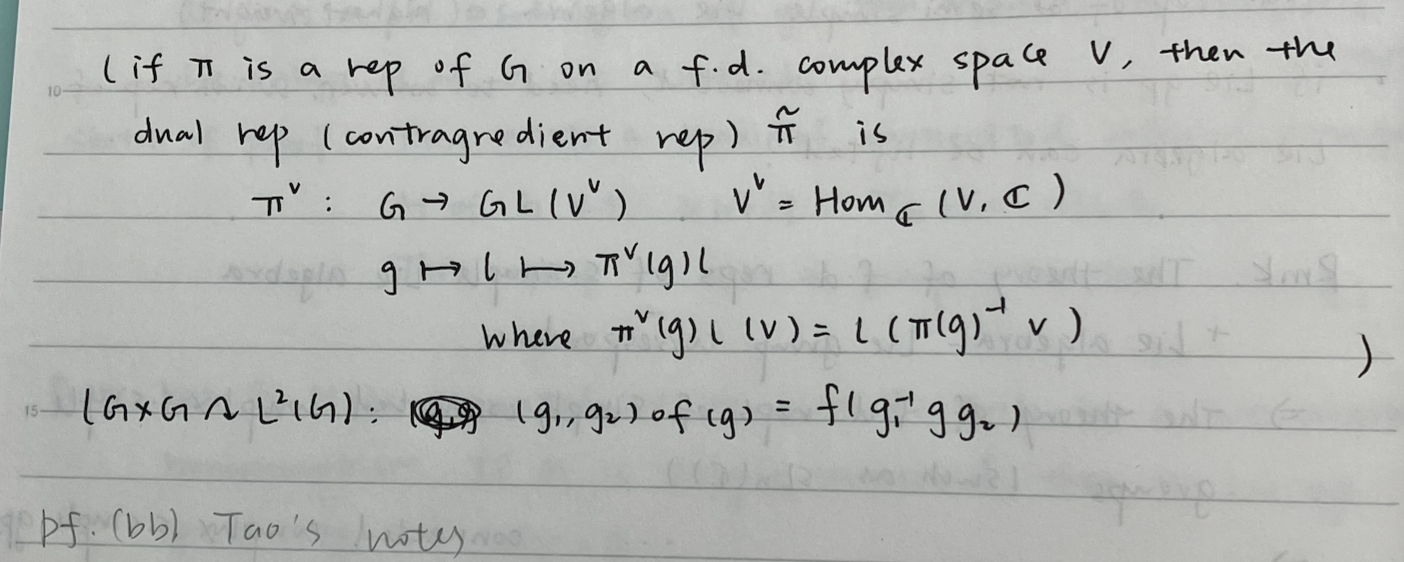
**Rmk.** If $g$ is a complex semi-simple Lie algebra, then there exists a real Lie subalgebra $g_\mathbb{R}$ such that $g=g_\mathbb{R}\otimes \mathbb{C}$, and $g_\mathbb{R}=\mathrm{Lie}\space K$ for some compact Lie group $K$. # Compact representation [!definition] Let $G$ be a topological group. A unitary representation of $G$ on a Hilbert space $V$ is a continuous group homomorphism $\rho:G\to U(V)$. And such a representation is called irreducible if $V$ has no closed invariant subspace. [!theorem] Let $G$ be a compact, Hausdorff, second-countable topological group. Then: - Every irreducible continuous Hilbert space representation is finite dimensional. - As a representation of $G\times G$,L^2(G)=\oplus_{\pi\in\hat G}\pi\times\pi^{\vee}
where .