Parity and Presentation of Symmetric Groups
parity
Each permutation in can be presented as a diagram permutation said to be odd (rep. even) if the number of crossing in this diagram is odd (rep. even). Define as if is even and if is odd.
Equivalently, the parity of permutation is the number of inversions in : such that .
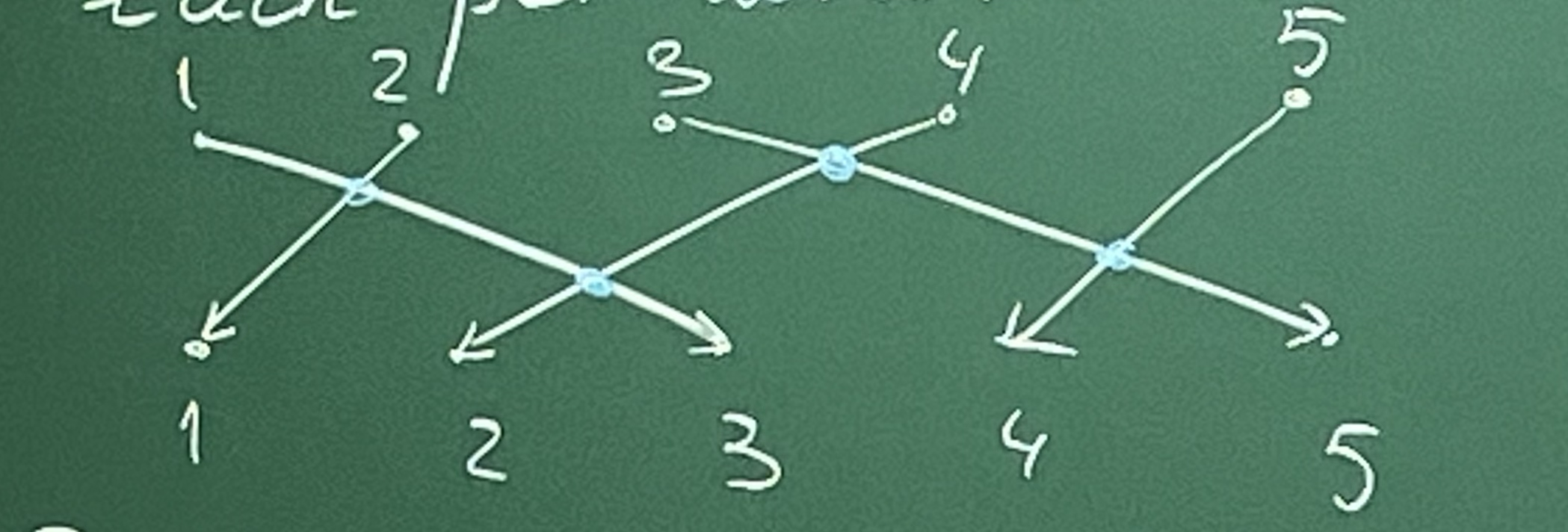
The adjacent transposition for all , then is generated by .
Proposition
The symmetric group has the following presentation
\begin{proof}
Define the LHS equals . We have a surjective homomorphism . It suffices to show . Note that the case of holds. Suppose that , and consider the subgroup generated by where by induction hypothesis. Note that
and this composition is stable by the action of . Therefore, and so .
\end{proof}
Definition
Any element of can be written as product of ‘s, and for , then minimum value of is called the length of .
Cycle Types and Partitions
Definition
Any permutation can be written as product of disjoint cycles. The cycle type is the set of length of cycles. For example, the cycle type of in is .
As two permutations with the same cycle type belong to the same conjugacy class, the conjugacy classes of can be described as with and .
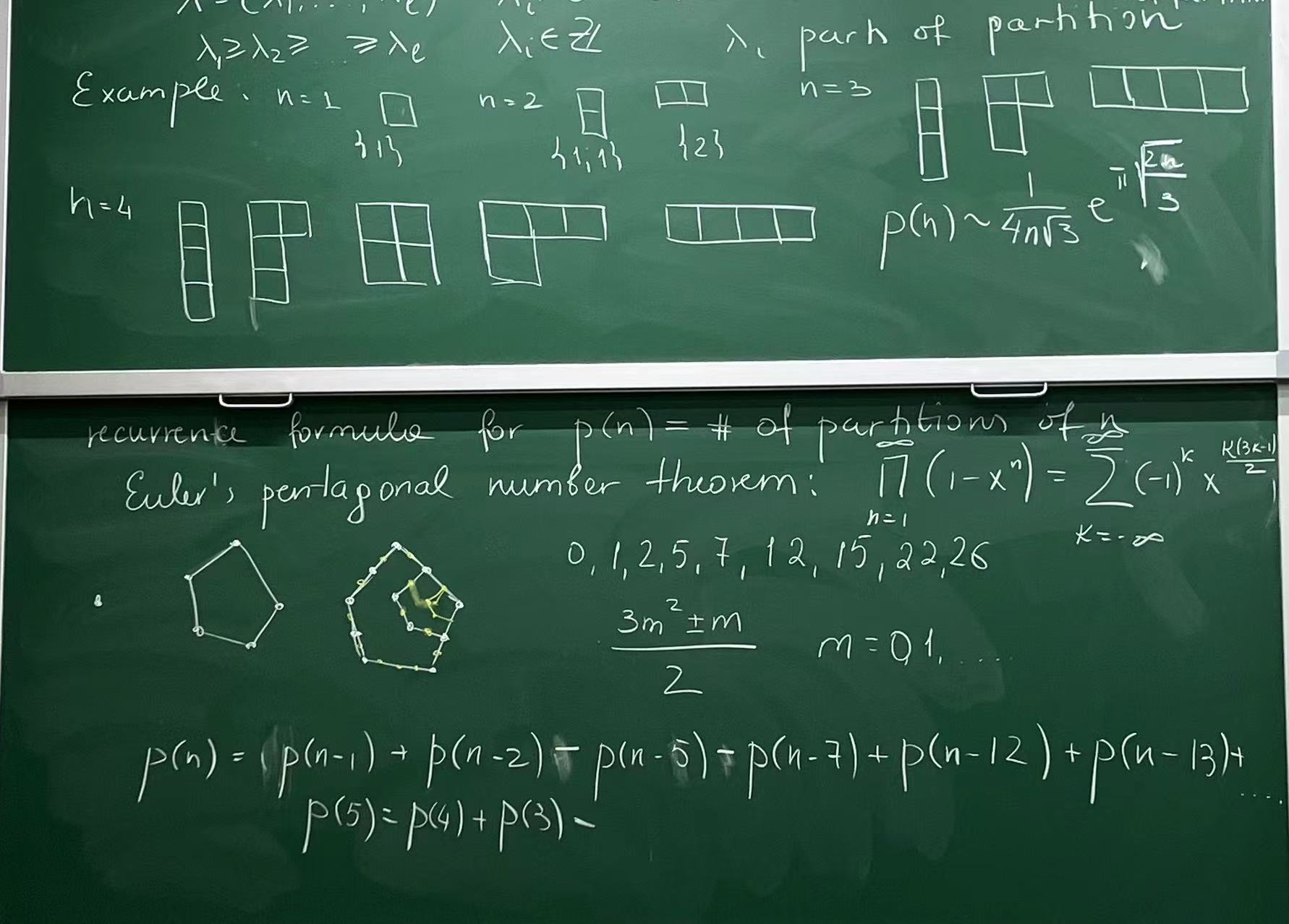
There are some properties of partition functions. Write partition in the multiplicity from with , then we have the following property.
Proposition
The cardinality of conjugacy class of corresponding to partition is
\begin{proof}
Note that
- are same cycles and there are repetitions.
- and are same cycles and there are repetitions.
Now we finish the proof.
\end{proof}
For any given , define as the number of partitions of . Then we can get its generating function.
Euler formula
The generating function for partition is
where is the number of partitions of .