Egorov's Theorem
Suppose is a measure space with . Suppose is a sequence of measurable functions from to that converges pointwise on to a measurable function . Then for every , there exists a set such that and uniformly on .
\begin{proof}
For any , we have that
Define , then as . For any , there exists such that . Let . Note that
For any , take such that . If , for any , we have for all . Therefore, uniformly on .
\end{proof}
Remark. is necessary. Let , , and let be counting measure. Define , then where . Let . For any with , we aim to show does not converge uniformly on . Since if , then . Claim that does not converge uniformly on , that is, there exists , for any , there exists and such that . Take , then for any there is . Hence, is not uniformly convergent.
simple function
Let be a set. A function is called a simple function if it takes on only finitely many values, i.e., the image is a finite subset of .
approximation by simple functions
Suppose is a measurable space and is measurable. Then there exists a sequence of functions from to such that
- each is a simple measurable function;
- for all and all ;
- for every ;
- converges uniformly to on any set on which is bounded.
\begin{proof}
Define as the diagram below.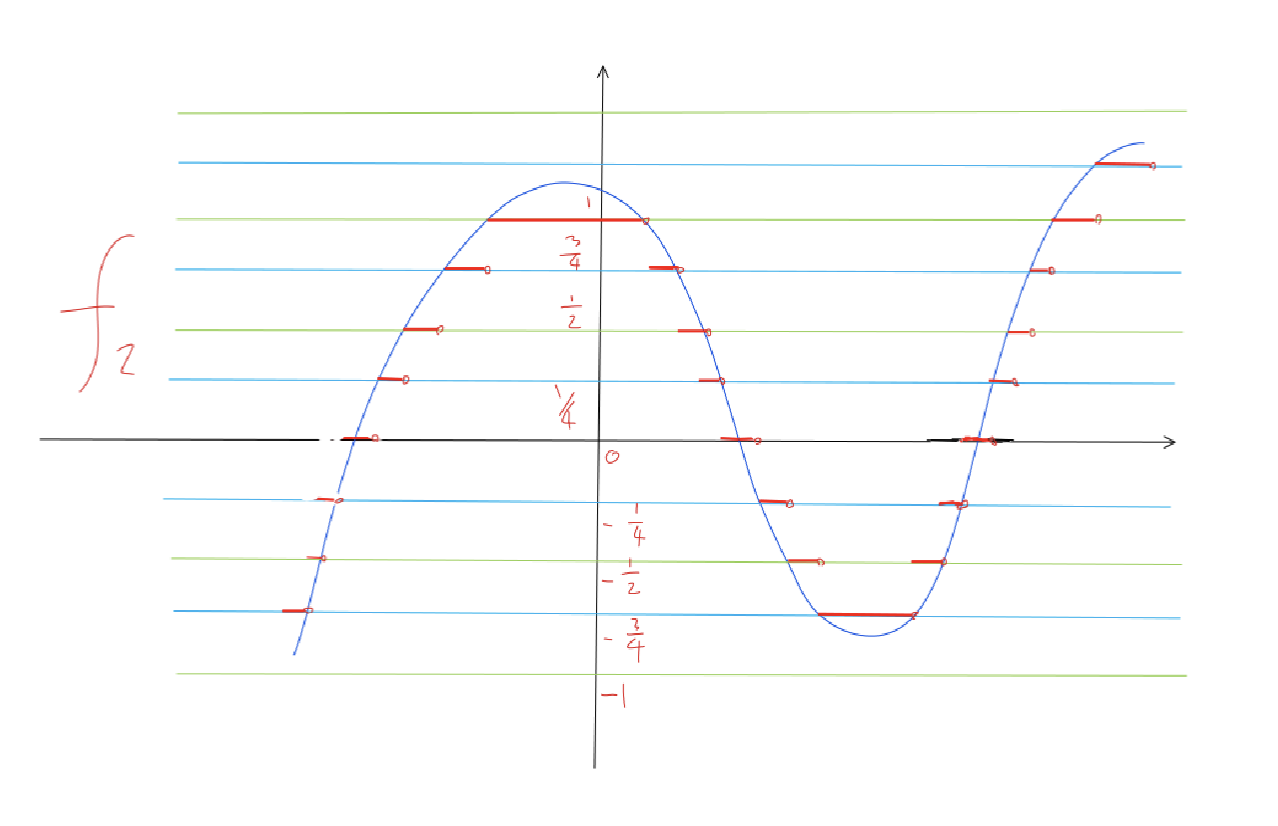
Then it is easy to prove the theorem.
\end{proof}
Definition
Let be a measure space and let be a sequence of real-valued measurable functions defined on . Let be a real-valued measurable function defined on . We say that converges in measure to , with notation , if for every , we have
We say that is Cauchy in measure if for every and for every , there exists such that for all , we have
Theorem
Let be a measure space and . Let be a sequence of real-valued measurable functions, defined on , converging a.e. to a real-valued measurable function . Then .
\begin{proof}
Let . Then . For any , let . Note that and so . Define , then , which yields that .
\end{proof}
Remark. Let , and let . Note that almost everywhere, and . Therefore, . Furthermore, this is also an example.
Proposition
Let be a measure space, and let and be real-valued measurable functions on . If , then there is a subsequence of that converges a.e. to .
\begin{proof}
Since , there exists such that . Repeat this procedure,
Now we get a subsequence . Define , then . It is easy to prove that . If , then there exists such that and so for all . Hence on .
\end{proof}