Basic Matrices
Recall that
Define Laplacian matrix .
Link to original
Definition
Let be the signless Laplacian matrix.
Let be the normalized Laplacian.
Remark. For a graph with adjacency matrix , its characteristic polynomial is . Since , , and are real symmetric matrices, each has real eigenvalues and admits an orthonormal basis of eigenvectors. The eigenvalues of and are called the adjacency spectrum and the Laplacian spectrum, respectively.
Examples of Spectral
Complete (Bipartite) Graphs
Example
The adjacency matrix of is , whose spectrum is , .
Then , whose spectrum is , .
Example
The adjacency matrix of is , whose spectrum is , , .
Then , whose spectrum is , , , .
\begin{proof}
Let be an eigenvector of .
Then .
Let and , then and .
If , then and , which deduces that , and .
If , then and there are eigenvectors of eigenvalue .
The eigenvalues of are easy to check.
Remark that and are two eigenvectors, whose eigenvalues are and , respectively.
Also and are eigenvectors with .
Now we finish the proof.
\end{proof}
Cycles and Paths
Example
Let be the directed cycle on vertices. Then
Note that has eigenvectors with .
Example
Let be the undirected cycle on vertices, then . Note that and have the same eigenvectors, and eigenvalues of are .
Example
Let be a path with vertices. Then has the eigenvalues , where .
\begin{proof}
First, we look at the eigenvectors of .
Define , then and both have eigenvalues .
It deduces that
is an eigenvector with eigenvalue . Assume that and , then . It follows that
and so is an eigenvalue of .
\end{proof}
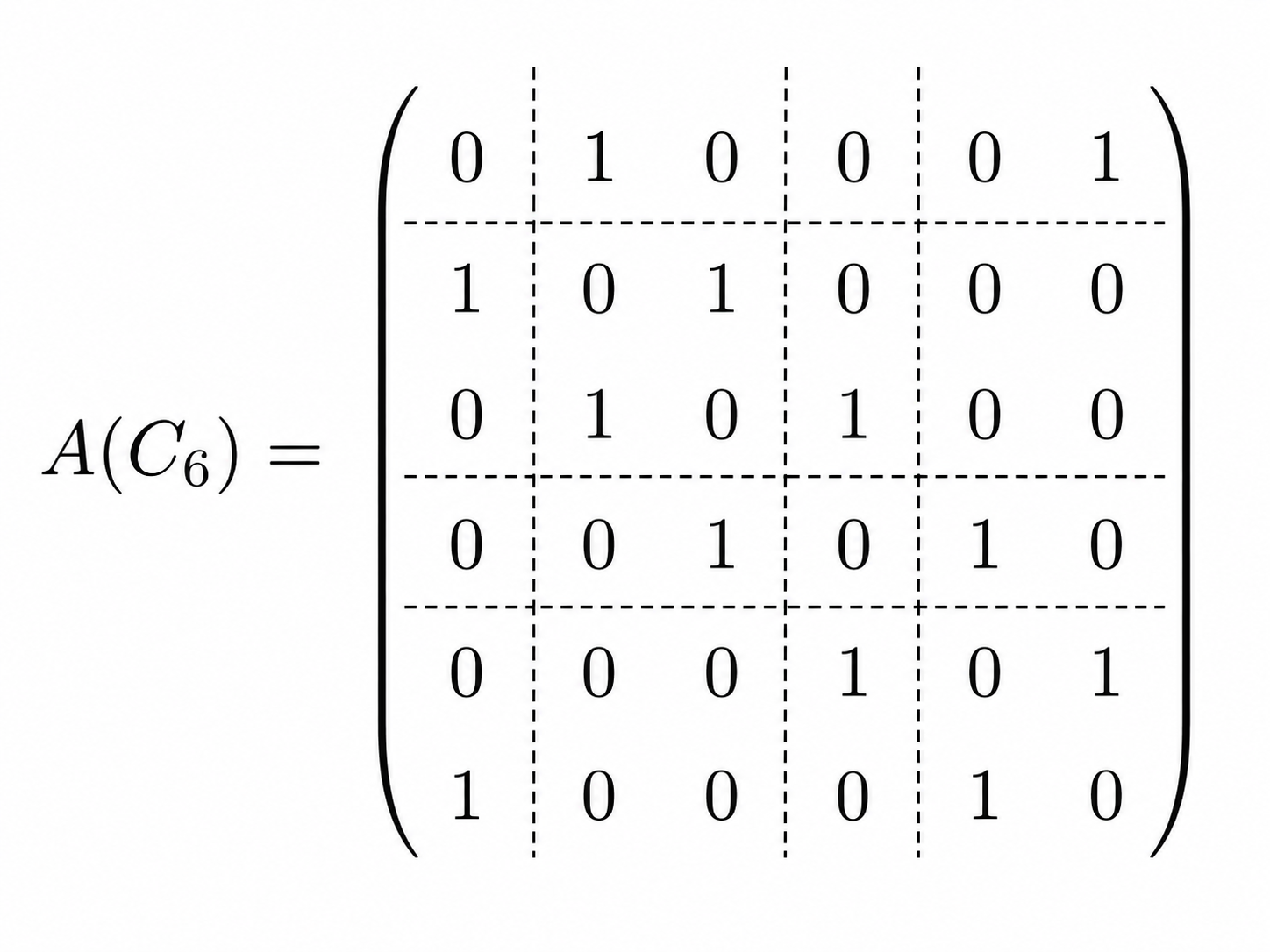
Remark. As an example, the following matrix is the adjacent matrix of .
Bipartite Graphs
Proposition
Let be an adjacency matrix of a bipartite graph. Then . If is an eigenvalue with eigenvector , then is an eigenvalue with eigenvector .
\begin{proof}
Easy.
\end{proof}
Graph Products and Cayley Graphs
There are more examples…
- graphs with vertex sets and . Then has vertex set and when or . ^rg4dj1
- Define is a point, , , .
- Notice that
- It deduces that
- spectrum of
- spectrum of
- spectrum of
- Kronecker product and bipartite doubles graphs with vertex sets .
- Kronecker product has vertex set , when , .
- , so it is easy to obtain eigenvalues.
- Definition of bipartite double: , spectrum:
- Some people write for or for .
- Strong product
- has vertex set , distinct iff or , and or
- , spectrum:
- Cayley graph
- abelian group, .
- A Cayley graph on with difference set is the (directed) graph with and . This graph is undirected iff
- Note that is regular with degree .
- Let be a character of .
- Then , so is a eigenvector of with eigenvalue .
- A group of order has orthogonal characters, so we have found all the eigenvalues.
- For example, when and , has spectrum , where is a primitive th root of unity.
Interlacing & Projections onto Eigenspaces
Let with . Then has a basis of orthonormal eigenvectors , with eigenvalues , respectively. If we work with more than one matrix , . Denote the eigenspace of by . If has distinct eigenvalues , , then write .
(This is not standard in general spectra graph but it will make everything more uniform for SRG, DRGs, association schemes. )
Define as the orthogonal projection (a matrix, not a map) onto , that is, .
property of Rayleigh quotient
The Rayleigh quotient of w.r.t. is .
If , then and
Thus,
- if , and
- if .
In both cases equality implies that .
Definition
Let and , both symmetric, . If for all ,
then we say that the eigenvalues of interlace the eigenvalues of .
If there exists an integer , such that
- for , and
- for ,
then the interlacing is tight.
Cauchy interlacing
Let such that . Let with . Put . Then
- the eigenvalues of interlace the eigenvalues of ;
- if , then there exists an eigenvector of for such that is an eigenvector of with eigenvalue ;
- if for some , for all , then is an eigenvector of for for all .
- if the interlacing is tight, then .
\begin{proof}
i) Take , .
Then , and so
Also .
ii) In case of equality, and must be eigenvectors of and , respectively.
iii) and iv) are similar.
\end{proof}
Corollary
If is a principal submatrix of , then the eigenvalues of interlace the eigenvalues of .
\begin{proof}
Take .
\end{proof}
Quotient Matrix
Definition
If we partition with as
then the matrix with average row sum of , i.e. , is called a quotient matrix of .
We call the partition equitable if for all , where .
Remark. In other words, perfect coloring = equitable partition. Let index , blablabla, is regular set.
Corollary
Let be a quotient matrix of . Then
- the eigenvalues of interlace the eigenvalues of ;
- if the interlacing is tight, then the partition is equitable.
Remark. If graph is -regular, then . If is connected, then .
Spectral Bound
Let be a -regular graph on vertices, , connected.
Ratio Bound/Delsarte-Hoffman bound
Write . Let be a coclique. Then
If equality holds, then the characteristic vector of satisfies , where
In particular, is an equitable bipartition of the form .
\begin{proof}
没看懂
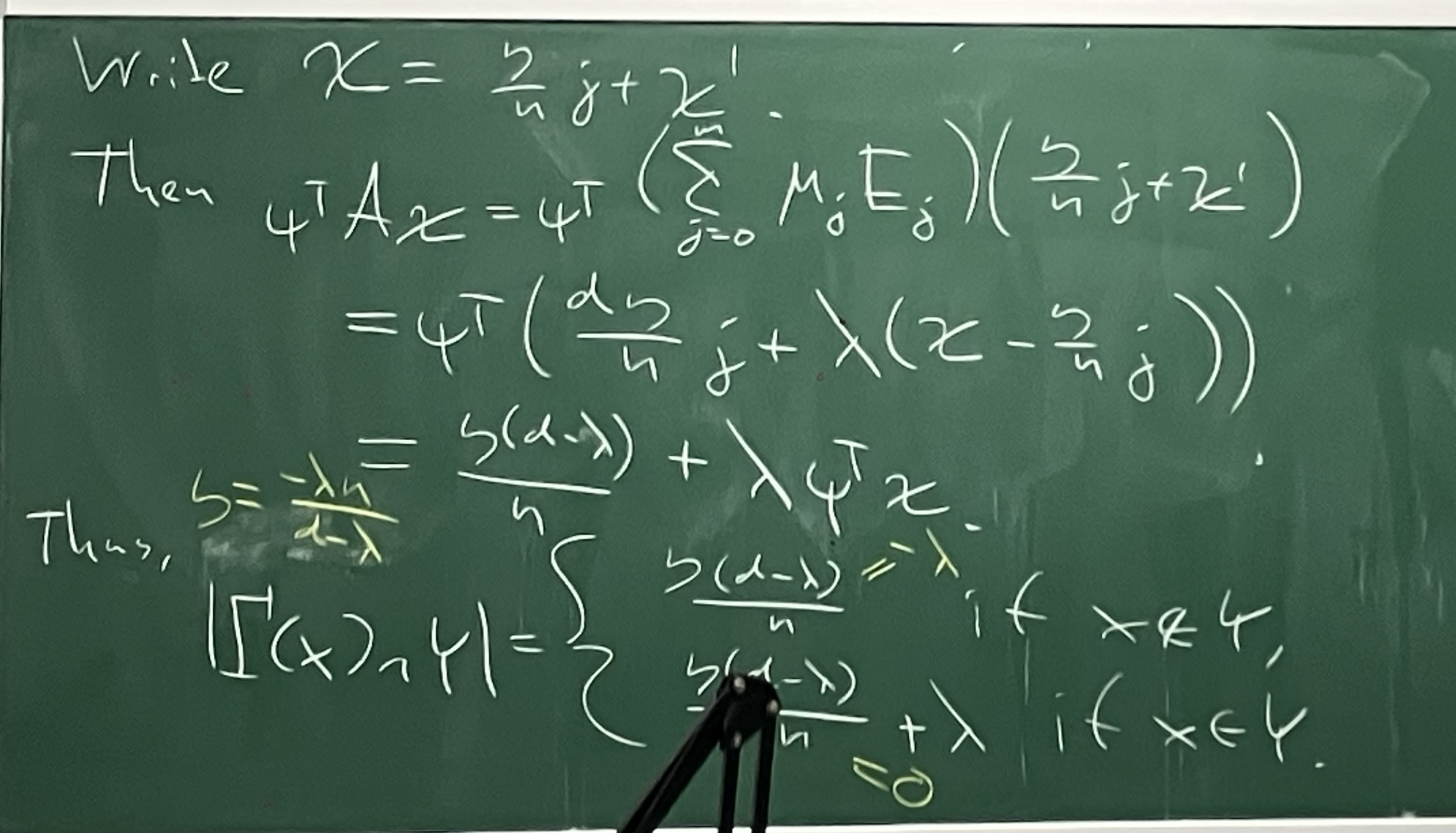
Write and .
Note that with multiplicity and eigenvector , so .
Put .
Also .
Then
A is a --vector, .
Thus .
Rearranging yields . Equality holds if .
Now let be the characteristic vector of for vertex.
\end{proof}
Remark. We can replace by any matrix that satisfies these conditions.
- if or
- and
Here is another proof.
\begin{proof}
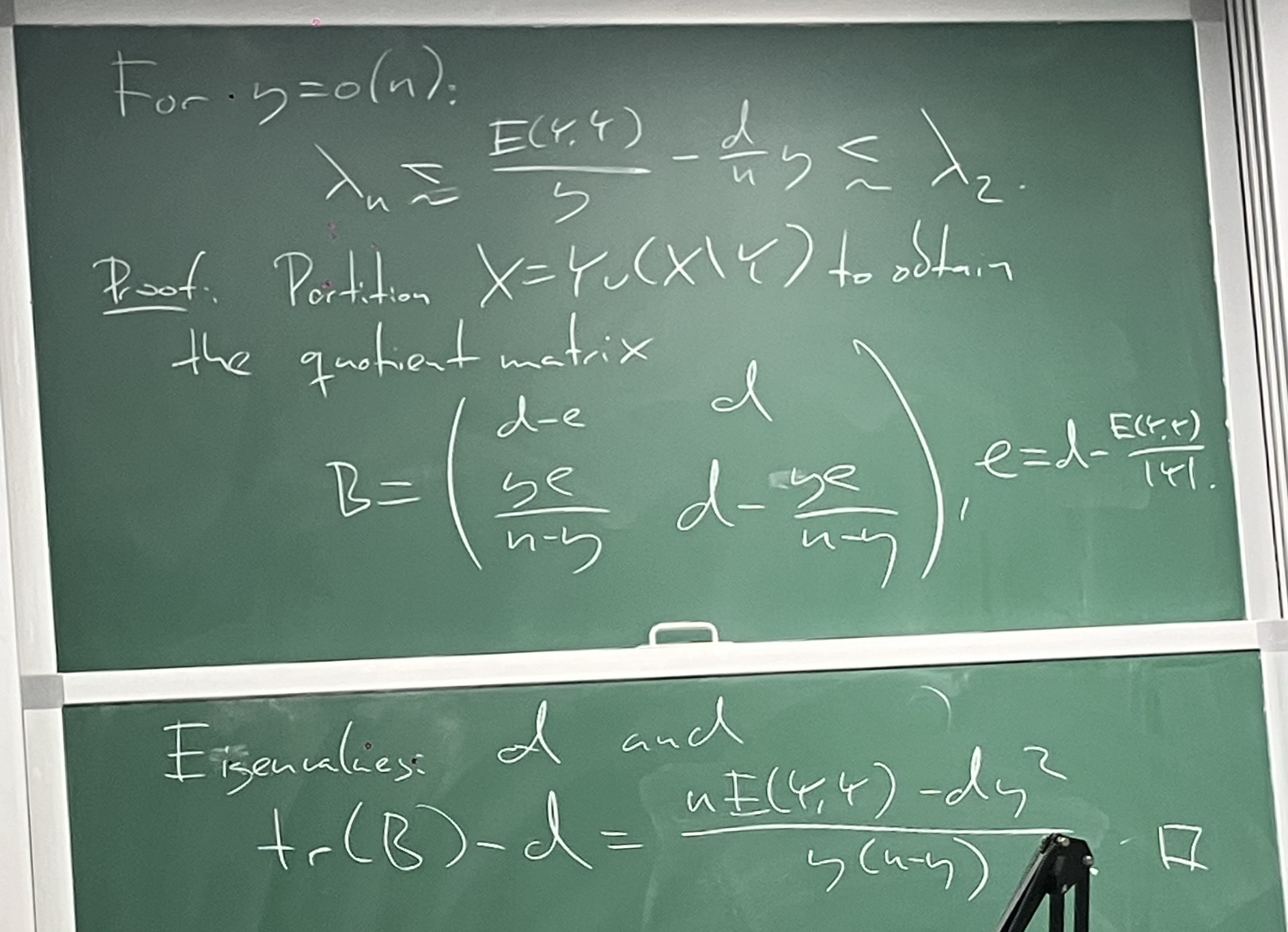
Write .
Then w.r.t. this partition, we obtain the quotient matrix
Eigenvalues of are and .
By interlacing, we have and so .
\end{proof}
Lemma
Let be the independence number of , and let be the chromatic number of . Then , where is the order of .
\begin{proof}
Each color class in a coloring is an independent set.
\end{proof}
Hoffman/Ratio bound
, which deduces that , where is the minimal eigenvalue.
Inertia bound/Cvetkovie bound
We have and .
\begin{proof}
The adjacent matrix has an all principal submatrix of order , that is, , where the matrix has lines.
All eigenvalues of are .
By ^ve7qqg, the eigenvalues of interlace the eigenvalues of , so the claim follows.
\end{proof}
Remark. For graphs with vertices, always tight for some such .
Question. (Godsil) is this bound always tight?
Rooney(?): Counterexample for or .
Theorem
Let be -regular, , , then
where is the actual number of edges in and is the expected number of edges in .
\begin{proof}
\end{proof}
Expander-Mixing
Let be a -regular graph, , . Then
Remark. If is bipartite, then , by ^vnqcpz. We get , which is useless.
So we have the following lemma.
Bipartite Expander-Mixing
Let be a -biregular bipartite graph on vertices with parts and . Let and . Then
\begin{proof}
Using the partition , obtain the quotient matrix
Trace of and determinant of are easy to calculate.
Then the eigenvalues of are and for some .
\end{proof}